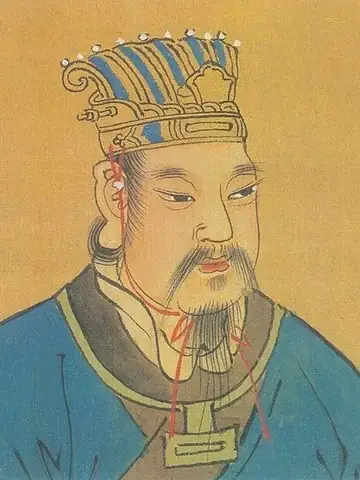
Facts
Emperor Yuan of Jin reigned for 4 years (318–323), taking the throne at 41 or 42, and died of natural causes at 46. 1st ruler of Eastern Jin.
- Reign
- 26 April 318 – 3 January 323 (1st ruler of Eastern Jin)
- Length of reign
- 4 years
- Born
- 276
- Died
- 3 January 323
- Age at accession
- 41–42
- Age at death
- 46
- Cause of death
- Natural causesNatural death or illness (including old age)
- Path to the throne
- Self-proclaimedFounded the titleClaimed the imperial title without receiving the throne from an earlier ruler (e.g. Emperor Gaozu of Han, Emperor Guangwu of Han, Hongwu Emperor)
- Posthumous name
- 晉元帝 Jìn Yuándì
- Temple name
- 晉中宗 Jìn Zhōngzōng
- Personal name
- 司馬睿 Sīmǎ Ruì
- Wade–Giles
- Chin Yüan-ti · Ssu-ma Jui
Life
In brief
The Book of Jin says that he was frugal, careful with punishments and opened a restoration, yet lacked martial capacity, and it also faults him for failing to hold his powerful ministers in check.
Road to the throne
A great-grandson of Sima Yi, he succeeded his father as Prince of Langya, and during the turmoil in the imperial house under Emperor Hui of Jin he kept a modest, retiring manner and escaped harm. When his uncle was killed by Ying, Prince of Chengdu, he fled; he was stopped at the Heyang ferry, but was let through after his attendant Song Dian treated him like a lowly official and laughed at him. On Wang Dao's plan he moved to Jianye, where Wang Dun, Wang Dao and others raised him up, and people said that the Wang and the Ma shared the realm. When he first took charge in Jiangdong he let drink keep him from his duties, but after Wang Dao admonished him he turned his cup upside down and gave up wine from then on. In 317, when his officials offered him the imperial title, he wept, called himself a guilty man and even made ready to go back to Langya, but he accepted becoming King of Jin. When a crown prince was to be named after he became King of Jin, he leaned toward his son Sima Pou, whom he judged more capable than Shao, but Wang Dao argued that the elder, Shao, should be named, and the choice of crown prince was settled. The next year, on receiving news of the death of Emperor Min of Jin, he took the throne, and he tried to have Wang Dao sit beside him on the imperial couch, but gave up when Wang Dao firmly declined.
Reign and death
He favoured simplicity: he turned down a proposal to hang crimson curtains in the Taiji Hall and had blue cloth curtains used in winter instead. When Huan, his son by Lady Zheng, died young, he wanted to bury him with the rites for an adult and had a tomb park built, and he did not act on a memorial of remonstrance. In 322, Wang Dun raised troops, claiming to be moving against Liu Wei. Liu Wei urged that the Wang clan be wiped out, but Emperor Yuan summoned Wang Dao, who was waiting to be punished, took his hand barefoot and asked why he spoke so when the emperor was about to entrust the fate of the state to him. The gates of Shitou were opened, and the government army was defeated. Emperor Yuan took the hands of Diao Xie and Liu Wei, sobbing, and urged them to flee, but Diao Xie was killed. He even sent word to Wang Dun that if Wang Dun did not withdraw his troops, he himself would go back to Langya and give up the throne, but Wang Dun made himself Chancellor and killed Dai Ruosi and Zhou Yi. Emperor Yuan died in the inner palace early the next year; the annals in the Book of Jin say that he left the world in grief and indignation but do not mention illness, and it is the Zizhi Tongjian that says grief and indignation made him ill.
Translated from the Japanese text of this site, which is written from the official histories. Years are the Western calendar years of the dates, as in English reference works. Months are omitted because the histories use the Chinese lunar calendar.