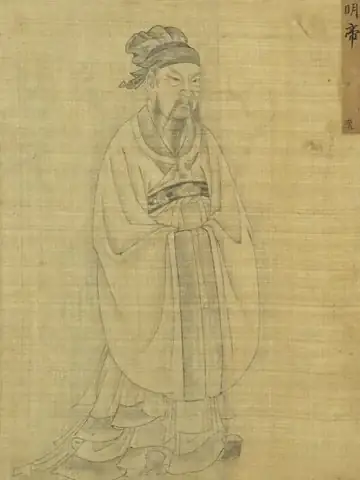
Facts
Emperor Ming of Han reigned for 18 years (57–75), taking the throne at 28 or 29, and died of natural causes at 46 or 47. 2nd ruler of Eastern Han.
- Reign
- 29 March 57 – 5 September 75 (2nd ruler of Eastern Han)
- Length of reign
- 18 years
- Born
- 28
- Died
- 5 September 75
- Age at accession
- 28–29
- Age at death
- 46–47
- Cause of death
- Natural causesNatural death or illness (including old age)
- Path to the throne
- Designated heirSucceeded the previous ruler of the same regime, who had chosen the heir (by testament, naming a crown prince, etc.)
- Posthumous name
- 漢明帝 Hàn Míngdì
- Temple name
- 漢顯宗 Hàn Xiǎnzōng
- Personal name
- 劉莊 Liú Zhuāng
- Wade–Giles
- Han Ming-ti · Liu Chuang
Life
In brief
He gave the imperial in-laws neither noble rank nor a part in government and kept his father's institutions, but the fine exactness with which he exposed hidden faults kept his close officials in fear. Fan Ye's discussion praises the clarity of the laws and asks whether Zhongli Yi and others took issue with Emperor Ming of Han's fine discernment because his magnanimity was insufficient.
Road to the throne
His mother was Lady Yin, who later became empress, and at the age of 10 (East Asian reckoning) he was well versed in the Spring and Autumn Annals, which astonished his father. In AD 39, when he was 12 years old (East Asian reckoning) and Duke of Donghai, Emperor Guangwu asked why a document of the survey of fields said not to question Henan and Nanyang, and the Duke of Donghai answered from behind a curtain that Henan, the emperor's city, had many close officials and Nanyang, the emperor's home district, had many close kin; it was as he said. The crown prince was Liu Qiang, the son of Empress Guo, but when his mother was deposed in AD 41 he repeatedly asked to withdraw to a princedom. In AD 43, Emperor Guangwu made Liu Qiang the Prince of Donghai and raised Liu Yang, until then the Prince of Donghai, to crown prince, renaming him Zhuang. When Emperor Guangwu died in AD 57, he took the throne the same day.
Reign and death
When Princess Guantao asked that her son be given the post of Gentleman, he refused, telling his ministers that a Gentleman governs a county of a hundred li, so that if the wrong man is appointed the people suffer the calamity. According to the biography of Zhongli Yi, the emperor's temper was narrow and punctilious, and the high officials too were often slandered; he himself struck the Gentleman Yao Song with a staff, driving him under a bed, but pardoned him when Yao Song admonished him. When Liu Ying, the Prince of Chu, was denounced for plotting rebellion, Emperor Ming of Han could not bear to have him put to death, and deprived him of his princely rank and moved him to Jing County. Liu Ying killed himself in AD 71, but the case of Chu went on for years, and those sentenced to death or exile were counted in the thousands. According to the biography of Han Lang, while officials who feared the emperor's anger made all those implicated equally guilty, Han Lang pleaded that the charges were unjust; the emperor was angry for a time, but two days later he went himself to the prison at Luoyang to review the prisoners and released more than a thousand people. In AD 74 he dreamed of his late parents and could not sleep, and after visiting the tomb he saw his mother's mirror case and wept. The account of the Western Regions of the Book of the Later Han gives as a tradition of the age the story of the coming of Buddhism: that he dreamed of a golden man and sent envoys to Tianzhu; Yuan Hong's Hou Han Ji states it in its own narrative; the Zizhi Tongjian does not touch the dream; and it is not in the annals. In AD 75 he died at the front hall of the Eastern Palace, and in a testamentary edict he did not have a resting temple built.
Translated from the Japanese text of this site, which is written from the official histories. Years are the Western calendar years of the dates, as in English reference works. Months are omitted because the histories use the Chinese lunar calendar.