Emperors of the Eastern Han dynasty 漢
The emperors of Eastern Han (25–220) in order of accession, from Emperor Guangwu of Han to Emperor Xian of Han.
- Emperors
- 14 emperors
Emperors in order
- 1stEmperor Guangwu of Han漢光武帝 Hàn Guāngwǔdì劉秀 Liú Xiù25–57 · 31 years · Natural causes, age 6125–5731 yearsNatural causes, age 61
- 2ndEmperor Ming of Han漢明帝 Hàn Míngdì劉莊 Liú Zhuāng57–75 · 18 years · Natural causes, age 46–4757–7518 yearsNatural causes, age 46–47
- 3rdEmperor Zhang of Han漢章帝 Hàn Zhāngdì劉炟 Liú Dá75–88 · 12 years · Natural causes, age 31–3275–8812 yearsNatural causes, age 31–32
- 4thEmperor He of Han漢和帝 Hàn Hédì劉肇 Liú Zhào88–106 · 17 years · Natural causes, age 2688–10617 yearsNatural causes, age 26
- 5thEmperor Shang of Han漢殤帝 Hàn Shāngdì劉隆 Liú Lóng106 · 220 days · Natural causes, age 0–1106220 daysNatural causes, age 0–1
- 6thEmperor An of Han漢安帝 Hàn Āndì劉祜 Liú Hù106–125 · 18 years · Natural causes, age 30–31106–12518 yearsNatural causes, age 30–31
- 7thMarquess of Beixiang漢少帝 Hàn Shàodì劉懿 Liú Yì125 · 206 days · Natural causes125206 daysNatural causes
- 8thEmperor Shun of Han漢順帝 Hàn Shùndì劉保 Liú Bǎo125–144 · 18 years · Natural causes, age 28–29125–14418 yearsNatural causes, age 28–29
- 9thEmperor Chong of Han漢沖帝 Hàn Chōngdì劉炳 Liú Bǐng144–145 · 148 days · Natural causes, age 1–2144–145148 daysNatural causes, age 1–2
- 10thEmperor Zhi of Han漢質帝 Hàn Zhìdì劉纘 Liú Zuǎn145–146 · 1 year · Assassinated, age 7–8145–1461 yearAssassinated, age 7–8
- 11thEmperor Huan of Han漢桓帝 Hàn Huándì劉志 Liú Zhì146–168 · 21 years · Natural causes, age 35146–16821 yearsNatural causes, age 35
- 12thEmperor Ling of Han漢靈帝 Hàn Língdì劉宏 Liú Hóng168–189 · 21 years · Natural causes, age 32–33168–18921 yearsNatural causes, age 32–33
- 13thLiu Bian漢少帝 Hàn Shàodì劉辯 Liú Biàn189 · 136 days · Assassinated, age 16–17189136 daysAssassinated, age 16–17
- 14thEmperor Xian of Han漢獻帝 Hàn Xiàndì劉協 Liú Xié189–220 · 31 years · Natural causes, age 52–53189–22031 yearsNatural causes, age 52–53
Rise and fall of the Eastern Han dynasty
Rise
Amid the famine at the end of Wang Mang's era, Emperor Guangwu of Han, a ninth-generation descendant of Emperor Gaozu of Han of the Western Han, raised troops at Wan in AD 22, and the next year at the battle of Kunyang he defeated Wang Mang's great army. Saying that Hebei had not yet been pacified, Emperor Guangwu of Han did not disband his troops and broke with the Gengshi Emperor; in AD 25, at the urging of his generals, he took the throne south of Hao and established the era name Jianwu, and in the same year he entered Luoyang and fixed his capital there.
Course
In AD 27 the Red Eyebrows surrendered, and in AD 36, after Wu Han and others defeated Gongsun Shu at Chengdu and Long and Shu were pacified, Emperor Guangwu of Han set aside his meritorious officials and employed civil officials. In the reign of Emperor Ming of Han, the trials over the treason of Liu Ying, the King of Chu, went on for several years, and those put to death or banished numbered in the thousands. In AD 79 Emperor Zhang of Han gathered the Confucian scholars at the White Tiger Hall to debate the differences among the Five Classics, and he gave the rulings himself.
When the young Emperor He of Han took the throne in AD 88, Empress Dowager Dou presided over the court; Emperor He of Han had the eunuch Zheng Zhong seek out precedents, and then in AD 92 he removed the General-in-Chief Dou Xian and others. After that, Empress Dowager Deng presided over the court in the reigns of Emperor Shang of Han and Emperor An of Han, and Empress Dowager Yan in the reign of the Marquess of Beixiang (Liu Yi), and the empresses dowager's elder brothers, Deng Zhi and Yan Xian, became General of Chariots and Cavalry. In 125 the eunuch Sun Cheng and others, 19 in all, beheaded Jiang Jing and others and set up Emperor Shun of Han, and Yan Xian and his younger brothers were put to death. Emperor Shun of Han for the first time allowed eunuchs to pass their noble titles on to adopted sons, and he made the empress's father, Liang Shang, and then Liang Shang's son, Liang Ji, General-in-Chief. In 146 Liang Ji killed the young Emperor Zhi of Han with poison and set up Emperor Huan of Han.
In 159 Emperor Huan of Han plotted with five eunuchs, among them Shan Chao, and drove Liang Ji to suicide; he enfeoffed the five as county marquises on the same day, and from then on power passed to the eunuchs. Early in 167 Li Ying and more than 200 others were arrested as partisans, and in 169, in the reign of Emperor Ling of Han, Li Ying, Du Mi and others were also thrown into prison and more than 100 died. In 178 Emperor Ling of Han opened the Western Residence and sold offices, and in 184 followers of Zhang Jue, wearing yellow turbans, rose up on the same day in many places.
Fall
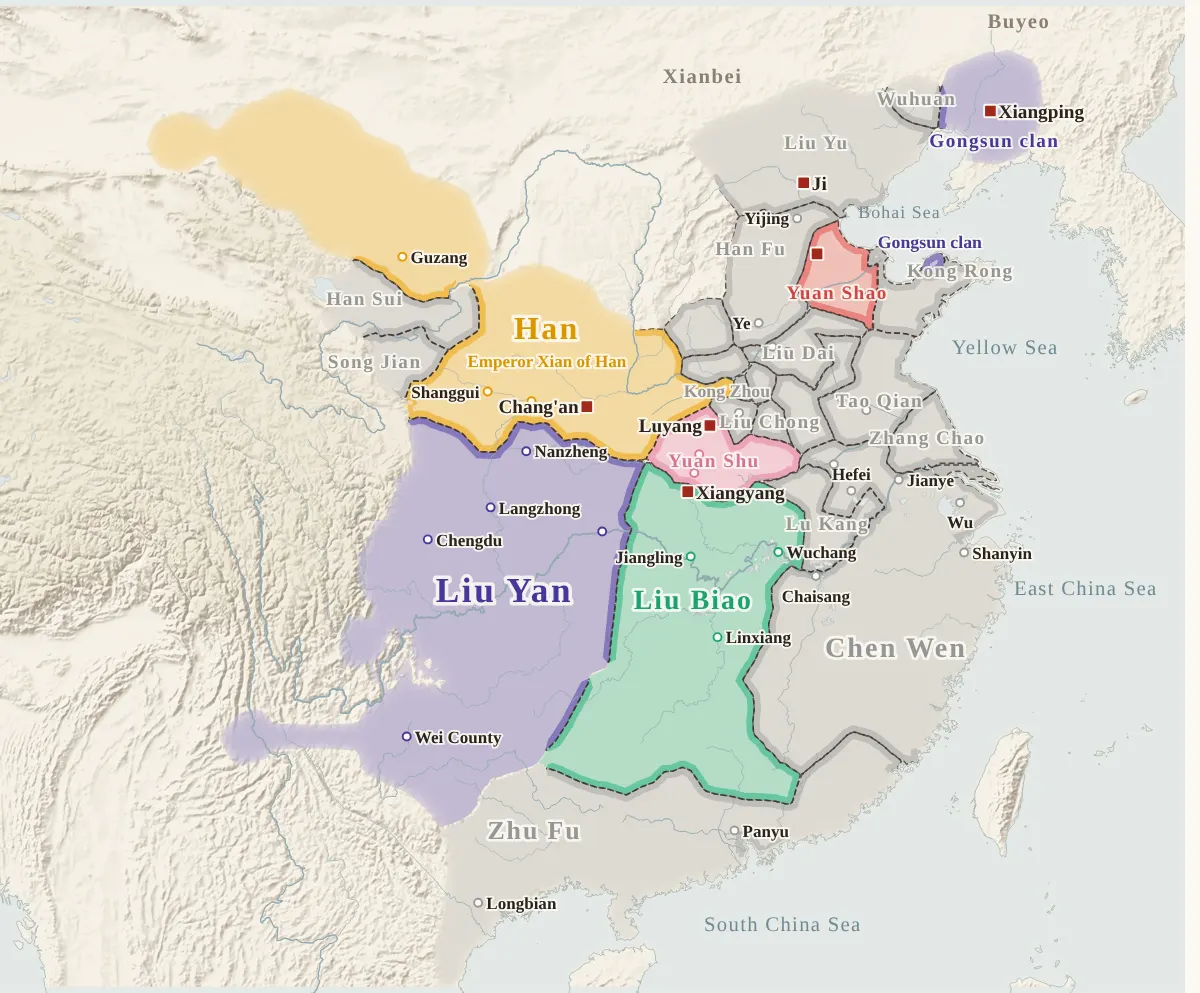
When Emperor Ling of Han died in 189, the consort kinsman He Jin, who sought to remove the eunuchs, was killed by them, and Dong Zhuo, whom He Jin had summoned, deposed the young emperor Liu Bian and set up Emperor Xian of Han. The next year the provinces and commanderies east of the mountains raised troops to attack Dong Zhuo, and Dong Zhuo moved the capital to Chang'an and drove all the people of Luoyang into Guanzhong. When Dong Zhuo was put to death in 192, his generals Li Jue, Guo Si and others took Chang'an, and later they fought among themselves. In 196 Emperor Xian of Han returned to Luoyang, where the palaces had burned, and Cao Cao took control of the affairs of the Imperial Secretariat and moved the capital to Xu. Cao Cao became chancellor in 208, Duke of Wei in 213, and King of Wei in 216. In 220, after Cao Cao's death, Emperor Xian of Han yielded the throne to Cao Pi, Cao Cao's son, who had succeeded him as King of Wei; Cao Pi proclaimed himself Son of Heaven, and Emperor Xian of Han was made Duke of Shanyang.
Translated from the Japanese text of this site, which is written from the official histories. Years are the Western calendar years of the dates, as in English reference works.