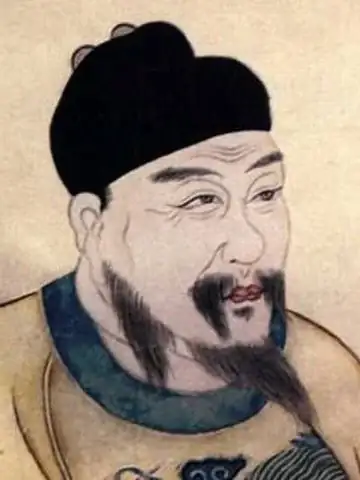
Road to the throne
A ninth-generation descendant of the Hongwu Emperor, he was born into the house of the Prince of Tang. When his grandfather, wishing to set up the son of a favourite concubine, confined his father, he was confined along with him and read books. In 1636, when he tried to lead troops to the capital in its time of danger, he was censured, reduced to commoner status and shut away within the high walls at Fengyang. The Xiaotian Jizhuan writes that on this march to the aid of the throne he also killed two of his uncles, and for the reason he was deposed, the Luqiao Jiwen gives his killing of his uncles to avenge his father, while the Siwen Daji gives his crossing the pass and killing without authority. Freed by an amnesty of the Hongguang court, he reached Hangzhou in 1645 to find that Nanjing had already fallen. Put forward by Zheng Hongkui and others, he took the throne at Fuzhou and changed the era name to Longwu.
Reign and death
According to the Xiaotian Jizhuan, he wore coarse clothes and ate plain vegetables, touched neither wine nor meat, and did not lay a hand on the ten beautiful women presented to him by Zheng Zhilong. The Luqiao Jiwen, on the contrary, writes that he built palaces on a large scale and had dragons and phoenixes woven even into the lower garments of his consort, Lady Zeng. According to the biography of Empress Zeng in the Xiaotian Jizhuan, Lady Zeng as empress took part in government and listened to court sessions from behind a curtain, and both that biography and the main text of the Nanjiang Yishi carry a comment that the emperor was besotted with love within the palace, but the Zhiyi in the Nanjiang Yishi dismisses this as harsh. Military power was held by the Zheng family: Zheng Zhilong turned down his urging to send out troops, pleading a shortage of provisions, and when the emperor tried to enter Jiangxi, Zheng Zhilong had tens of thousands of soldiers and civilians block the road, so the emperor had no choice but to stay at Yanping. According to the Xiaotian Jinian, in 1646 he was angered by the way a letter from Chen Qian, envoy of the Regent of Lu, addressed him, and had Chen imprisoned, and on a secret memorial from Qian Bangqi he had Chen beheaded, and Zheng Zhilong, who had pleaded for Chen's life, harboured disloyal intentions all the more. In the same year, knowing that the Xianxia Pass could not be held, he left Yanping, and according to the Xiaotian Jizhuan he was still carrying more than ten chests of books. The works differ on where he died: the annals of the Xiaotian Jizhuan, the Xiaotian Jinian, the Draft History of Qing and the Taiwan Waiji say he was killed at Tingzhou, the History of Ming and the Mingji Nanlüe say he died at Fuzhou, and the Xiaotian Jizhuan also lists other accounts in its interlinear notes and says it cannot tell which is true. The discussion in the Nanjiang Yishi, citing his frugality, his love of learning and his willingness to heed remonstrance among other things, says it cannot be denied that he was a fine ruler for his time, while the discussion in the Juehuo Lu says he had no means of keeping the Zheng family in hand.
Translated from the Japanese text of this site, which is written from the official histories. Years are the Western calendar years of the dates, as in English reference works. Months are omitted because the histories use the Chinese lunar calendar.