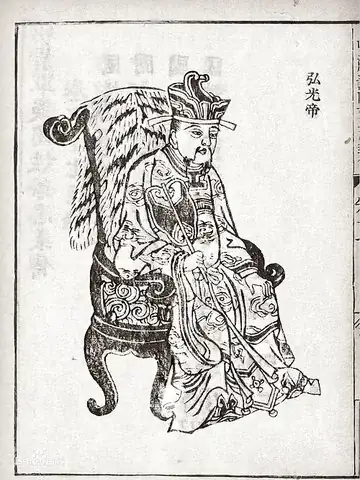
Road to the throne
He was a grandson of the Wanli Emperor and the eldest son of Zhu Changxun, Prince of Fu. In 1641, after his father was killed by Li Zicheng, he fled to Huaiqing, and in 1643 he succeeded as Prince of Fu. In 1644, when Beijing fell, senior ministers in Nanjing listed seven reasons against him, among them lack of filial piety, not reading books, greed, lust, and drunkenness, and put forward the Prince of Lu instead, but according to the biography of Ma Shiying in the History of Ming, when Ma Shiying joined with the generals and led troops to welcome him, the ministers held their tongues. In the same year he took the throne in Nanjing and changed the era name to Hongguang.
Reign and death
According to the biography of Ma Shiying in the History of Ming, he meant to remove Ma Shiying after Huang Shu denounced Ma in his presence, but when the eunuch Tian Cheng and others, who had been given money by Ma, wept before him that he could never have been enthroned without Lord Ma, he said nothing and kept Ma in office. According to the biography of Han Zanzhou in the Xiaotian Jizhuan, when asked why he looked downcast, he answered that there were no new songs, and when admonished for hanging lanterns with his own hands, he said that for the affairs of the realm there was Old Ma, meaning Ma Shiying. In 1645, when a Lady Tong who claimed to be his consort from his days as Prince of Fu was sent to the capital, he called her a wicked woman and had her imprisoned; the biographies of the empresses and consorts and of Ma Shiying in the Xiaotian Jizhuan say she was tortured and died in prison, while the Sheng'an Benji leaves it unknown whether she lived or died. The biography of his father, Prince Gong of Fu, in the History of Ming describes him as weak and benighted, sunk in wine and women, and leaving the government to Ma Shiying and others, while Li Qing, cited in the Nanjiang Yishi, defends him by saying that the eunuchs and the outer officials laid their faults on him, and judges him to have had kindness to spare but too little firmness and clarity. The Kanben in the Nanjiang Yishi goes on to criticize this as no more than a subject shielding his ruler. In the same year the Qing army took Yangzhou, and when the gates of Nanjing were shut, according to the Xiaotian Jizhuan he ignored Han Zanzhou's advice to lead a campaign in person and drank with the performers of the Pear Garden, and according to the biography of Prince Gong of Fu he left Nanjing that night, though the biography of Ma Shiying in the History of Ming gives a different day. According to the Xiaotian Jizhuan, he fled to the camp of Huang Degong, but when Degong cut his own throat, he was carried off on Tian Xiong's back and handed over to the Qing, and in Nanjing, when Prince Yu asked him why he had fled, he sweated and said nothing. He was sent north; the annals of the Xiaotian Jizhuan say he died in Beijing in 1646, and the biography of the Prince of Lu in the same work says he was killed together with the Prince of Lu, but these works do not say how he died.
Translated from the Japanese text of this site, which is written from the official histories. Years are the Western calendar years of the dates, as in English reference works. Months are omitted because the histories use the Chinese lunar calendar.