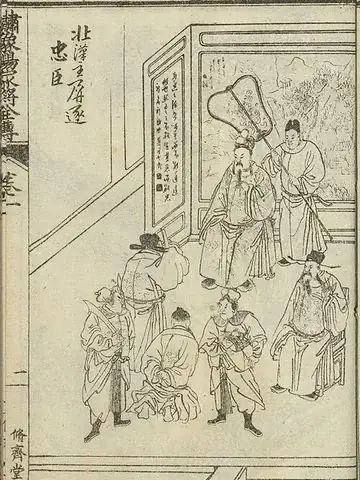
In brief
The Zizhi Tongjian and the Shiguo Chunqiu say that he was filial and prudent, worked diligently at government, cared for the people, and treated scholars with courtesy, so that the realm was more or less at peace.
Road to the throne
When his father died, he observed three years of mourning. The Shiguo Chunqiu says this was because he considered shortening the mourning to be contrary to ritual. When Liu Chong died in 954, he succeeded him and presented a memorial to the Khitan in which he styled himself a son. The Zizhi Tongjian and the Shiguo Chunqiu say that the Khitan invested him as emperor and had him change his name to Jun. In 957 he changed the era name to Tianhui and established seven ancestral temples.
Reign and death
In 960, to aid Li Yun, who had rebelled against the Song, he advanced as far as the Taiping post station and made Li Yun a prince, but Li Yun, seeing that Liu Jun's guard of honor was not properly arrayed, regretted his choice and spoke of the kindness he had received from the Later Zhou. Liu Jun had Lu Zan supervise Li Yun's army; the biographies of Li Yun in the Shiguo Chunqiu and the History of Song say that Liu Jun fell silent at this point and grew suspicious, while the New History of the Five Dynasties and the annals in the Shiguo Chunqiu say that he was displeased. When he set out, Vice Director Zhao Hua remonstrated that Li Yun's taking up arms was rash. The biography of Zhao Hua in the Shiguo Chunqiu says that the advice was not heeded, and the biography of Guo Wuwei in the History of Song says that Liu Jun grew angry and set out without regard to it. After Li Yun was defeated, Liu Jun told Zhao Hua that by not listening to Zhao Hua's words he had come close to defeat, and from then on he valued Confucian scholars all the more. According to the New History of the Five Dynasties and the Shiguo Chunqiu, when Emperor Taizu of Song told him to come down from the Taihang and settle matters in battle, he replied that he was only holding his ground for fear that the sacrifices of the Han would be cut off, and Taizu, taking pity on him, said that he would open a way for him to survive. Duan Chang, who had recommended Guo Wuwei, was implicated in a plot against the throne and sent out to Fenzhou. According to the Shiguo Chunqiu, Liu Jun acted on the words of his favorite, Lady Guo, and had Duan Chang strangled. The biography of Guo Wuwei in the same work places his appointment of Guo Wuwei as chief minister after Duan Chang's death. He had no sons and adopted Liu Ji'en and Liu Jiyuan. According to the New History of the Five Dynasties and the Shiguo Chunqiu, when he told Guo Wuwei that Liu Ji'en was filial but lacked the talent to save the age, Guo Wuwei made no reply, while the History of Song says that Guo Wuwei agreed with him. In 968, according to the Shiguo Chunqiu and the History of Song, he fell ill from worry. According to the Shiguo Chunqiu and the New History of the Five Dynasties, he took Guo Wuwei by the hand, entrusted him with the affairs to follow, and died. He was succeeded by his adopted son Liu Ji'en; the History of Liao names Liu Jiyuan instead.
Translated from the Japanese text of this site, which is written from the official histories. Years are the Western calendar years of the dates, as in English reference works. Months are omitted because the histories use the Chinese lunar calendar.