Emperor Taizu of Song
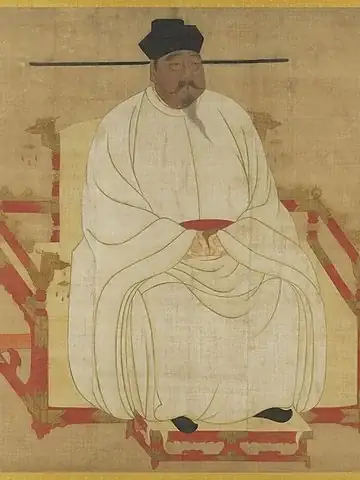
Northern Song · Song · 1st ruler
宋太祖 Sòng Tàizǔ趙匡胤 Zhào Kuāngyìn
Wade–Giles: Sung T'ai-tsu · Chao K'uang-yin
Reigned 960–976 (16 years)
Reigned 16 years (960–976). Died at 50 (East Asian reckoning); cause of death disputed. 1st ruler of Northern Song.
Facts
- Reign
- 4 February 960 – 14 November 976 (1st ruler of Northern Song)
- Length of reign
- 16 years
- Born
- 927
- Died
- 14 November 976
- Age at accession
- 34
- Age at death
- 50
- Cause of death
- DisputedPrimary sources or accepted accounts conflict and cannot be narrowed to one
- Path to the throne
- Abdication from another dynastyReceived the throne from an emperor of another family or regime in a change of dynasty led by the new emperor (e.g. Cao Pi, Yang Jian, Zhao Kuangyin)
- Predecessor
- Emperor Gong of Later Zhou
- Successor
- Emperor Taizong of Song
- Era names
- 建隆 Jiànlóng (proclaimed 960)
- 乾德 Qiándé (proclaimed 963)
- 開寶 Kāibǎo (proclaimed 968)
Ages are given in East Asian reckoning (sui): a person is one year old at birth and gains a year at each New Year, so the figure is one or two years higher than the Western age.
Life
In brief
He rose from command of the Later Zhou palace army to receive the throne by abdication, and founded the Song. He brought Jingnan, Hunan, Later Shu, Southern Han and Southern Tang under his rule one after another. The assessment in the History of Song cites as his achievements that he took military power away from the regional commanders and bound corrupt officials with severe laws.
Road to the throne
On a northern campaign, Shizong of Later Zhou, Chai Rong, found a wooden tablet saying that the Inspector would become Son of Heaven and was suspicious of it; when he fell ill and returned to the capital, he replaced Zhang Yongde with Taizu as Inspector of the Palace Command. In 960, when Taizu, on campaign, stopped at the Chenqiao post station, his generals lined up in the courtyard at dawn with blades in hand, put a yellow robe on him and cheered him as emperor. In the capital Tao Gu produced the abdication edict of Emperor Gong of Later Zhou, and Taizu took the throne in the Chongyuan Hall.
Reign and death
According to the biography of Shi Shouxin in the History of Song, at a banquet Taizu asked Shi Shouxin and the others what they would do if their own men put the yellow robe on them, and the next day they gave up their military commands, pleading illness. In the winter of 976 he died at night in the Wansui Hall. The annals place no mention of illness before his death and do not give a cause, but the Xu Zizhi Tongjian Changbian records that Taizu had been ill before this. The throne passed to his younger brother Emperor Taizong of Song, and the History of Song records that this followed the dying wish of their mother, Empress Dowager Du. Li Tao's Xu Zizhi Tongjian Changbian includes a story that on the night of his death Taizu summoned his brother, that in the shadows of the candlelight the brother now and then left his seat, and that Taizu struck the ground with an axe and told him to do it well. Li Tao notes that he took this story from the Xiangshan Yelu of the monk Wenying, and points out that it is not in the official history or the veritable records. The Changbian further records that Empress Song had sent for the imperial son Defang, but the messenger Wang Ji'en went to summon Taizong instead. The assessment in the annals of Taizong in the History of Song cites such things as the change of era within the year of Taizu's death, and says that the criticism of later ages cannot be avoided.
Translated from the Japanese text of this site, which is written from the official histories. Years are given in the Western calendar; months are omitted because the histories use the Chinese lunar calendar.
During the reign
Number of times each event is recorded in the official histories. How each item is counted
- Era name changes
- 3
- General amnesties
- 8
- Empresses installed
- 2
- Crown princes deposed
- 0
- Personal campaigns
- 3
- Rebellions suppressed
- 6
- Rebellions faced
- 6
- Capital relocations
- 0
Emperors of Northern Song
- 1stEmperor Taizu of Song宋太祖 Sòng Tàizǔ趙匡胤 Zhào Kuāngyìn960–976 · 16 years · Disputed, age 50960–97616 yearsDisputed, age 50
- 2ndEmperor Taizong of Song宋太宗 Sòng Tàizōng趙炅 Zhào Jiǒng976–997 · 20 years · Natural causes, age 59976–99720 yearsNatural causes, age 59
- 3rdEmperor Zhenzong of Song宋真宗 Sòng Zhēnzōng趙恆 Zhào Héng997–1022 · 24 years · Natural causes, age 55997–102224 yearsNatural causes, age 55
- 4thEmperor Renzong of Song宋仁宗 Sòng Rénzōng趙禎 Zhào Zhēn1022–1063 · 41 years · Natural causes, age 541022–106341 yearsNatural causes, age 54
- 5thEmperor Yingzong of Song宋英宗 Sòng Yīngzōng趙曙 Zhào Shǔ1063–1067 · 3 years · Natural causes, age 361063–10673 yearsNatural causes, age 36
- 6thEmperor Shenzong of Song宋神宗 Sòng Shénzōng趙頊 Zhào Xū1067–1085 · 18 years · Natural causes, age 381067–108518 yearsNatural causes, age 38
- 7thEmperor Zhezong of Song宋哲宗 Sòng Zhézōng趙煦 Zhào Xù1085–1100 · 14 years · Natural causes, age 251085–110014 yearsNatural causes, age 25
- 8thEmperor Huizong of Song宋徽宗 Sòng Huīzōng趙佶 Zhào Jí1100–1126 · 25 years · Natural causes, age 541100–112625 yearsNatural causes, age 54
- 9thEmperor Qinzong of Song宋欽宗 Sòng Qīnzōng趙桓 Zhào Huán1126–1127 · 1 year · Natural causes, age 571126–11271 yearNatural causes, age 57