Liu Shan
A son of Liu Bei, he succeeded to the throne of Shu Han and later surrendered to Deng Ai of Wei.
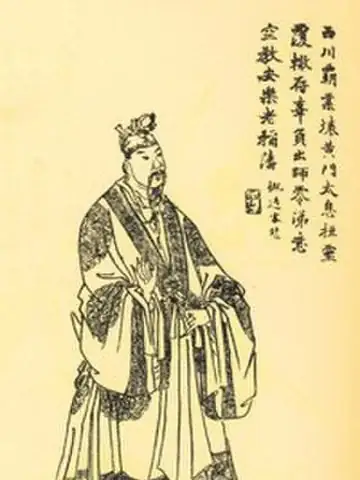
Facts
Liu Shan reigned for 40 years (223–264), taking the throne at 15 or 16, and died at 63 or 64 of unknown causes. 2nd ruler of Shu Han.
- Reign
- June 223 – January 264 (2nd ruler of Shu Han)
- Length of reign
- 40 years
- Born
- Unknown
- Died
- 271
- Age at accession
- 15–16
- Age at death
- 63–64
- Cause of death
- UnknownThe primary sources record no cause of death or clue to it
- Path to the throne
- Designated heirSucceeded the previous ruler of the same regime, who had chosen the heir (by testament, naming a crown prince, etc.)
- Predecessor
- Liu Bei
- Era names
- 建興 Jiànxīng (proclaimed 223)
- 延熙 Yánxī (proclaimed 238)
- 景耀 Jǐngyào (proclaimed 258)
- 炎興 Yánxīng (proclaimed 263)
- Posthumous name
- 蜀漢懷帝 Shǔ Hàn Huáidì
- Personal name
- 劉禪 Liú Shàn
- Wade–Giles
- Shu Han Huai-ti · Liu Shan
Life
In brief
Chen Shou's assessment describes him as a ruler who followed reason when he entrusted affairs to a worthy chancellor and a benighted ruler when eunuchs led him astray, just like white thread that changes its color as it is dyed. The same assessment praises him for not changing the era name and not issuing amnesties recklessly for the 12 years from his accession, and holds that this practice gradually broke down after Zhuge Liang died.
Road to the throne
His mother, Lady Gan, a concubine of Liu Bei, gave birth to Liu Shan in Jing Province. In 208, when Cao Cao's army caught up with Liu Bei at Changban, Liu Bei left mother and child behind, but Zhao Yun held the young Liu Shan in his arms and protected him. A story that Liu Bei threw down the Liu Shan who had been rescued appears in neither the relevant biographies of the Records of the Three Kingdoms nor the Changban entry of the Zizhi Tongjian. His courtesy name was Gongsi, and in 219, when Liu Bei became King of Hanzhong, Liu Shan was installed as the king's heir. As he was dying, Liu Bei entrusted the affairs after his death to Zhuge Liang, telling him to assist his heir if the heir was fit to be assisted, but to take it himself if the heir had no ability. In 223, when Liu Bei died, he succeeded to the throne in Chengdu at the age of 17 (East Asian reckoning).
Reign and death
Zhuge Liang, who also held the office of Governor of Yi Province, decided affairs of government both great and small. According to the biography of Dong Yun, Liu Shan tried to fill his harem, but Dong Yun would not consent, saying that the consorts of the ancient Son of Heaven numbered no more than 12, and Liu Shan came to fear him all the more. In 234, Zhuge Liang died, and Jiang Wan took charge of the affairs of state. According to the biography of Qiao Zhou, after Liu Shan established the crown prince he went out on excursions more often and increased his music, and Qiao Zhou admonished him, while praising his filial conduct, for not attending the sacrifices. The biography of Dong Yun says that from the time Chen Zhi came to be favored, Liu Shan, because of Chen Zhi's flattery and Huang Hao's slander, resented the late Dong Yun more each day, believing that Dong Yun had thought lightly of him. In 258, the eunuch Huang Hao took sole charge of the government for the first time. That same year Chen Zhi died, and Liu Shan wept and conferred on him the posthumous name Marquis Zhong. According to the Huayang Guozhi cited in the commentary, when Jiang Wei asked for Huang Hao to be killed, Liu Shan said that Huang Hao was no more than a petty servant who ran errands and that he had also resented Dong Yun's hatred of Huang Hao, and he had Huang Hao apologize. According to the biography of Jiang Wei, the preparations against Zhong Hui that Jiang Wei proposed in a memorial also came to nothing, for Huang Hao, who believed in spirit-mediums, said that the enemy would not come and had Liu Shan set the matter aside. In the winter of 263, when Deng Ai defeated Zhuge Zhan at Mianzhu, Liu Shan used Qiao Zhou's plan, placed a coffin on a cart and bound himself, and surrendered to Deng Ai. His son Liu Chen, the Prince of Beidi, grieved over the fall of the state, killed his wife and children, and then took his own life. The Han Jin Chunqiu cited in the commentary says that Liu Chen urged that they fight a battle and Liu Shan rejected his plea. The next year, 264, he was moved with his whole family to Luoyang and enfeoffed as Duke of Anle County. According to the Han Jin Chunqiu cited in the commentary, at a banquet given by Sima Zhao, Liu Shan laughed calmly even as he watched the entertainments of Shu, and Sima Zhao said that even if Zhuge Liang had been there he could not have supported him for long. The story that Liu Shan, when asked whether he thought of Shu, answered that it was pleasant here and that he did not think of Shu does not appear in the main text of the biography of the Later Ruler, but appears in the Han Jin Chunqiu cited in the commentary and in the Zizhi Tongjian. In 271, he died at Luoyang, but the biography of the Later Ruler does not record the cause of his death.
Translated from the Japanese text of this site, which is written from the official histories. Years are the Western calendar years of the dates, as in English reference works. Months are omitted because the histories use the Chinese lunar calendar.
During the reign
Number of times each event is recorded in the official histories. How each item is counted
- Era name changes
- 4
- General amnesties
- 13
- Empresses installed
- 2
- Crown princes deposed
- 0
- Personal campaigns
- 0
- Rebellions suppressed
- 5
- Rebellions faced
- 5
- Capital relocations
- 0