Liu Bei
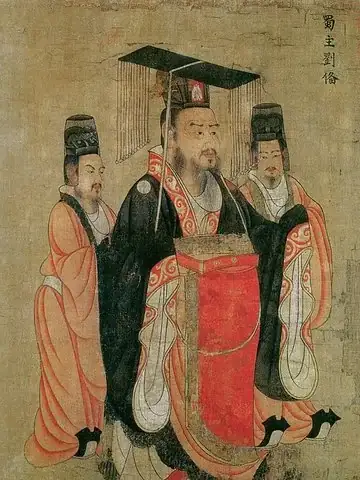
Shu Han · Three Kingdoms · 1st ruler
蜀漢昭烈帝 Shǔ Hàn Zhāolièdì劉備 Liú Bèi
Wade–Giles: Shu Han Chao-lieh-ti · Liu Pei
Reigned 221–223 (2 years)
Reigned 2 years (221–223). Died at 63 (East Asian reckoning) of natural causes. 1st ruler of Shu Han.
Facts
- Reign
- 15 May 221 – 21 June 223 (1st ruler of Shu Han)
- Length of reign
- 2 years
- Born
- Unknown
- Died
- 21 June 223
- Age at accession
- 61
- Age at death
- 63
- Cause of death
- Natural causesNatural death or illness (including old age)
- Path to the throne
- Self-proclaimedFounded the titleClaimed the imperial title without receiving the throne from an earlier ruler (e.g. Emperor Gaozu of Han, Emperor Guangwu of Han, Hongwu Emperor)
- Successor
- Liu Shan
- Era names
- 章武 Zhāngwǔ (proclaimed 221)
Ages are given in East Asian reckoning (sui): a person is one year old at birth and gains a year at each New Year, so the figure is one or two years higher than the Western age.
Life
In brief
Liu Bei came from Zhuo commandery; after fighting in many places he won Yi province, and in 221 he took the throne at Chengdu as emperor carrying on the Han. After his accession he attacked Wu to avenge Guan Yu, but he was crushingly defeated at Xiaoting and died in the Yong'an Palace the following year.
Road to the throne
The biography of the First Ruler in the Records of the Three Kingdoms makes him a descendant of Liu Sheng, Prince Jing of Zhongshan, but the Dianlüe, quoted in Pei Songzhi's commentary, makes him a member of a branch of the Marquis of Linyi's family. He lost his father as a child, and lived with his mother by selling sandals and weaving mats. In 208 he sent Zhuge Liang to ally with Sun Quan, and together with the fleet of Zhou Yu and others he crushed Cao Cao at Red Cliffs. In 211 he was invited by Liu Zhang into Yi province, and in 214 he besieged Chengdu, received Liu Zhang's surrender, and became governor of Yi province. In 219 he killed Xiahou Yuan at Mount Dingjun, took Hanzhong, and became King of Hanzhong. The next year, when Cao Pi claimed the title of emperor and a rumor spread that Emperor Xian of Han had been killed, Liu Bei announced mourning and gave him the posthumous title Emperor Xiaomin. In 221, in response to petitions from his officials, he took the throne south of Wudan in Chengdu, changed the era name, and made Zhuge Liang chancellor, Lady Wu empress, and his son Liu Shan crown prince.
Reign and death
That same year, angered that Sun Quan had attacked Guan Yu, he led his armies in person against Wu and rejected Sun Quan's letter asking for peace. In 222 Lu Xun crushed Liu Bei's army at Xiaoting, and Liu Bei withdrew to Yufu and renamed the county Yong'an. According to the biography of Lu Xun, Lu Xun broke more than 40 of Liu Bei's camps with fire, Liu Bei fled by night into Baidi, and he was ashamed and angry at having been humiliated by Lu Xun. Hearing that Liu Bei was staying at Baidi, Sun Quan grew afraid and asked for peace, which was granted. When his illness grew grave in 223, he entrusted his affairs after his death to the chancellor Zhuge Liang, with the Prefect of the Masters of Writing Li Yan as his deputy, and he died in the Yong'an Palace. According to the biography of Zhuge Liang, Liu Bei told Zhuge Liang that if his heir proved not worth assisting he should take the state himself, and Zhuge Liang wept and answered that he would serve with loyalty until death. In his testamentary edict, quoted in Pei Songzhi's commentary, Liu Bei said that his illness had begun as mere diarrhea and brought on other ailments, and he warned Liu Shan not to do even a small evil and not to neglect even a small good. The biography of the First Ruler does not state where he entrusted his son to Zhuge Liang, and the phrase about entrusting the orphan at Baidi does not appear in the relevant passages of the biographies of the First Ruler, Lu Xun or Zhuge Liang, but the biography of the Ruler of Wu records that Liu Bei died at Baidi.
Translated from the Japanese text of this site, which is written from the official histories. Years are given in the Western calendar; months are omitted because the histories use the Chinese lunar calendar.
During the reign
Number of times each event is recorded in the official histories. How each item is counted
- Era name changes
- 1
- General amnesties
- 1
- Empresses installed
- 1
- Crown princes deposed
- 0
- Personal campaigns
- 1
- Rebellions suppressed
- 1
- Rebellions faced
- 1
- Capital relocations
- 0