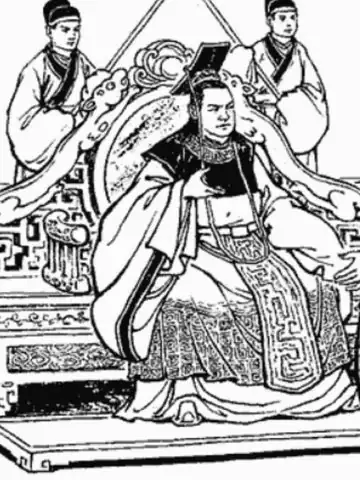
In brief
Chen Shou's assessment granted that he had the capacity of a ruler but criticized him for throwing himself into building palaces, and Sun Sheng praised Cao Rui's magnanimity in leaving those who remonstrated with him unpunished while lamenting that Cao Rui brought on the calamity of great power being held lopsidedly.
Road to the throne
He was a son of Cao Pi, and because his mother, Lady Zhen, had been put to death, he was not made heir. Of the works cited in Pei Songzhi's commentary, the Weilüe says that Cao Pi considered another son as heir, and the Wei Mo Zhuan relates that when Cao Pi, who had shot a doe, told him to shoot its fawn, he refused in tears, saying that with the mother already killed he could not bring himself to kill the young one as well, and that Cao Pi then settled on him as heir. In 226, only when Cao Pi fell gravely ill was he made crown prince, and he then took the throne.
Reign and death
According to the Weishu cited in Pei Songzhi's commentary, even when memorials from officials and commoners reached dozens or a hundred in a month, he read them through to the end without tiring of them. In 228 Zhang He crushed Zhuge Liang's army at Jieting, and in 234 Zhuge Liang, who had been facing Sima Yi, died and the Shu Han army withdrew. In 229 he renamed the Pingwang Tower the Tower for Hearing Lawsuits, and, saying that criminal cases were the lives of the people of the realm, he heard major cases himself. The biography of Chen Jiao does not record the year, but once, when Cao Rui came without warning to the gate of the Imperial Secretariat and Chen Jiao told him that this was a minister's duty and that His Majesty should go back, Cao Rui turned his carriage around in shame. Empress Dowager Guo, Cao Pi's empress, died in 235; the main text of the biographies of empresses and consorts says only that she died, the Weilüe says that she died suddenly of distress, and the Han Jin Chunqiu says that Cao Rui, having asked her in tears how Lady Zhen had died, killed her. His great building works on the Luoyang palace cost the people their farming seasons, and Yang Fu and others remonstrated again and again, but he did not stop the building, nor did he punish those who had remonstrated. According to the Weilüe, in 237 he made even the highest ministers carry earth on their backs to build an earthen hill, and he took no action against Dong Xun, who had remonstrated with him prepared to die. He favored Lady Guo, and in 237, when Empress Mao spoke of a banquet to which she had not been invited, he killed more than ten people on the grounds that his attendants had let it out, and ordered Empress Mao to die. His annals say only that Empress Mao died. Late in 238 he fell ill; he made Cao Yu, Prince of Yan, general-in-chief, but a few days later, early in 239, replaced him with Cao Shuang. In 239 he took the hand of Sima Yi, who had hurried to his side, entrusted him with joining Cao Shuang in assisting his young son, and died that same day.
Translated from the Japanese text of this site, which is written from the official histories. Years are the Western calendar years of the dates, as in English reference works. Months are omitted because the histories use the Chinese lunar calendar.