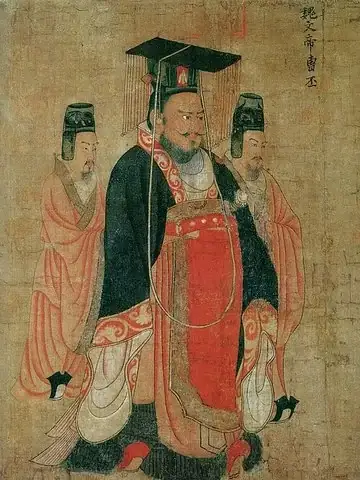
Facts
Cao Pi reigned for 5 years (220–226), taking the throne at 32 or 33, and died of natural causes at 38 or 39. 1st ruler of Cao Wei.
- Reign
- 10 December 220 – 29 June 226 (1st ruler of Cao Wei)
- Length of reign
- 5 years
- Born
- 187
- Died
- 29 June 226
- Age at accession
- 32–33
- Age at death
- 38–39
- Cause of death
- Natural causesNatural death or illness (including old age)
- Path to the throne
- Abdication from another dynastyReceived the throne from an emperor of another family or regime in a change of dynasty led by the new emperor (e.g. Cao Pi, Yang Jian, Zhao Kuangyin)
- Predecessor
- Emperor Xian of Han
- Successor
- Cao Rui
- Era names
- 黃初 Huángchū (proclaimed 220)
- Posthumous name
- 魏文帝 Wèi Wéndì
- Temple name
- 魏高祖 Wèi Gāozǔ
- Personal name
- 曹丕 Cáo Pī
- Wade–Giles
- Wei Wen-ti · Ts'ao P'i
Life
In brief
He loved literature and completed close to a hundred works himself, and he had the Confucians compile the Huanglan, more than a thousand sections in all. Chen Shou appraises him as rich in literary talent, widely learned and versatile, and says that with breadth of mind and fairness added he would not be far from the wise sovereigns of old.
Road to the throne
He was the heir of Cao Cao and was born at Qiao. When Ji province was pacified, he took Lady Zhen, who had been the wife of Yuan Xi, as his wife at Ye and favored her, and Cao Rui was born. In 211 he became General of the Household Gentlemen of the Five Offices and vice chancellor, and in 217 he was made crown prince of Wei. According to the biography of Cao Zhi, Cao Cao several times came near to making the talented Cao Zhi his heir, but Cao Zhi acted on his whims and drank without measure, while Cao Pi used artifice, disguised his true feelings and put on a good outward show, and his attendants also spoke in his favor, so Cao Pi was settled as the successor. In 220, when Cao Cao died, he succeeded him as chancellor and King of Wei, and changed the era name to Yankang. The nine-rank system for officials was established on the proposal of Chen Qun while he was King of Wei, but the annals do not record it. The same year, Emperor Xian of Han ceded the throne to him on the ground that the hopes of the people lay with Wei, and according to the Xiandi Zhuan cited in Pei Songzhi's commentary, Cao Pi repeatedly issued orders declining it. He took the throne on an altar built at Fanyang, changed the era name to Huangchu, and made Emperor Xian the Duke of Shanyang.
Reign and death
In 220 he was greatly angered by Dai Ling, who had remonstrated that he hunted too often, and Dai Ling's death sentence was reduced by one degree. He comforted Yu Jin, who had returned to Wei, but had a picture drawn at Cao Cao's tomb showing Yu Jin surrendering, and Yu Jin, seeing it, was ashamed, fell ill, and died. When his younger brother Cao Zhi was accused of threatening an envoy while drunk, he did no more than lower his noble rank for the empress dowager's sake. In 221 his consort Lady Zhen died; the annals say only that she died, but the biographies of empresses and consorts say that Cao Pi was greatly angered with her for voicing resentment and ordered her to die. In 222, when he heard that Liu Bei had linked camps across more than 700 li, he said that Liu Bei did not understand warfare, and seven days later the news of Liu Bei's defeat arrived. The same year he forbade women and the families of empresses from taking part in government, and made Lady Guo empress. He further ordered a plain burial, with no mound or tomb hall built and no gold or silver placed in the tomb. He bore a grudge against Cao Hong, who had refused him a loan in his youth, and when Cao Hong was put in prison he came near to having him put to death, but Empress Dowager Bian pressed him through Empress Guo, and he did no more than dismiss Cao Hong from office and reduce his rank and fief. He also tore up the memorial in which Bao Xun remonstrated against hunting in mourning and went out hunting; later, though senior ministers begged for Bao Xun's life, he would not spare him and put him to death. Because his mother had been ordered to die, Cao Rui was long left unestablished as his heir. The Weimo Zhuan in Pei Songzhi's commentary carries the story that when Cao Pi, having shot the mother deer, told him to shoot the fawn, he wept and refused, and Cao Pi resolved to make him his heir, but the Weilüe in the same commentary reports that he thought of the Prince of Jingzhao as his successor. When his illness grew grave in 226, he made Cao Rui crown prince, entrusted the succession to Cao Zhen, Chen Qun, Cao Xiu, and Sima Yi, and died. The tale of the seven-step poem is in neither the text of the Records of the Three Kingdoms nor its commentary, but appears in the Shishuo Xinyu.
Translated from the Japanese text of this site, which is written from the official histories. Years are the Western calendar years of the dates, as in English reference works. Months are omitted because the histories use the Chinese lunar calendar.
During the reign
Number of times each event is recorded in the official histories. How each item is counted
- Era name changes
- 1
- General amnesties
- 1
- Empresses installed
- 1
- Crown princes deposed
- 0
- Personal campaigns
- 3
- Rebellions suppressed
- 2
- Rebellions faced
- 2
- Capital relocations
- 0
Emperors of Cao Wei
- 1stCao Pi魏文帝 Wèi Wéndì · 曹丕 Cáo Pī220–226 · 5 years · Natural causes, age 38–39220–2265 yearsNatural causes, age 38–39
- 2ndCao Rui魏明帝 Wèi Míngdì · 曹叡 Cáo Ruì226–239 · 12 years · Natural causes, age 34–35226–23912 yearsNatural causes, age 34–35
- 3rdCao Fang曹芳 Cáo Fāng239–254 · 15 years · Unknown, age 41–42239–25415 yearsUnknown, age 41–42
- 4thCao Mao曹髦 Cáo Máo254–260 · 5 years · Assassinated, age 18–19254–2605 yearsAssassinated, age 18–19
- 5thCao Huan魏元帝 Wèi Yuándì · 曹奐 Cáo Huàn260–266 · 5 years · Unknown260–2665 yearsUnknown