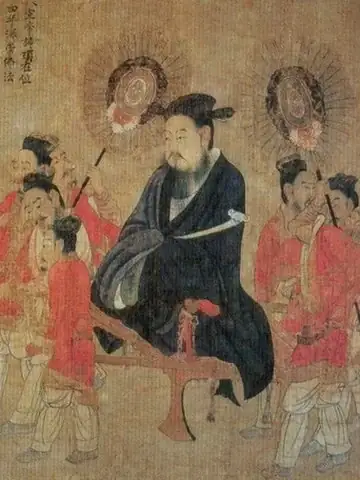
Road to the throne
In his youth he was magnanimous and rich in wisdom and strategy, and he was brave and strong and excelled at mounted archery. On his deathbed his elder brother Emperor Wen told him that he wished to follow the example of Taibo, but Chen Xu wept and firmly declined. According to the biography of Mao Xi, when Chen Xu was assisting in the government under his nephew Emperor Fei and learned of Han Zigao's plot to rebel, he adopted Mao Xi's plan of putting Han Zigao at ease before striking him. In 568 Emperor Fei was deposed by an order of Empress Dowager Cixun. The Zizhi Tongjian writes that the order falsely accused Emperor Fei of conspiring with Liu Shizhi, Hua Jiao and others, and the Book of Zhou records that Chen Xu deposed his sovereign and set himself up. Chen Bomao, a son of Emperor Wen, had been demoted to Marquis of Wenma on the day Emperor Fei was deposed, and he died in his carriage while being moved. The Book of Chen says that he was killed in a robbery, while the History of the Southern Dynasties and the Zizhi Tongjian say that the robbery was Chen Xu's doing. The next year, Chen Xu took the throne.
Reign and death
He doted on Lady Qian, whom he had married in his home district, making her Noble Consort, and Empress Liu passed all the finest goods on to the Noble Consort. In 575 he had a blue ox that had been presented to him returned to the people, and had brocade coverlets burned. In 573 he sent Wu Mingche on a northern campaign and gained Huainan. In 577, when Wu Mingche's army defeated the Northern Zhou forces at Lüliang and was about to advance on Pengcheng, Chen Xu was angered by Cai Jingli, who remonstrated that the army was worn out and the generals arrogant, but because Cai Jingli was an old minister he did not punish him severely and appointed him to a local post. Mao Xi, asked about advancing, also replied that the borders should be guarded, but Chen Xu did not follow his advice. In 578 the northern expedition suffered a crushing defeat at Lüliang, and Wu Mingche was captured. According to the biography of Cai Jingli, on learning of the defeat Chen Xu summoned Cai Jingli back that same day; before he could take up his post, Cai Jingli had been dismissed for taking bribes. On hearing of the deeds of his son Chen Shuling, such as digging up the tomb of Xie An, he dismissed the Vice Censor-in-Chief who had failed to report them and had Chen Shuling's attendants flogged, but he only reprimanded Chen Shuling, whom he loved. In 582 he died, leaving a testamentary edict saying that he had been unable to fulfil his ambition of swallowing the eight directions and was leaving his regret beneath the earth. According to the Book of Sui, Gao Jiong of Sui asked for the troops to be withdrawn on the grounds that a state in mourning should not be attacked.
Translated from the Japanese text of this site, which is written from the official histories. Years are the Western calendar years of the dates, as in English reference works. Months are omitted because the histories use the Chinese lunar calendar.