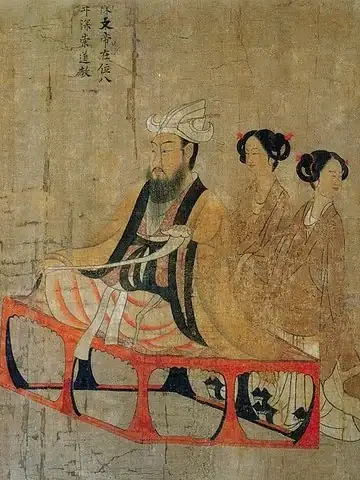
In brief
Yao Cha praised him for honouring Confucian learning, using people well, and working diligently, and likened his reliance on his own intelligence and judgement of people to the government of Emperor Ming of Han.
Road to the throne
The eldest son of Prince Zhaolie of Shixing, Emperor Wu's elder brother, he was composed from his youth and fond of the classics and histories, and his uncle loved him as the finest talent of their clan. During the rebellion of Hou Jing he was seized, and he hid a small knife in his sleeve meaning to stab Hou Jing but could not carry it out; he got free when Hou Jing was defeated. When Emperor Wu died in 559, he was summoned by a testamentary edict, and according to the biography of Cai Jingli the empress conferred with Cai Jingli and others, kept the death secret, and called him in haste. The empress's decree said that the late emperor's orphaned children were young and there was no telling when they could return to the country, so an older ruler had to be set up, and after declining again and again he took the throne. The biography of Hou Andu says that when the empress was reluctant to issue the decree on account of Chen Chang, Prince of Hengyang, Hou Andu put his hand on his sword and made her bring out the imperial seal, but the annals do not record this.
Reign and death
In 560, Emperor Wu's son Chen Chang died while crossing the Yangtze. The annals of the Book of Chen do not give the cause of his death, while Chen Chang's own biography says he drowned. According to the biography of Hou Andu, when Emperor Wen, displeased by an insolent letter from Chen Chang, hinted that he would step aside, Hou Andu refused and asked to go and meet Chen Chang himself, and after Chen Chang's death Hou Andu was raised in noble rank for his merit. The biography of Hou Andu in the History of the Southern Dynasties says that he killed Chen Chang in midstream, and the Zizhi Tongjian says that Chen Chang was killed and reported as drowned. According to the biography of Hou Andu, Emperor Wen bore a deep grudge against the arrogant Hou Andu. Asked again and again at a banquet how things compared with his days as Prince of Linchuan, Emperor Wen replied that it was the mandate of Heaven, though it was also owed to Hou Andu's efforts. In 563, Hou Andu was ordered to take his own life. According to the annals, he was sharp at telling true memorials from false, knew the hardships of the people and kept state spending frugal, and had himself woken by the sound of the time tallies even when asleep. According to the annals of Emperor Fei of Chen, he worried about his gentle and weak crown prince, and when his illness grew grave he told the Prince of Ancheng that he wished to follow the example of Taibo, but the prince wept and firmly declined. According to the biography of Kong Huan, when Emperor Wen said from his sickbed that he wished to set up an older ruler, Kong Huan wept and answered that if Emperor Wen had any thought of deposing and replacing the heir, he and the other ministers could not accept the edict, and Emperor Wen said that he saw in him the uprightness of the ancients. Sima Guang judged that Emperor Wen's calling Kong Huan, a treacherous flatterer of the worst kind, a man of ancient uprightness and entrusting his young son to him went against reason. He died in 566, and by his testamentary edict the crown prince succeeded him.
Translated from the Japanese text of this site, which is written from the official histories. Years are the Western calendar years of the dates, as in English reference works. Months are omitted because the histories use the Chinese lunar calendar.