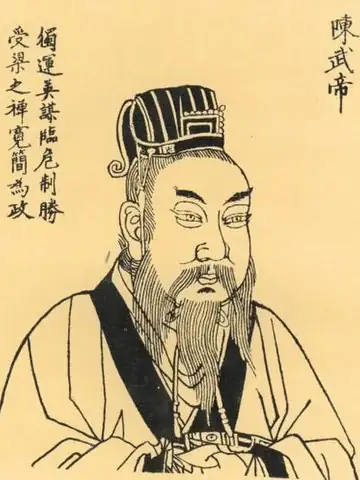
Facts
Emperor Wu of Chen reigned for 1 year (557–559), taking the throne at 53 or 54, and died of natural causes at 55 or 56. 1st ruler of Chen.
- Reign
- 16 November 557 – 9 August 559 (1st ruler of Chen)
- Length of reign
- 1 year
- Born
- 503
- Died
- 9 August 559
- Age at accession
- 53–54
- Age at death
- 55–56
- Cause of death
- Natural causesNatural death or illness (including old age)
- Path to the throne
- Abdication from another dynastyReceived the throne from an emperor of another family or regime in a change of dynasty led by the new emperor (e.g. Cao Pi, Yang Jian, Zhao Kuangyin)
- Posthumous name
- 陳武帝 Chén Wǔdì
- Temple name
- 陳高祖 Chén Gāozǔ
- Personal name
- 陳霸先 Chén Bàxiān
- Wade–Giles
- Ch'en Wu-ti · Ch'en Pa-hsien
Life
In brief
Yao Cha praised him as second only to Emperor Gaozu of Han and Emperor Wu of Wei. The historians' comment by Wei Zheng criticizes him for transferring the throne too quickly, while praising the breadth of mind with which he employed even his enemies and got them to fight to the death for him.
Road to the throne
He was born in 503. According to the Book of Chen, when he captured Du Sengming, Zhou Wenyu, and others who had rebelled in Guangzhou, he released them and made them commanders. In 551, when the army sent against Hou Jing ran short of food, he shared his army provisions with Wang Sengbian, and in 552 he swore an alliance with Wang Sengbian and crushed the army of Hou Jing. When Northern Qi asked that Xiao Yuanming be accepted, he argued that it should not be done, but Wang Sengbian would not listen and in 555 welcomed Xiao Yuanming and put him on the throne. The same year, according to the biography of Du Leng in the Book of Chen, he choked Du Leng, who had objected to a plot to attack Wang Sengbian, by the neck with a handkerchief until Du Leng passed out, but took him along when the army set out. He made a surprise attack on Shitou, captured Wang Sengbian, and that night strangled him together with his son. In 556 he crushed a Northern Qi army that had advanced on Jiankang, and in 557 he received the throne by abdication from Emperor Jing of Liang, took the throne, and changed the era name to Yongding.
Reign and death
According to the Book of Chen, he held to frugality, using earthenware vessels even at private banquets, and he distributed all the treasure obtained when he put down Hou Jing and when he set up Emperor Jing among his officers and soldiers. After he gained the realm, he always said of a younger brother who had died early that, had that brother lived, pacifying northern China would have been easy, and he loved that brother's son Chen Tanlang more than his own sons. In 558 the abdicated Emperor Jing died. The annals of the Book of Chen do not mention the cause of death; the Zizhi Tongjian says he had Emperor Jing killed, the annals of Chen in the History of the Southern Dynasties present the death as the will of Chen, and the Book of Northern Qi writes that he murdered Emperor Jing when he took the throne. The same year he went to a temple and offered himself to it, and the officials petitioned him to return to the palace. At the end of the year he also gave up his carriage and ritual objects at a temple, and the officials came to receive him, and he returned to the palace that same day. When Zhou Wenyu and Hou Andu, who had gone out to attack Wang Lin, been defeated, and been held captive, escaped back and asked to be punished, they were received in audience and pardoned that same day, and later an edict restored their offices. In 559, when the coffin of Zhou Wenyu, who had been killed by Xiong Tanlang, arrived, he wept for him despite his illness, and the next day he personally judged lawsuits, but his illness grew worse and he died. The annals say that his testamentary edict summoned his elder brother's son, Emperor Wen of Chen, while the biographies of the empresses and consorts and the Zizhi Tongjian say that the empress kept his death secret and summoned him.
Translated from the Japanese text of this site, which is written from the official histories. Years are the Western calendar years of the dates, as in English reference works. Months are omitted because the histories use the Chinese lunar calendar.