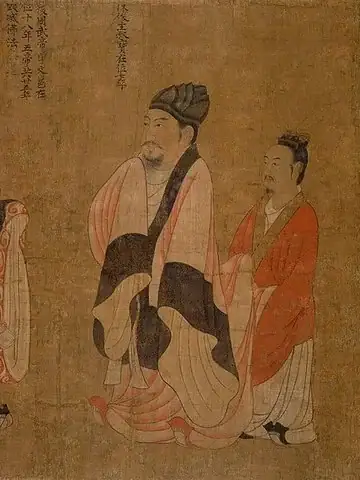
In brief
The historians' comment at the end of the annals in the Book of Chen says that he had shown fine virtue ever since he was crown prince, but that before he had reformed the old abuses, Shi Wenqing and others took sole charge of the key affairs of state, and it concludes that the fall was also the will of Heaven. The discussion by Wei Zheng says that, raised by the hands of women, he did not know the hardships of the people, and that he entrusted the government to petty men.
Road to the throne
When his father died in 582, his younger brother Chen Shuling slashed Chen Shubao on the neck. According to the biography of Chen Shuling in the Book of Chen, a wet nurse pulled back Chen Shuling's elbow and Chen Shubao got up and broke free by himself, but according to the biography of Chen Shujian, as he lay unconscious the empress dowager and the wet nurse shielded him with their own bodies. Chen Shujian took the knife away, and Chen Shuling gathered troops at Dongfu but was hunted down and killed, and Chen Shubao took the throne.
Reign and death
According to the closing passage of the biographies of empresses and consorts in the Book of Chen, only Noble Consort Zhang attended him while he lay wounded, and Chen Shubao later built three pavilions and had palace women sing songs such as Yushu Houtinghua, which praised the beauty of the consorts. When Fu Zai, who had been thrown into prison on slanderous charges, admonished him for indulging in wine and women, Chen Shubao flew into a rage, but before long he sent someone to ask whether Fu Zai could mend his ways, meaning to pardon him. Told in reply that Fu Zai's heart was like his face and could not be changed, he ordered Fu Zai to take his own life. In 588 Sui invaded. The Book of Chen says that Shi Wenqing and others held back the reports, so Chen Shubao did not know and no defences were prepared. According to the Zizhi Tongjian, Yuan Xian and others petitioned again and again, but they were blocked by Shi Wenqing and Jiang Zong and the debate went undecided, while Chen Shubao said that the kingly aura lay here, laughed as he accepted what Kong Fan told him, and kept up his feasting. In 589 the Sui army crossed the Yangtze, and Ren Zhong surrendered and led it into the palace city. Even though Yuan Xian remonstrated with him, Chen Shubao went into a well, and he was captured by the Sui army. The biographies of empresses and consorts in the Book of Chen say that Noble Consort Zhang went into the well with him, and the History of the Southern Dynasties and the Zizhi Tongjian say that when he was hauled up, Noble Consort Zhang came up with him, together with a woman whom the History of the Southern Dynasties calls Honored Lady Kong and the Zizhi Tongjian calls Noble Concubine Kong. Chen Shubao was sent to Chang'an. According to the History of the Southern Dynasties and the Zizhi Tongjian, Emperor Wen of Sui pardoned him and gave him generous gifts, but on hearing that he had asked for an official title, Emperor Wen said that he had no heart or liver at all, and those set to watch him reported that he was always drunk. He died at Luoyang in 604 and was given the posthumous name Yang. The annals of the Book of Chen and the History of the Southern Dynasties, the Zizhi Tongjian, and the Book of Sui all say nothing of the cause of his death.
Translated from the Japanese text of this site, which is written from the official histories. Years are the Western calendar years of the dates, as in English reference works. Months are omitted because the histories use the Chinese lunar calendar.