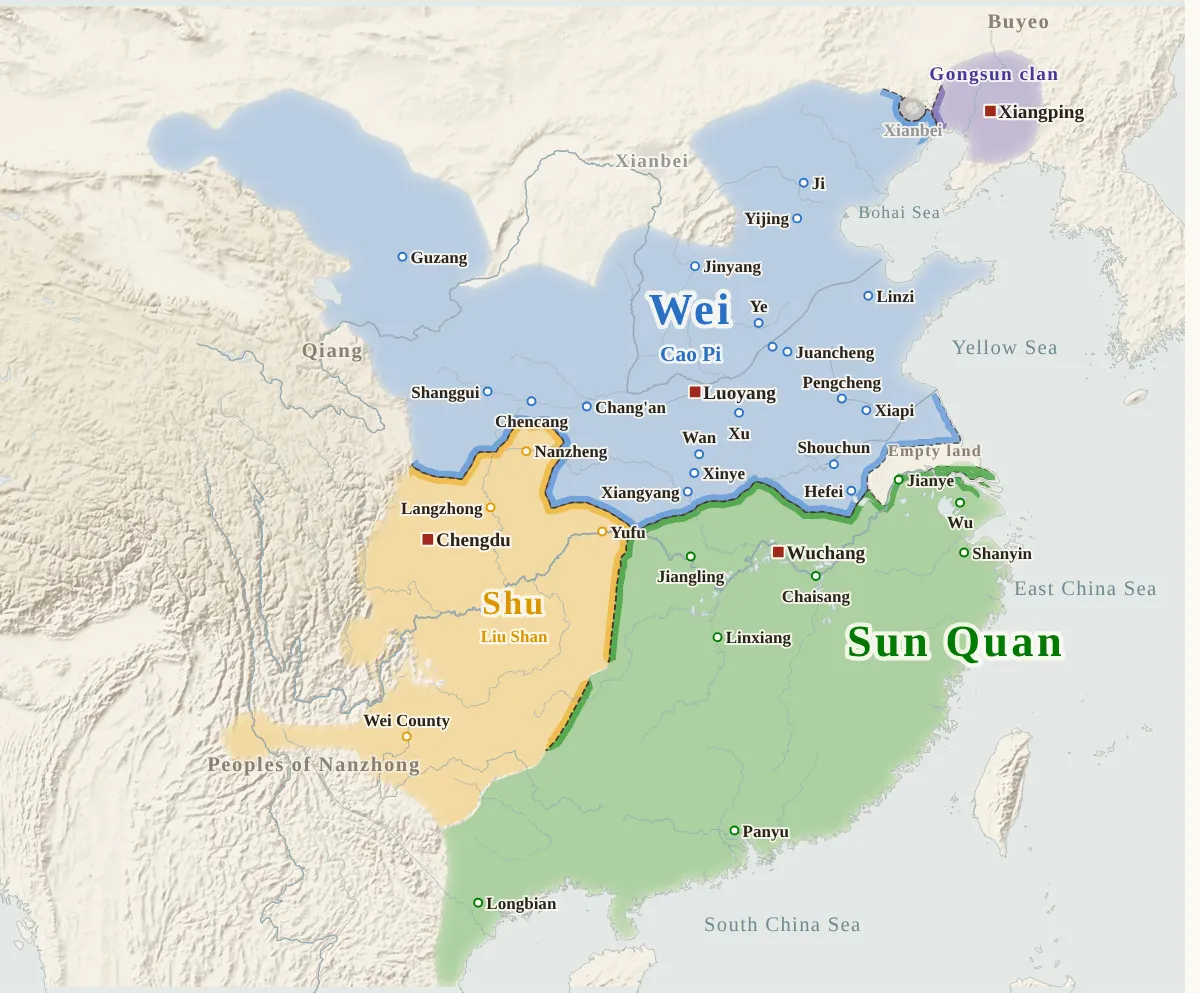
Emperors of the Cao Wei dynasty 魏
The emperors of Cao Wei (220–266) in order of accession, from Cao Pi to Cao Huan.
- Emperors
- 5 emperors
Emperors in order
- 1stCao Pi魏文帝 Wèi Wéndì曹丕 Cáo Pī220–226 · 5 years · Natural causes, age 38–39220–2265 yearsNatural causes, age 38–39
- 2ndCao Rui魏明帝 Wèi Míngdì曹叡 Cáo Ruì226–239 · 12 years · Natural causes, age 34–35226–23912 yearsNatural causes, age 34–35
- 3rdCao Fang曹芳 Cáo Fāng239–254 · 15 years · Unknown, age 41–42239–25415 yearsUnknown, age 41–42
- 4thCao Mao曹髦 Cáo Máo254–260 · 5 years · Assassinated, age 18–19254–2605 yearsAssassinated, age 18–19
- 5thCao Huan魏元帝 Wèi Yuándì曹奐 Cáo Huàn260–266 · 5 years · Unknown260–2665 yearsUnknown
Rise and fall of the Cao Wei dynasty
Rise
Cao Cao, who had been chancellor of the Eastern Han, was enfeoffed in 213 as Duke of Wei, ruling 10 commanderies of Ji Province, and set up the altars of soil and grain and the ancestral temple of Wei, and in 216 he became King of Wei. When Cao Cao died in 220, his son Cao Pi succeeded him as King of Wei; the same year he received the throne from Emperor Xian of Han of the Eastern Han and took the throne on the altar at Fanyang, and early in 221 he moved to Luoyang.
Course
Under Cao Pi as King of Wei, the nine-rank system for appointing officials was established on the proposal of Chen Qun, and after taking the throne Cao Pi forbade officials to report on government to the empress dowager and the families of empresses to assist in government. When Zhuge Liang of Shu Han invaded in the reign of Cao Rui, Zhang He defeated Ma Su, who led the Shu Han vanguard, at Jieting in 228, and in 234 Zhuge Liang, who had been facing Sima Yi, died and the Shu Han army withdrew. In 238 Sima Yi attacked and killed Gongsun Yuan of Liaodong.
In 239, on his deathbed, Cao Rui entrusted Cao Shuang and Sima Yi with assisting the young Cao Fang. In 249, while Cao Fang was visiting the Gaoping Tomb, Sima Yi moved troops, and Cao Shuang and others were put to death along with their three sets of kin. In 254 the General-in-Chief Sima Shi informed the empress dowager and deposed Cao Fang, and Cao Mao, who was set up next, was stabbed to death by Cheng Ji in 260 when he went out to attack the General-in-Chief Sima Zhao in person.
Fall
In 263, in the reign of Cao Huan, Shu Han surrendered to the expedition of Deng Ai and Zhong Hui. When Sima Zhao died in 265 and his son, Emperor Wu of Jin, succeeded him as King of Jin, Cao Huan issued an edict early in 266 to have an altar set up in the southern suburb, and had the imperial seals presented by envoy and yielded the throne to Emperor Wu of Jin. The Western Jin enfeoffed Cao Huan as King of Chenliu, had him live in the palace at Ye, and allowed him to fly the banners of the Son of Heaven and use the Wei calendar.
Translated from the Japanese text of this site, which is written from the official histories. Years are the Western calendar years of the dates, as in English reference works.