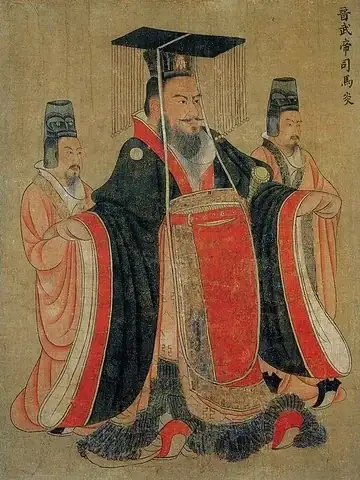
In brief
The annals record that he was generous and large-minded, accepted blunt words, and never changed countenance before anyone. The decree at the end of the annals praises his generosity, but criticizes him for not removing Liu Yuan, so that the realm was thrown into disorder, and for not deposing Emperor Hui of Jin, so that the foundations of the state were overturned.
Road to the throne
He was the eldest son of Sima Zhao, and his courtesy name was Anshi. His father favored his younger brother Sima You, but He Zeng and others fought hard, and Sima Yan was settled on as heir. In 265 he became heir apparent of the Prince of Jin, and when his father died the same year he succeeded as Prince of Jin. Early the next year he received the throne from the emperor of Cao Wei and changed the era name.
Reign and death
In 269, when the officials sought the death penalty for a man who had slandered him, he said that it was his own fault and pardoned him. In 272, when someone sought the punishment of the minister who had argued with him, he dismissed that man from office instead. According to the biographies of empresses and consorts, he wanted Wei Guan's daughter as the crown prince's consort and opposed Jia Chong's daughter as having five failings such as jealousy, but Empress Yang pleaded firmly and Xun Yi and others also recommended her, and so it was settled. In 274, on her deathbed, Empress Yang laid her head on the knee of Emperor Wu of Jin and asked that her uncle Yang Jun's daughter be brought into the inner palace, and Emperor Wu wept and consented. In 279 he attacked Wu with more than two hundred thousand troops, and in 280, when Wang Jun's fleet reached Shitou, Sun Hao surrendered. According to the biography of Consort Hu, after the conquest of Wu Emperor Wu added several thousand of Sun Hao's palace women, so that the inner palace came to nearly ten thousand, and he rode in a cart drawn by a sheep and spent the night wherever the sheep stopped. According to the biography of Liu Yi, after the conquest of Wu he asked Liu Yi which Han emperor he could be compared to, and Liu Yi answered that he did not quite come up to Emperor Huan and Emperor Ling, for they put the money from selling offices into the public treasury, while His Majesty put it into his own house. Emperor Wu laughed heartily and said that the difference was that he now had straightforward ministers. According to the biography of Wei Guan, while Emperor Hui of Jin was crown prince, Wei Guan pretended to be drunk and stroked Emperor Wu's seat, saying that it was a pity about that seat and hinting at the deposition of the crown prince, but Emperor Wu, though he understood, put him off by asking whether he was really drunk. The annals record near the end that when the realm was at peace he neglected government, gave himself up to feasting, and favored the empress's family. According to the biography of Sima You, Prince of Qi, in his late years, when the court ministers inclined toward his younger brother Sima You, he believed Xun Xu and others and sent You out to his principality, and the physicians, reading his wishes, said that there was no illness. You died vomiting blood, and Emperor Wu wept bitterly, but when told that it was good fortune for the state he stopped crying. The annals hold that, relying on the intelligence of his imperial grandson, he had no thought of deposing the crown prince. According to the annals, when his illness eased for a time an edict was issued appointing Sima Liang, Prince of Ru'nan, as regent, but Yang Jun suppressed it, and when his mind clouded again the empress, Yang Jun's daughter, drew up an edict appointing Yang Jun regent. The annals hold that the troubles began here. Emperor Wu died at the Hanzhang Hall in 290 and was given the temple name Shizu.
Translated from the Japanese text of this site, which is written from the official histories. Years are the Western calendar years of the dates, as in English reference works. Months are omitted because the histories use the Chinese lunar calendar.