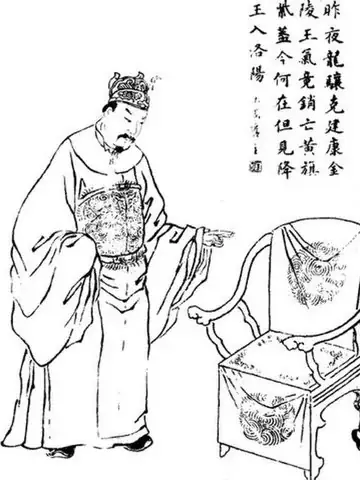
Road to the throne
A grandson of Sun Quan and a son of Sun He, he was named Pengzu by a delighted Sun Quan at his birth, and under Sun Xiu he was made Marquis of Wucheng. When Sun Xiu died in 264, with Shu Han destroyed and Jiaozhi in revolt, an older ruler was sought; Wan Yu recommended Sun Hao, and Puyang Xing and Zhang Bu won over Empress Dowager Zhu and then brought him in and enthroned him. According to the Jiangbiao Zhuan, early in his reign he opened the granaries to relieve the poor and gave palace women to men who had no wives, and he was called an enlightened ruler.
Reign and death
He soon became violent and fond of wine and women, and within the year of his accession, acting on slander, he killed Puyang Xing and Zhang Bu, who had come to regret enthroning him. The next year he drove Sun Xiu's empress, Lady Zhu, to her death and killed the two eldest of Sun Xiu's sons. In 271 he set out for Huali with a great army, taking his mother and his consorts; the main text says he turned back because of strong remonstrances from Hua He and others, while the Jiangbiao Zhuan says he turned back after hearing the soldiers tell one another that they would turn their spears around if they met the enemy. In 273 he had Chen Sheng, a favored official who had enforced the law against the agents of one of his favorite concubines, killed on another pretext by cutting off his head with a heated saw. At banquets he got his ministers blind drunk and punished their lapses, he also used punishments such as flaying people's faces and gouging out their eyes, and those above and below became estranged. In 280, as the Western Jin armies closed in, he killed his favorite Cen Hun at the demand of several hundred of his close attendants, and surrendered to Wang Jun, who was the first to arrive. According to the Jiangbiao Zhuan, before surrendering he wrote to his maternal uncle that it was not Heaven that was destroying Wu but he himself who had brought it on, yet in a letter to his ministers he also said that he had failed to notice the cruelty of the petty men around him. He was moved west with his whole family and granted the title Marquis of Guiming. According to the Zizhi Tongjian, at a court audience after the surrender Emperor Wu of Jin said that he had set out this seat and waited for him, and Sun Hao replied that he too had set out the same seat in the south and waited for His Majesty. According to the same work, when Jia Chong asked him about the punishment of flaying faces, he replied that he had inflicted it only on subjects who had murdered their lords and on the disloyal, and he showed no shame. The main text of the Records of the Three Kingdoms says only that he died in Luoyang in the fifth year of Taikang, while the Wu Lu cited in Pei Songzhi's commentary places his death at the end of the fourth year of Taikang.
Translated from the Japanese text of this site, which is written from the official histories. Years are the Western calendar years of the dates, as in English reference works. Months are omitted because the histories use the Chinese lunar calendar.