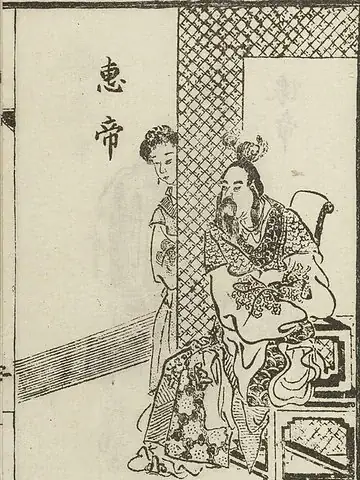
Road to the throne
He was a son of Emperor Wu of Jin and of Yang Yan, who later became empress, and in 267 he was made crown prince. When Emperor Wu said that the crown prince was unequal to carrying on the great succession, Empress Yang answered that a legitimate son is set up by seniority and not by worthiness, and when He Jiao said that he feared the crown prince could not carry out His Majesty's family affairs, Emperor Wu said nothing. Earlier, Emperor Wu had thought of Wei Guan's daughter for the crown prince's consort, but Empress Yang, having taken a bribe from Jia Chong's wife, favored Jia Chong's daughter, and it was settled. When Emperor Wu sent business of the Imperial Secretariat to the Eastern Palace for the crown prince to decide, the crown prince could not answer, and Consort Jia had Zhang Hong draft a reply for him to copy out, so that the crown prince kept his position. On the day Emperor Wu died in 290 he took the throne and made Consort Jia empress.
Reign and death
The next year Grand Tutor Yang Jun was put to death, and Empress Jia forged an edict to depose Yang Jun's daughter, the empress dowager Yang Zhi, and had Sima Wei, Prince of Chu, kill Sima Liang, Prince of Ru'nan, and Wei Guan. When the crown prince Sima Yu was deposed, Empress Jia forged an edict and killed him, but she was soon deposed by Sima Lun, Prince of Zhao, and others. In 301 Sima Lun, Prince of Zhao, seized the throne and made him retired emperor, and after Sima Jiong, Prince of Qi, and others raised troops and Sima Lun's partisans were beheaded, the emperor returned to the throne the same day and told the ministers who bowed in apology that it was not their fault. In 304 he was brought out to campaign against Sima Ying, Prince of Chengdu, and was defeated at Dangyin, where his cheek was wounded and the imperial seals lost; when the blood of Ji Shao, killed at his side, spattered on his robe, he later said that this was the blood of Palace Attendant Ji and must not be removed. The same year, when Zhang Fang drove his carriage into the palace hall, the emperor fled into the bamboo grove but was carried off to Chang'an. The Book of Jin records that when the people were starving he asked why they did not eat meat porridge, and that when he heard frogs croaking he asked whether the croaking was for the public or for the private. In 306 the generals of Sima Yue, Prince of Donghai, defeated the army of Sima Yong, Prince of Hejian, and Emperor Hui of Jin returned to Luoyang in an ox cart, but early in 307 he died at the Xianyang Hall. The annals in the Book of Jin say that he died of poisoning after eating cakes and also record that Sima Yue is said to have poisoned him, while the Zizhi Tongjian records only the poisoning and Hu Sanxing's commentary adds the theory that he was poisoned to death.
Translated from the Japanese text of this site, which is written from the official histories. Years are the Western calendar years of the dates, as in English reference works. Months are omitted because the histories use the Chinese lunar calendar.