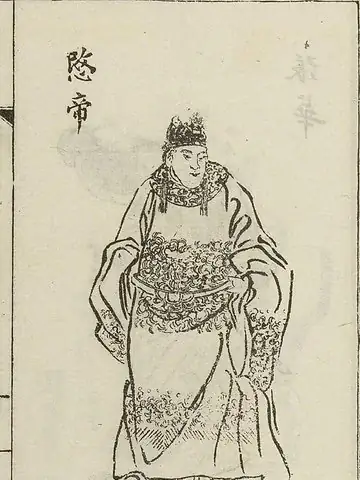
In brief
The annals of Emperor Min in the Book of Jin conclude that, because the princes and the regional commanders had no will to come to his rescue, ruler and ministers were driven into desperate straits and ended up killed and humiliated.
Road to the throne
A grandson of Emperor Wu of Jin, he was the son of Sima Yan, whom his biography in the Book of Jin calls the least talented of Emperor Wu's sons, and he succeeded his uncle as Prince of Qin. His father was killed when Luoyang fell, and he, escorted by Yan Ding and met by Jia Ya's troops, entered Chang'an, where he was proclaimed crown prince in 312. The next year, on news of the death of Emperor Huai of Jin, he took the throne, but Chang'an had fewer than a hundred households, and there were only four carriages, public and private.
Reign and death
In the year of his accession, edicts ordered troops from across the realm to march to Pingyang, Chang'an and Luoyang and said that he would set out in person once word came from the Prince of Langya, but all of this was only the language of the edicts. Later, in an edict to Suo Chen, he said that it was thanks to him that the state had not perished, and entrusted him with all military and state affairs. In 315 he had the remaining treasures from the looted Han tombs placed in the palace treasury, and later had the tombs repaired. According to the biography of Suo Chen, when he asked why the Han tombs held so much treasure, Suo Chen replied that a third of the tribute and taxes had been devoted to the tombs. In 316 Liu Yao closed in on Chang'an, and in a great famine that winter Qu Yun served gruel made from crushed yeast cakes, but that too ran out. Weeping, he told Qu Yun that dying for the state was his own duty but that he wished to spare the people the suffering of slaughter, and he decided to surrender. The biography of Qu Yun and the Zizhi Tongjian also record him lamenting that it was the two lords Qu and Suo who had ruined his cause, but this line is not among his words in the annals. He surrendered riding in a goat-drawn carriage with his upper body bared, and at Pingyang he was made Marquis of Huai'an. Qu Yun killed himself on the spot according to the annals, and after being held in prison according to the biography of Qu Yun and the Zizhi Tongjian. In the winter of 317, Liu Cong made him lead the way holding a halberd on a hunt, and resented it when some of the elders among the onlookers wept. When his son Liu Can urged that Emperor Min be done away with, Liu Cong agreed according to the chronicle of Liu Cong in the Book of Jin, but put it off for the time being according to the Zizhi Tongjian. Liu Cong also had him pour wine at a banquet, and killed Xin Bin, who held Emperor Min in his arms and wailed. Early in 318 he was killed at Pingyang, but the annals and the Zizhi Tongjian record neither who did it nor how, and the chronicle of Liu Cong does not record the killing at all.
Translated from the Japanese text of this site, which is written from the official histories. Years are the Western calendar years of the dates, as in English reference works. Months are omitted because the histories use the Chinese lunar calendar.