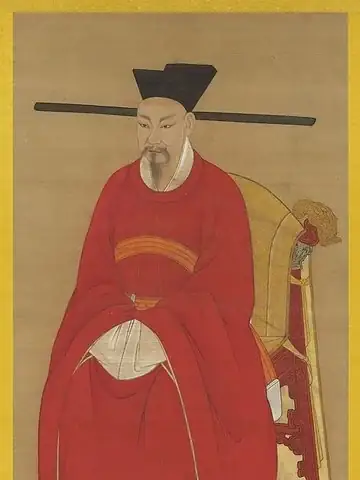
Road to the throne
Looking for an heir for the Prince of Yi, Shi Miyuan judged that Yuju, the elder of two brothers whom the tutor of his family school had met while sheltering from rain, was the one destined for the greatest eminence, and in 1221 Yuju became heir to the Prince of Yi. Lizong was grave and spoke little, loved learning, and kept a solemn bearing alone even when those around him were chatting and laughing. In 1224 Shi Miyuan, who was at odds with the imperial son Zhao Hong, claimed an edict to make Lizong an imperial son when Ningzong's illness grew grave, and when Ningzong died he had Yang Gu and others persuade Empress Yang, sent Zhao Hong away from the capital, and had Lizong succeed to the throne.
Reign and death
In 1225 Zhao Hong, whom Pan Ren and others in Huzhou had taken up as their candidate, reported to the court and led the prefectural troops against the rebels, but Shi Miyuan sent a retainer disguised as a physician and drove Zhao Hong to his death. Shi Miyuan died in 1233, and the biography of Zheng Qingzhi says that the following year Lizong decided affairs alone with commanding force. In 1234, after the Jin fell, troops were sent to recover the three capitals and were defeated; the annals record a memorial by Zhao Fan blaming the rashness of Zhao Kui and others, the biography of Zhao Kui says that Zhao Fan impeached Zhao Kui, and the biography of Jia Sidao lays the blame on Zhao Fan's plan. According to the biography of Xu Qiao, when Lizong, seeing Xu Qiao's soiled and tattered clothing, said that he was poor but upright, Xu Qiao replied that it was His Majesty who was poor, and Lizong was so moved that the next day he had wasteful expenses cut. According to the biography of Jia Sidao, as Lizong's reign grew long, the eunuch Dong Songchen and others amassed wealth for him to win his favor and brought in actors and puppets for his banquets and amusements, and when censorial officials remonstrated, Lizong had them removed. In 1259, when the Mongol army crossed the Yangtze, a proposal to move the capital arose; the biography of Empress Xie says that Lizong raised it and the empress stopped it, while the biographies of Dong Songchen and Wen Tianxiang say that Dong Songchen urged it. According to the biography of Liu Yinglong, when the chief minister Wu Qian, with whom Lizong was already displeased for objecting to the choice of an imperial son, urged him to move the court and said that he himself would defend the capital to the death, Lizong wept and asked whether he meant to be a Zhang Bangchang, and when the enemy troops withdrew he dismissed Wu Qian. Jia Sidao later reported that the siege of Ezhou had been lifted, but according to his biography he had secretly offered peace as a subject and been rebuffed, and after the death of Möngke had obtained peace by agreeing to annual payments. He died of illness in 1264. The appraisal in his annals criticizes Lizong for growing indulgent in his desires and neglecting affairs of state from middle age on, and Shi Miyuan, Jia Sidao and others for wielding power at will.
Translated from the Japanese text of this site, which is written from the official histories. Years are the Western calendar years of the dates, as in English reference works. Months are omitted because the histories use the Chinese lunar calendar.