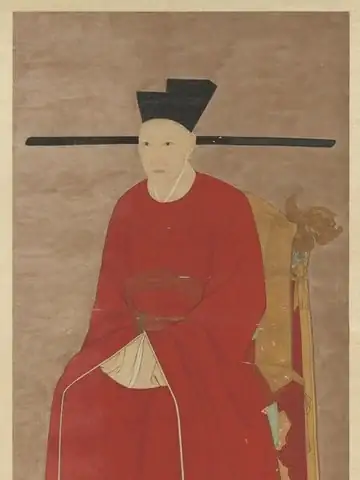
Road to the throne
He was the ninth son of Emperor Huizong of Song, and his mother was Empress Xianren of the Wei clan; he was born in 1107 and was enfeoffed as the Prince of Kang in 1122. In 1127 the Jin set Zhang Bangchang up as emperor and had him name his state Great Chu, and carried Emperor Huizong of Song and Emperor Qinzong of Song off to the north. The same year the Prince of Kang ascended the altar at Yingtianfu, thanked the two emperors in the north from afar, took the throne, and changed the era name to Jianyan.
Reign and death
An edict after he took the throne said that he alone would remain in the Central Plains and fight a decisive battle with the Jin, but a handwritten edict three days later said that he would make a progress to the southeast. The same year, the annals write that he used the proposal of Huang Qianshan and killed Chen Dong, a student of the Imperial University who had submitted a memorial, and Ouyang Che; the biography of Chen Dong says that Huang Qianshan angered Gaozong and killed the two, and in 1129 Gaozong granted the two men offices. In 1129, on receiving word that Jin troops had come, he put on armor and rode at a gallop to Zhenjiang, and issued an edict reproaching himself. The same year the rebellion of Miao Fu and Liu Zhengyan forced him off the throne for a time. In 1130 he was pleased that Qin Hui, who had returned from the Jin, surpassed other men in plain loyalty, and employed him. In 1138 he moved to Lin'an; late in 1141 a peace with the Jin was concluded, with the Huai River as the border and an agreement to pay silver and silk every year; and according to the History of Jin, in 1142 the Jin invested Gaozong as emperor and made the Song its vassal (the Shaoxing peace). Early in 1142 he granted Yue Fei death; the biography of Yue Fei records that Qin Hui had the prison report the death; and its discussion comments that Gaozong, who could bear to abandon the Central Plains, could also bear to kill Yue Fei. Later that year he went in person to Linping to welcome his mother, Empress Dowager Wei, who was returning from the Jin, and wept for joy the moment he met her. According to the Jianyan Yilai Xinian Yaolu and the Xu Zizhi Tongjian, when the Jin army defeated Wang Quan in 1161, Gaozong proposed disbanding the officials and fleeing to the sea; Chen Kangbo opposed it, and when Yang Cunzhong asked to fight to the death, Gaozong was pleased and decided to lead a campaign in person. The biography of Chen Kangbo in the History of Song says that Chen Kangbo burned a handwritten edict ordering the officials to be disbanded if the enemy did not withdraw. Having no heir, he yielded the throne in 1162 to the Prince of Jian, chosen from among the descendants of Emperor Taizu of Song, and retired to the Deshou Palace. He died at the Deshou Hall in 1187. The appraisal in the History of Song says that he had more than enough for continuing the succession and preserving the inherited order, but had no talent for quelling disorder, and laments that he sought ease and bore disgrace.
Translated from the Japanese text of this site, which is written from the official histories. Years are the Western calendar years of the dates, as in English reference works. Months are omitted because the histories use the Chinese lunar calendar.