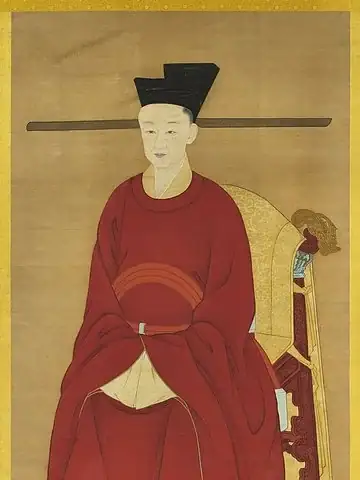
Road to the throne
An eleventh-generation descendant of Emperor Taizu of Song, he was the son of Yurui, the succeeding Prince of Rong and a younger brother of Lizong by the same mother, and he was born in 1240 at the Rong princely residence in Shaoxing. Lizong, who had no son, decided to entrust the throne to him, made him an imperial son in 1253, and set him up as crown prince in 1260. According to the annals, Lizong's instruction of his family was strict: each day Duzong was questioned on the classic he had been taught, and if he still did not understand it, he had to have the lecture again the next day. When Lizong died in 1264, Duzong took the throne under the testamentary edict.
Reign and death
According to the biography of Jiang Wanli, soon after Duzong took the throne, when Jia Sidao hinted that he would resign, Duzong called him Teacher Chancellor and bowed to him in tears, until Jiang Wanli held him up. Duzong returned the bow of Jia, who had put him on the throne, at every audience and called him Teacher Minister. In 1267 Duzong made Jia Grand Preceptor and Pingzhang Junguo Zhongshi, having him attend the classics lectures three times a month, come to court once every three days, and handle affairs in the Dutang. From 1270 Duzong no longer had Jia bow when he entered court, and when Jia withdrew, Duzong rose from his seat to see him off. In 1268 the Yuan army built Baihe Fort, and the siege of Xiangyang and Fancheng began. The Songji Sanchao Zhengyao and the Xu Zizhi Tongjian record that when Duzong asked Jia about the siege of Xiangyang, Jia answered that the northern troops had already withdrawn, and had the palace consort who had told Duzong framed on another charge and ordered to die, but the History of Song does not have this story. In 1273 Fancheng fell, and Lü Wenhuan surrendered Xiangyang to the Yuan. Jia was slow to report it, and around that time his requests to lead the army in person were refused. The biography of Jia Sidao in the History of Song and the Xu Zizhi Tongjian write that each time Jia made such a request he secretly had the censors petition to keep him at court, and the Xu Zizhi Tongjian adds that Duzong said the Teacher Chancellor must not leave his side. Duzong issued an edict lamenting that Xiangyang, held for six years, had been lost all at once. He died in the Funing Hall in 1274, and the next day the palace physician Cai Youxi was impeached and sent to live in a prefecture 500 li away. The annals of the History of Song do not give a cause of death, while the Songji Sanchao Zhengyao writes that after his accession he indulged in wine and women, and that illness kept him from presiding over the palace examination before he died. The appraisal in the History of Song says that, although he had no great failings of virtue, he left the government to a powerful and treacherous minister and the state declined, and it concludes that it was fortunate the state did not fall in his own reign.
Translated from the Japanese text of this site, which is written from the official histories. Years are the Western calendar years of the dates, as in English reference works. Months are omitted because the histories use the Chinese lunar calendar.