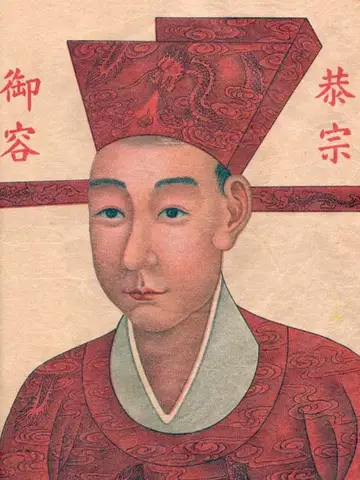
Road to the throne
He was a son of Emperor Duzong of Song, and his mother was Empress Quan. In 1271 he was born in the palace at Lin'an. In 1274, when Duzong died, he took the throne before the coffin by the late emperor's testamentary edict. The biography of Empress Xie records that Grand Empress Dowager Xie, pressed by the ministers, only then agreed to sit behind the curtain and hear affairs of state. The annals of the History of Song say he took the throne by testamentary edict, but its account of the two princes says that after Duzong died Empress Dowager Xie summoned Jia Sidao and others to the palace to decide whom to enthrone, and that when the others held that the elder Zhao Shi should be set up, Sidao rejected this and had the legitimate son set up.
Reign and death
According to the biography of Yang Wenzhong, when there was a proposal to have the Mingtang sacrifice performed on the emperor's behalf, Yang Wenzhong argued that although the emperor was young, he had borne the kneeling and bowing of mourning without erring in the rites, so he should perform the sacrifice himself. In 1275 Sun Huchen suffered a great defeat at the hands of the Yuan army at Dingjiazhou and fled with Jia Sidao to Yangzhou in a small boat, and the armies collapsed. Chen Yizhong asked for Jia Sidao to be put to death, but according to the biography of Empress Xie and the biography of Jia Sidao, the Grand Empress Dowager held that Sidao was a minister who had labored in three reigns, and only had him removed from the posts of Pingzhang and Dudu; Sidao was later killed at Zhangzhou by Zheng Hucheng, the officer escorting him to the place of exile. According to the biography of Bayan in the History of Yuan, to the envoy who sought peace Bayan answered that the Song had taken the realm from the hands of a child and would lose it at the hands of a child. In 1276, when the proposals of the envoys seeking peace were both refused, the Grand Empress Dowager ordered that the rites of a subject be used. According to the biography of Empress Xie, when Chen Yizhong was reluctant to go as envoy to the Yuan army, the Grand Empress Dowager wept and said that if the state could be preserved, being a subject was not something to weigh. When the Yuan army reached Gaoting Mountain, the Song surrendered and presented the imperial seal of succession, and the surrender memorial in the emperor's name said that he had met with many troubles of his house while young and that Jia Sidao had ruined the state. That night the chancellor Chen Yizhong fled, and Zhang Shijie and others also left with their troops. According to the annals of Shizu in the History of Yuan, as the emperor and his mother were about to leave the palace, Empress Dowager Quan wept and told him that the Son of Heaven's compassion had kept him alive, so he should bow in thanks. In the same year he had audience at Shangdu and was made the Duke of Ying, while at Fuzhou Chen Yizhong and others set up his elder brother, Emperor Duanzong of Song. In 1288 it was decided that he would study the Buddhist law in Tubo, and in an entry for 1291 he and his mother had already become a monk and a nun. The Buddhist historical work Fozu Lidai Tongzai records that in 1323 he was ordered to die at Hexi. Neither the annals of the History of Song nor the History of Yuan records his death, and the History of Yuan only treats him as a man already dead in an entry for 1330.
Translated from the Japanese text of this site, which is written from the official histories. Years are the Western calendar years of the dates, as in English reference works. Months are omitted because the histories use the Chinese lunar calendar.