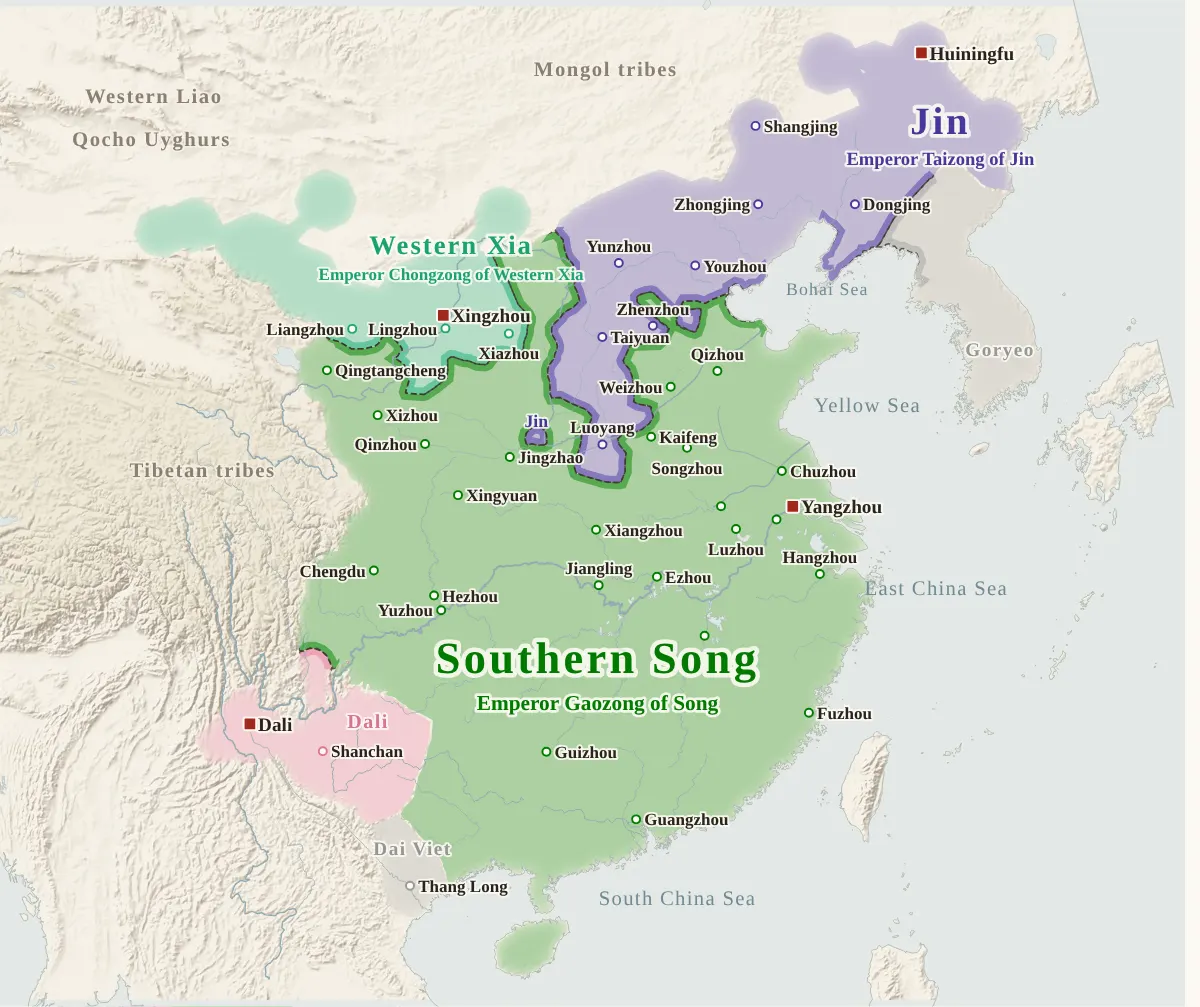
Emperors of the Southern Song dynasty 宋
The emperors of Southern Song (1127–1279) in order of accession, from Emperor Gaozong of Song to Zhao Bing.
- Emperors
- 9 emperors
Emperors in order
- 1st, 2ndEmperor Gaozong of Song宋高宗 Sòng Gāozōng趙構 Zhào Gòu1127–1129; restored 1129–1162 · 35 years · Natural causes, age 801127–1129; restored 1129–116235 yearsNatural causes, age 80
- 3rdEmperor Xiaozong of Song宋孝宗 Sòng Xiàozōng趙眘 Zhào Shèn1162–1189 · 26 years · Natural causes, age 661162–118926 yearsNatural causes, age 66
- 4thEmperor Guangzong of Song宋光宗 Sòng Guāngzōng趙惇 Zhào Dūn1189–1194 · 5 years · Natural causes, age 521189–11945 yearsNatural causes, age 52
- 5thEmperor Ningzong of Song宋寧宗 Sòng Níngzōng趙擴 Zhào Kuò1194–1224 · 30 years · Disputed, age 551194–122430 yearsDisputed, age 55
- 6thEmperor Lizong of Song宋理宗 Sòng Lǐzōng趙昀 Zhào Yún1224–1264 · 40 years · Natural causes, age 591224–126440 yearsNatural causes, age 59
- 7thEmperor Duzong of Song宋度宗 Sòng Dùzōng趙禥 Zhào Qí1264–1274 · 9 years · Natural causes, age 341264–12749 yearsNatural causes, age 34
- 8thEmperor Gong of Song宋恭帝 Sòng Gōngdì趙㬎 Zhào Xiǎn1274–1276 · 1 year · Disputed1274–12761 yearDisputed
- 9thEmperor Duanzong of Song宋端宗 Sòng Duānzōng趙昰 Zhào Shì1276–1278 · 1 year · Natural causes, age 81276–12781 yearNatural causes, age 8
- 10thZhao Bing宋衛王 Sòng Wèiwáng趙昺 Zhào Bǐng1278–1279 · 313 days · Suicide (incl. forced), age 71278–1279313 daysSuicide (incl. forced), age 7
Rise and fall of the Southern Song dynasty
Rise
In 1127 the Jin, having taken Kaifeng, set up Zhang Bangchang as emperor under the name of the Great Chu and carried Emperor Huizong of Song and Emperor Qinzong of Song off to the north. Empress Yuanyou, whom Zhang Bangchang had honoured as Empress Dowager of Song, announced in a letter in her own hand that Prince Kang would carry on the imperial line, and the same year Prince Kang, Emperor Gaozong of Song, the ninth son of Huizong, took the throne at Yingtian Prefecture and changed the era name to Jianyan.
Course
Within the year of his accession Gaozong moved to Yangzhou, and in 1129 the revolt of Miao Fu and Liu Zhengyan forced him to give up the throne, but he was restored the next month. In 1138 Gaozong moved from Jiankang to Lin'an, and that year the Southern Song for the first time fixed its capital at Hang. The Southern Song made peace with the Jin on terms that set the border at the Huai River and bound it to send the Jin two hundred and fifty thousand each of silver and silk every year, and early in 1142 Gaozong bestowed death on Yue Fei. Gaozong had no heir, and in 1162 he gave up the throne to Emperor Xiaozong of Song, whom he had chosen from among the descendants of Emperor Taizu of Song.
In 1163, in the reign of Xiaozong, the Southern Song sent out troops on a northern expedition, but they collapsed at Fuli, and later the terms of a peace were settled under which the Southern Song and the Jin became states of uncle and nephew and the annual payments were reduced. In 1194, as Emperor Guangzong of Song was ill and could not conduct the mourning for Xiaozong, Zhao Ruyu and others petitioned the grand empress dowager, and Prince Jia, Emperor Ningzong of Song, took the throne in his place. In 1206 Ningzong issued an edict to attack the Jin, and the next year Shi Miyuan and others, acting on a secret decree, had Han Tuozhou killed; in 1208 the Southern Song made peace with the Jin, sending Han Tuozhou's head in a box. When Ningzong died in 1224, Shi Miyuan sent Yang Gu and others in to Empress Yang, set aside the imperial son Zhao Hong, and had Emperor Lizong of Song succeed to the throne.
In 1233 the Southern Song supplied troops and grain for the Mongol attack on Caizhou, and after the Jin fell the next year the Southern Song set out to recover the three former capitals, but the army sent toward the Western Capital was defeated. In 1259, when the Mongol army crossed the Yangtze and besieged Ezhou, Jia Sidao secretly offered submission as a subject and annual payments. In 1267 Emperor Duzong of Song made Jia Sidao Grand Preceptor and Manager of Important Military and State Affairs and had him conduct government business at the Dutang, but from the next year the Mongol army besieged Xiangyang and Fancheng, and in 1273 Fancheng fell and Xiangyang also surrendered to the Yuan.
Fall
In 1275 Sun Huchen suffered a great defeat against the Yuan army at Dingjiazhou and the armies collapsed, and the next year the Southern Song surrendered to the Yuan, presenting the Heirloom Seal of the Realm, and Emperor Gong of Song was made Duke of Ying at Shangdu. The same year Chen Yizhong and others set up Emperor Duanzong of Song, the elder brother of Emperor Gong, at Fuzhou, but Duanzong kept moving from place to place at sea and died at Gangzhou in 1278. Lu Xiufu and others set up Duanzong's younger brother, the Prince of Wei, Zhao Bing, and moved to Yashan, but in 1279 they were defeated by the army of Zhang Hongfan, and Lu Xiufu threw himself into the sea with Zhao Bing on his back, and the Southern Song came to an end.
Translated from the Japanese text of this site, which is written from the official histories. Years are the Western calendar years of the dates, as in English reference works.