Emperors of the Northern Song dynasty 宋
The emperors of Northern Song (960–1127) in order of accession, from Emperor Taizu of Song to Emperor Qinzong of Song.
- Emperors
- 9 emperors
Emperors in order
- 1stEmperor Taizu of Song宋太祖 Sòng Tàizǔ趙匡胤 Zhào Kuāngyìn960–976 · 16 years · Disputed, age 48–49960–97616 yearsDisputed, age 48–49
- 2ndEmperor Taizong of Song宋太宗 Sòng Tàizōng趙炅 Zhào Jiǒng976–997 · 20 years · Natural causes, age 57976–99720 yearsNatural causes, age 57
- 3rdEmperor Zhenzong of Song宋真宗 Sòng Zhēnzōng趙恆 Zhào Héng997–1022 · 24 years · Natural causes, age 53997–102224 yearsNatural causes, age 53
- 4thEmperor Renzong of Song宋仁宗 Sòng Rénzōng趙禎 Zhào Zhēn1022–1063 · 41 years · Natural causes, age 521022–106341 yearsNatural causes, age 52
- 5thEmperor Yingzong of Song宋英宗 Sòng Yīngzōng趙曙 Zhào Shǔ1063–1067 · 3 years · Natural causes, age 341063–10673 yearsNatural causes, age 34
- 6thEmperor Shenzong of Song宋神宗 Sòng Shénzōng趙頊 Zhào Xū1067–1085 · 18 years · Natural causes, age 361067–108518 yearsNatural causes, age 36
- 7thEmperor Zhezong of Song宋哲宗 Sòng Zhézōng趙煦 Zhào Xù1085–1100 · 14 years · Natural causes, age 231085–110014 yearsNatural causes, age 23
- 8thEmperor Huizong of Song宋徽宗 Sòng Huīzōng趙佶 Zhào Jí1100–1126 · 25 years · Natural causes, age 521100–112625 yearsNatural causes, age 52
- 9thEmperor Qinzong of Song宋欽宗 Sòng Qīnzōng趙桓 Zhào Huán1126–1127 · 1 year · Natural causes, age 55–561126–11271 yearNatural causes, age 55–56
Rise and fall of the Northern Song dynasty
Rise
Emperor Taizu of Song, whom Chai Rong of the Later Zhou had made Chief Inspector of the Palace Command, had a yellow robe thrown over him by his generals in 960 at the Chenqiao post station, where he had stopped on campaign; he turned back to the capital and took the throne in the Chongyuan Hall. The Northern Song kept as its capital Kaifeng, which had been the capital of the Later Zhou.
Course
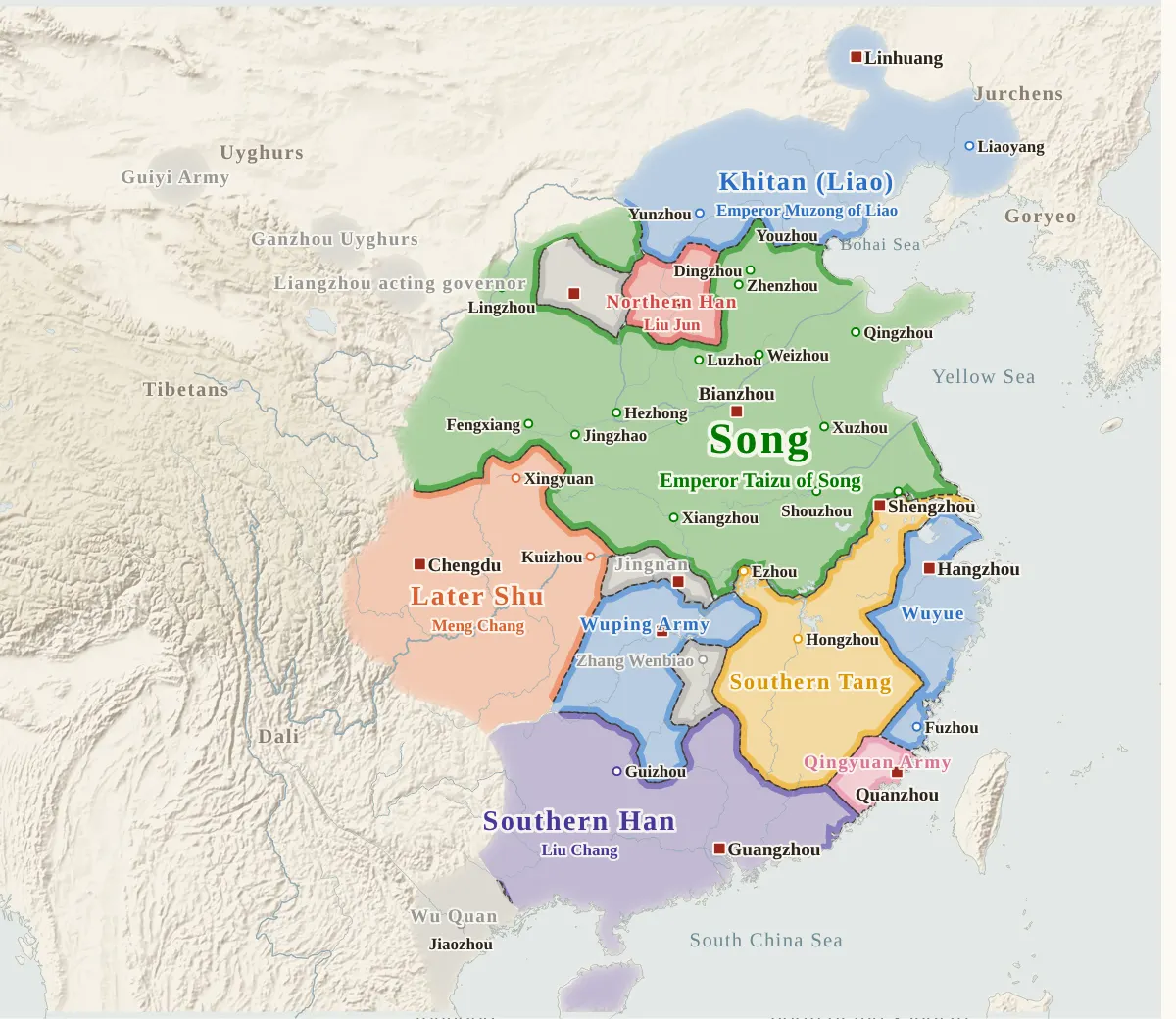
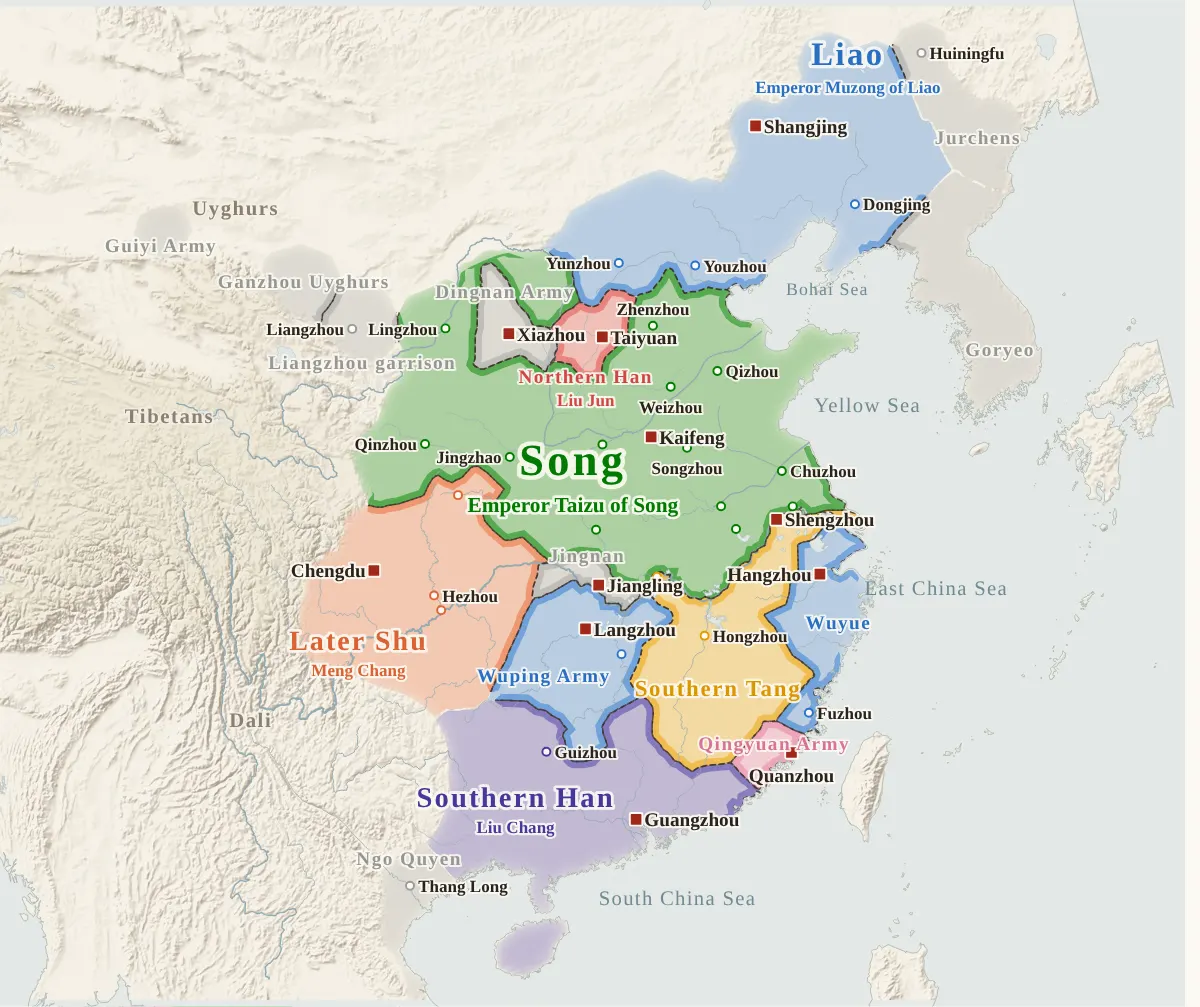
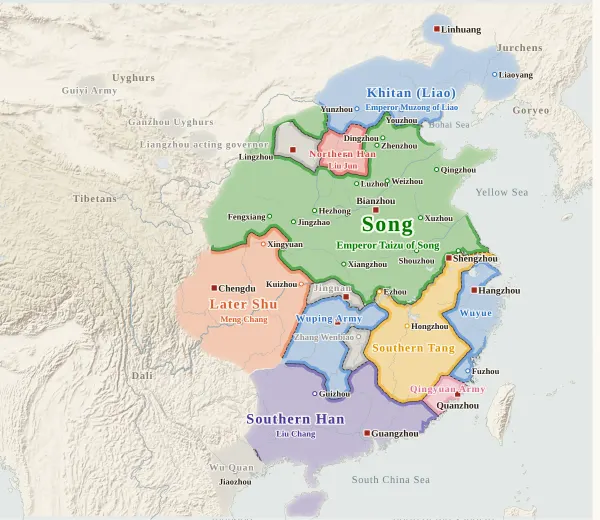
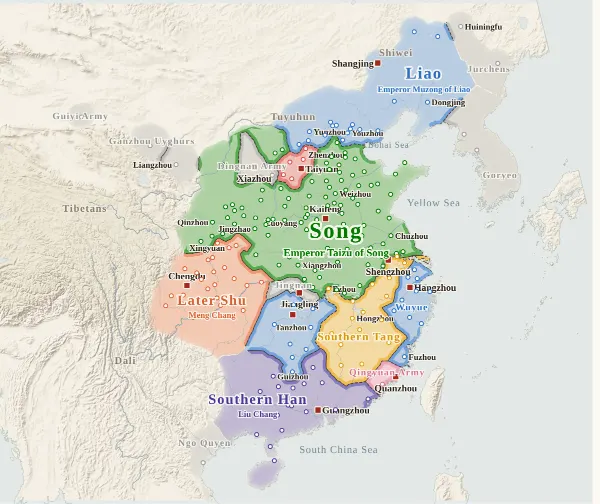
Taizu persuaded Shi Shouxin and others to give up their military commands, and he subdued Jingnan and Hunan in 963, the Later Shu in 965, the Southern Han in 971, and the Southern Tang in 976. When Taizu died in 976, his younger brother Emperor Taizong of Song succeeded to the throne in accordance with the command of Empress Dowager Du. In 979 Taizong brought the Northern Han to surrender, and in the same year he attacked Youzhou in person but was heavily defeated at the Gaoliang River. In the northern campaign of 986 as well, Cao Bin's army was heavily defeated at Qigou Pass.
When the Liao army came south in 1004, Emperor Zhenzong of Song, at the urging of Kou Zhun, went in person to Chanzhou early in 1005 and concluded a covenant to send silver and silk to the Liao every year. In 1008 a piece of yellow silk hanging on the Left Chengtian Gate was declared a heavenly text and the era was changed to Dazhong Xiangfu, and Zhenzong sacrificed to Heaven at Mount Tai. In the reign of Emperor Renzong of Song, Yuanhao rebelled against the Northern Song, and the Song armies were defeated at Yanzhou, Haoshuichuan and Dingchuan Fort, but in 1044 peace was made by enfeoffing Yuanhao as ruler of the state of Xia. In 1043 Renzong adopted the ten proposals of Fan Zhongyan and began reforms, but slander and talk of factions arose, and in 1045 Fan Zhongyan was dismissed.
In 1069 Emperor Shenzong of Song made Wang Anshi Canzhi Zhengshi and had him deliberate on the new policies. Wang Anshi was dismissed after the great drought of 1074, returned as chief minister the following year, and stepped down again in 1076. From 1081 the Northern Song attacked the Western Xia, but the following year the newly built city of Yongle was taken by a large Western Xia army. After Shenzong's death, while Emperor Zhezong of Song's grandmother, the grand empress dowager, directed the government, the green sprouts money was abolished, but in 1093 the grand empress dowager died and Zhezong began to rule in person, and the following year he made Zhang Dun chief minister and restored the hired-service law of the Yuanfeng era. In 1102 Emperor Huizong of Song made Cai Jing chief minister, and in the same year he took up the brush himself and had the names of former officials of the Yuanyou era and others carved at the Duanli Gate. Cai Jing had Zhu Mian present rare objects from Zhezhong, and the flotillas that carried them were called the Flower and Rock Convoys. In 1120 Fang La took up arms, taking advantage of the people suffering from the harm done by the flowers and rocks.
Fall
When the Jin armies invaded along two routes, Huizong abolished the Flower and Rock Convoys and yielded the throne to the crown prince, Emperor Qinzong of Song. In 1126 the Jin army that attacked Kaifeng withdrew on condition of the cession of three garrison towns and the handing over of hostages, but late in the same year it attacked again, and early in 1127 the capital fell. In 1127 the Jin set up Zhang Bangchang as emperor of Chu and carried Huizong and Qinzong off to the north together with Qinzong's empress and crown prince and others. In the same year the Prince of Kang, the ninth son of Huizong, took the throne at Yingtian Prefecture and changed the era to Jianyan.
Translated from the Japanese text of this site, which is written from the official histories. Years are the Western calendar years of the dates, as in English reference works.