Skip to content

Emperor Wen of Han

He was a Western Han emperor who was brought from Dai, where he was prince, to the throne after the fall of the Lü clan, abolished mutilating punishments and the land tax, made peace by marriage with the Xiongnu, and strove for frugality.
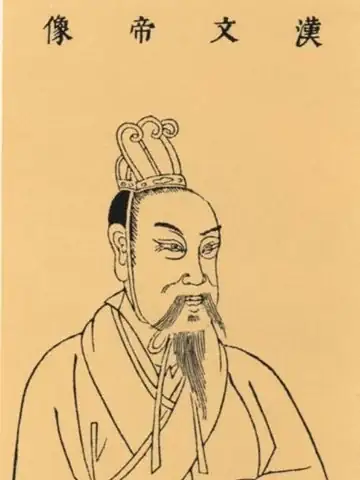
Portrait of Emperor Wen of Han

Western Han · 5th ruler

Reigned 180–157 BC (22 years)

漢文帝 Other names ›

Facts

Emperor Wen of Han reigned for 22 years (180–157 BC) and died of natural causes (age unknown). 5th ruler of Western Han.

Reign
14 November 180 BC – 6 July 157 BC (5th ruler of Western Han)
Length of reign
22 years
Born
Unknown
Died
6 July 157 BC
Age at accession
Unknown
Age at death
Unknown
Cause of death
Natural causesNatural death or illness (including old age)
Path to the throne
Installed by othersSucceeded the previous ruler of the same regime, but the choice was made by officials, the army, eunuchs, consort kin, an empress dowager or the imperial clan
Posthumous name
漢文帝 Hàn Wéndì
Temple name
漢太宗 Hàn Tàizōng
Personal name
劉恆 Liú Héng
Wade–Giles
Han Wen-ti · Liu Heng

Life

In brief

According to the appraisal in the Book of Han, when he wanted to build a terrace and was told it would cost a hundred pieces of gold, he said that this was what ten middling households owned and gave it up, and he himself wore thick black silk.

Road to the throne

A son of Emperor Gaozu of Han by Consort Bo, he was made the Prince of Dai in 196 BC. According to the words of Yuan Ang, when his mother was ill for three years while he was in Dai, he nursed her without taking off his clothes, and he would not present broth or medicine to her until he had tasted it himself. According to the biographies of imperial in-laws in the Book of Han, among the palace women who had been sent to Dai through a eunuch's mistake he favored only Lady Dou, and in 188 BC she gave birth to Emperor Jing of Han. In 180 BC, when the Lü clan was put to death and the summons came, most of his close attendants said that the ministers could not be trusted and urged him not to go, and Song Chang alone encouraged him to accept. He divined, had his mother's younger brother Bo Zhao confirm Zhou Bo's true intent, and then set out for Chang'an, where he did not accept the imperial seal offered to him at the Wei Bridge and, after declining five times, took the throne.

Reign and death

In 178 BC he abolished the crimes of slander and ominous speech. Though his younger half-brother Liu Chang, the Prince of Huainan, grew arrogant, he pardoned him, but when his rebellion was discovered he deposed him and moved him to Shu. The biography of the Prince of Huainan writes that Liu Chang refused food on the way and died, while the biography of Yuan Ang gives his death as from illness. When he heard the people singing that two brothers could not get along, he asked whether the realm thought he had coveted the land of Huainan, and gave Liu Chang the posthumous name Prince Li. In 167 BC, taking pity on the petition of Tiying, who wished to redeem her father from punishment, he abolished the mutilating punishments. In the midst of a Xiongnu invasion, when Feng Tang told him that the law was too clear, the rewards too light and the punishments too heavy, he pardoned Wei Shang, who had been charged, the same day. In 162 BC he made peace by marriage with the Xiongnu. When the Xiongnu invaded in great force, at Zhou Yafu's camp at Xiliu, where only the general's orders were obeyed, he was stopped at the gate and received with military ceremony, and as he left the camp he said that this was a true general. When Zhang Shizhi judged the man who had frightened the horses of the imperial carriage to a fine he grew angry, but when he was told that the law was shared with the realm, he acknowledged that the Commandant of Justice was right. His favorite Deng Tong had no ability and did nothing but flatter him, but he gave him a copper mountain and had him mint coins. In 157 BC he died at Weiyang Palace, and in a testamentary edict he rejected lavish burial and heavy mourning.

Translated from the Japanese text of this site, which is written from the official histories. Years are the Western calendar years of the dates, as in English reference works. Months are omitted because the histories use the Chinese lunar calendar.

During the reign

Number of times each event is recorded in the official histories. How each item is counted

Era name changes
2
General amnesties
4
Empresses installed
1
Crown princes deposed
0
Personal campaigns
0
Rebellions suppressed
1
Rebellions faced
1
Capital relocations
0

Emperors of Western Han

All 14 emperors of Western Han