Skip to content

Emperor Wu of Han

He established Confucian learning, sent great armies against the Xiongnu, and in his last years lost his crown prince in the witchcraft affair.
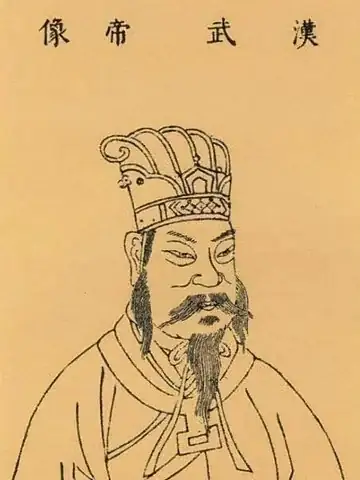
Portrait of Emperor Wu of Han

Western Han · 7th ruler

Reigned 141–87 BC (54 years)

漢武帝 Other names ›

Facts

Emperor Wu of Han reigned for 54 years (141–87 BC), taking the throne at 14 or 15, and died of natural causes at 68 or 69. 7th ruler of Western Han.

Reign
9 March 141 BC – 29 March 87 BC (7th ruler of Western Han)
Length of reign
54 years
Born
156 BC
Died
29 March 87 BC
Age at accession
14–15
Age at death
68–69
Cause of death
Natural causesNatural death or illness (including old age)
Path to the throne
Designated heirSucceeded the previous ruler of the same regime, who had chosen the heir (by testament, naming a crown prince, etc.)
Era names
  • 建元 Jiànyuán (proclaimed 140 BC)
  • 元光 Yuánguāng (proclaimed 134 BC)
  • 元朔 Yuánshuò (proclaimed 128 BC)
  • 元狩 Yuánshòu (proclaimed 122 BC)
  • 元鼎 Yuándǐng (proclaimed 116 BC)
  • 元封 Yuánfēng (proclaimed 110 BC)
  • 太初 Tàichū (proclaimed 104 BC)
  • 天漢 Tiānhàn (proclaimed 100 BC)
  • 太始 Tàishǐ (proclaimed 96 BC)
  • 征和 Zhēnghé (proclaimed 92 BC)
Posthumous name
漢武帝 Hàn Wǔdì
Temple name
漢世宗 Hàn Shìzōng
Personal name
劉徹 Liú Chè
Wade–Giles
Han Wu-ti · Liu Ch'e

Life

In brief

The assessment in the Book of Han calls him a man of great talent and grand designs, but concludes that had he kept the restraint and thrift of Emperor Wen of Han and Emperor Jing of Han in caring for the people, he would not have fallen short of the kings of old.

Road to the throne

He was the son of Emperor Jing, his mother was Beauty Wang, and he became crown prince at the age of 7 (East Asian reckoning). When Emperor Jing died in 141 BC, he took the throne. Soon after taking the throne he heard that his mother had a daughter, born when she was still of low status and living among the common people; he went in his own carriage to fetch her, asked his elder sister why she had hidden herself so deeply, and brought her to meet the empress dowager.

Reign and death

When Ji An told him that he had many desires within while outwardly practicing benevolence and righteousness, he was angry, but after withdrawing he remarked that Ji An's bluntness was extreme. In 130 BC he had the witchcraft of Empress Chen, who was childless and arrogant, investigated to the end; more than three hundred people implicated were executed, and the empress was sent away to the Changmen Palace. In 119 BC Wei Qing and Huo Qubing attacked the Xiongnu, but the dead of both armies numbered in the tens of thousands. When a magician told him how the Yellow Emperor had been met by a dragon and rose to heaven, he said that if he could truly become like the Yellow Emperor, he would leave his wife and children as easily as taking off a pair of shoes. In 106 BC, saying that famous ministers were nearly gone and that extraordinary deeds required extraordinary men, he had men recommended who could serve as generals, chancellors, or envoys to distant lands. In 91 BC, when Jiang Chong and others dug up witchcraft objects in the crown prince's palace, Crown Prince Li beheaded Jiang Chong and raised troops, and tens of thousands died in Chang'an. Empress Wei killed herself, and the crown prince, who had fled, also later killed himself. When Emperor Wu learned that most of the witchcraft charges were false, he wiped out Jiang Chong's family and, mourning the crown prince, built the Palace for Remembering a Son. According to the account of the Western Regions, in response to a proposal to set up military farms at Luntai, he issued an edict deeply regretting the past, and afterward sent out no more armies. He meant to make the son of Lady Gouyi his heir, and in 87 BC, two days after making Fuling crown prince, he died at the Wuzuo Palace. The biographies of imperial in-laws in the Book of Han record that Emperor Wu hesitated to name the crown prince because the boy was young and his mother young, and say that Lady Gouyi died of grief after being reprimanded. The supplement to the Shiji says that Emperor Wu had her put to death to prevent disorder. In the reign of Emperor Xuan of Han, Xiahou Sheng acknowledged his success in driving back the peoples on all four borders, but criticized him for exhausting the strength of soldiers and people and for extravagance without limit.

Translated from the Japanese text of this site, which is written from the official histories. Years are the Western calendar years of the dates, as in English reference works. Months are omitted because the histories use the Chinese lunar calendar.

During the reign

Number of times each event is recorded in the official histories. How each item is counted

Era name changes
11
General amnesties
18
Empresses installed
1
Crown princes deposed
1
Personal campaigns
1
Rebellions suppressed
5
Rebellions faced
5
Capital relocations
0

Emperors of Western Han

All 14 emperors of Western Han