Skip to content

Emperor Xuan of Han

He was an emperor of the Western Han and a great-grandson of Emperor Wu of Han; he lost his family in the witchcraft affair, was set up by Huo Guang, and after Huo Guang's death began to rule in person and destroyed the Huo family.
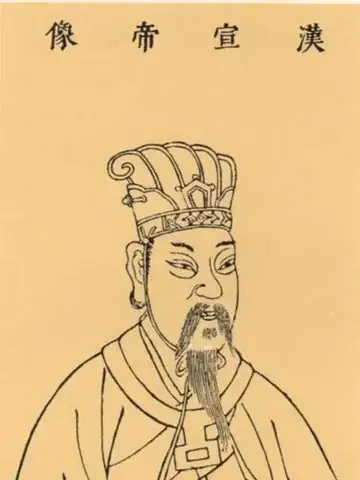
Portrait of Emperor Xuan of Han

Western Han · 10th ruler

Reigned 74–48 BC (25 years)

漢宣帝 Other names ›

Facts

Emperor Xuan of Han reigned for 25 years (74–48 BC), taking the throne at 16 or 17, and died of natural causes at 42. 10th ruler of Western Han.

Reign
10 September 74 BC – 10 January 48 BC (10th ruler of Western Han)
Length of reign
25 years
Born
91 BC
Died
10 January 48 BC
Age at accession
16–17
Age at death
42
Cause of death
Natural causesNatural death or illness (including old age)
Path to the throne
Installed by othersSucceeded the previous ruler of the same regime, but the choice was made by officials, the army, eunuchs, consort kin, an empress dowager or the imperial clan
Era names
  • 本始 Běnshǐ (proclaimed 73 BC)
  • 地節 Dìjié (proclaimed 69 BC)
  • 元康 Yuánkāng (proclaimed 65 BC)
  • 神爵 Shénjué (proclaimed 61 BC)
  • 五鳳 Wǔfèng (proclaimed 57 BC)
  • 甘露 Gānlù (proclaimed 53 BC)
  • 黃龍 Huánglóng (proclaimed 49 BC)
Posthumous name
漢宣帝 Hàn Xuāndì
Temple name
漢中宗 Hàn Zhōngzōng
Personal name
劉詢 Liú Xún
Wade–Giles
Han Hsüan-ti · Liu Hsün

Life

In brief

Ban Gu's appraisal names sure rewards and certain punishments and the scrutiny of names against realities and calls the reign a restoration; Sima Guang in the Zizhi Tongjian blames both Huo Guang, who did not let go of power, and Emperor Xuan, who gave the Huo family office and troops and then cut them back, and says that to have wiped out Huo Guang's family was to show too little kindness.

Road to the throne

He was the grandson of Crown Prince Li, and in 91 BC, a few months after birth, he was caught up in the witchcraft affair; his grandparents and parents all lost their lives, and he was thrown into prison while still an infant. Bing Ji, an officer under the Commandant of Justice, had the female prisoners nurse him and protected him, and in 87 BC, when Emperor Wu tried to have all the prisoners killed, Bing Ji shut the gate and would not let the envoy in. He grew up in the Yeting and married the daughter of Xu Guanghan; he enjoyed cockfighting and horse racing, and knew well the wrongdoing among the common people and the merits and faults of officials. In 74 BC, when Liu He, King of Changyi, was deposed, the great-grandson, who was among the common people, was put forward by Huo Guang and took the throne.

Reign and death

On his visit to the temple of the founding emperor, Huo Guang rode in the same carriage, and Emperor Xuan feared and dreaded him as though there were thorns at his back. While the high ministers wished to make Huo Guang's daughter empress, he issued an edict seeking the old sword from the days when he was of low standing, and Lady Xu, a jieyu, was set up as empress. In 71 BC, Huo Guang's wife Xian had Empress Xu poisoned to make her own daughter empress, and Huo Guang, though he knew, could not bring himself to report it. In 68 BC he visited the gravely ill Huo Guang and wept. After Huo Guang died he began to rule in person. In 66 BC the Huo family was put to death on the charge of rebellion, the poisoning of Empress Xu came to light, and thousands of families were destroyed in the collective punishment. When he learned that the man who had saved his life was Bing Ji, who had never spoken of the kindness he had shown him, he thought him greatly worthy and in 63 BC enfeoffed him as a marquis. When Bing Ji fell ill just before the enfeoffment, Emperor Xuan wanted to enfeoff him while he was still alive. In 60 BC he took as slander Gai Kuanrao's sealed memorial, which criticized the use of punishments and the trust placed in eunuchs, and sent it down, and Gai Kuanrao cut his own throat. To the crown prince, who told him he should use Confucian scholars, Emperor Xuan answered that the Han house used the way of the hegemon and the kingly way together, and sighed that the crown prince would throw the Han house into disorder. There was also a wish to replace him with the King of Huaiyang, who loved the law, but thinking of the Xu family from the days of his humble station, he did not replace the crown prince. He died at Weiyang Palace in 48 BC.

Translated from the Japanese text of this site, which is written from the official histories. Years are the Western calendar years of the dates, as in English reference works. Months are omitted because the histories use the Chinese lunar calendar.

During the reign

Number of times each event is recorded in the official histories. How each item is counted

Era name changes
7
General amnesties
10
Empresses installed
3
Crown princes deposed
0
Personal campaigns
0
Rebellions suppressed
1
Rebellions faced
1
Capital relocations
0

Emperors of Western Han

All 14 emperors of Western Han