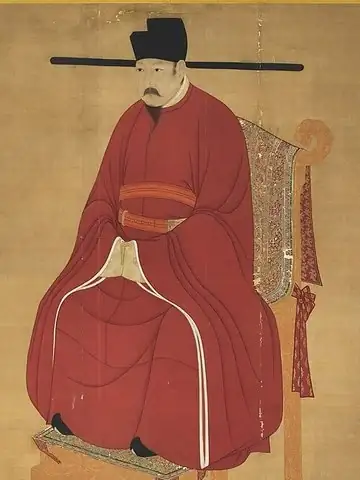
Road to the throne
He was the sixth son of Emperor Zhenzong of Song, and though his birth mother was Consort Li, the childless Lady Liu, later Empress Zhangxian, raised him as her own son. According to the annals, he was benevolent and filial and generous by nature, and neither joy nor anger showed in his face. When Emperor Zhenzong of Song died in 1022, he took the throne by testamentary edict, and Empress Zhangxian handled the government from behind a curtain as empress dowager.
Reign and death
In 1033, when Empress Dowager Zhangxian died and Consort Li was posthumously honored as empress dowager, he learned for the first time that he was her son and began to rule in person. When memorials condemning the empress dowager's era continued, Fan Zhongyan argued that her small faults should be covered over, and according to the biographies of empresses he said that such talk was what he could not bear to hear and forbade it. Early in 1034 he deposed Empress Guo and dismissed Kong Daofu and Fan Zhongyan, who had remonstrated at the palace gate, from the court. Early in 1039 the revolt of Yuanhao was reported, and the Song armies suffered defeats at Yan Prefecture, Haoshuichuan and Dingchuan Fort, but in 1044 he enfeoffed Yuanhao as ruler of the Xia state and made peace. In 1043, according to the biography of Fan Zhongyan, he adopted the ten measures Fan Zhongyan submitted and began reforms, but slander and talk of factions reached his ears, and Fan Zhongyan, having gone out to the frontier, asked to resign from the government and was dismissed in 1045. When he heaped high offices on Zhang Yaozuo, the uncle of Noble Consort Zhang, Bao Zheng and others remonstrated that close attendants and ministers were leading His Majesty into the fault of private fondness for the rear palace, and Emperor Renzong of Song warned the censors and remonstrants, but Zhang Yaozuo declined the posts of Xuanhui commissioner and commissioner of the Jingling Palace, and before long was sent out to Heyang again as Xuanhui commissioner. By 1043 all three of his sons had died, and according to the biography of Han Qi, when he fell ill his subjects contended in pressing him to name an heir, but he hesitated for five or six years. In 1062 he made Zongshi, a son of the Prince Anyi of Pu, his own son and gave him the name Shu. In 1063 he fell ill, and according to the Xu Zizhi Tongjian Changbian, after his recovery was celebrated he suddenly pointed at his chest on the night of a peaceful day and lost his speech, and died. The appraisal in the annals says that he was reverent and frugal, wearing washed clothes among other things, and that even when hungry at night he did not send for roast lamb for fear the cooks would come to kill living creatures, and it closes by saying that as a ruler he rested in benevolence.
Translated from the Japanese text of this site, which is written from the official histories. Years are the Western calendar years of the dates, as in English reference works. Months are omitted because the histories use the Chinese lunar calendar.