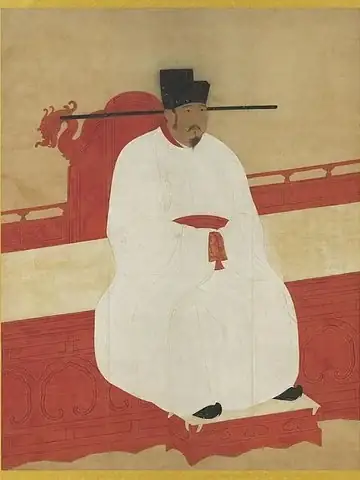
Road to the throne
He was the thirteenth son of Yunrang, the Prince Anyi of Pu, and was born in 1032. The annals of the History of Song record that he was deeply filial and fond of reading, that his clothing and furnishings were as plain as a Confucian scholar's, and that he always met his instructors in court dress. In 1062 he was made imperial prince, but claimed illness and firmly declined, and was raised from his bedchamber and brought into the palace. When Renzong died suddenly in 1063, the annals hold that the empress conveyed the testamentary edict and that he succeeded to the throne, while the biographies of empresses and consorts have it that the empress first summoned the imperial prince into the palace. The Xu Zizhi Tongjian Changbian holds that the prince was summoned after the senior ministers had entered the sleeping hall, and records that he cried out in alarm that he could not do it, fled, was caught, and was dressed in the imperial robes.
Reign and death
He fell ill within days of his accession, and according to the Changbian, on the day of Renzong's encoffining he ran about shouting and could not perform the rites, and Han Qi caught hold of him, while a note states that Han Qi's action is not in the state history. The same day, he asked the empress dowager by edict to hear affairs of state together with him. According to the biography of Han Qi and the Changbian, because his illness made his conduct depart from the norm, slander opened a rift between him and the empress dowager; Han Qi and Ouyang Xiu soothed the empress dowager, and when he let slip that she showed him no kindness, he too was admonished with the filial piety of Shun and came to a great realization. In 1064 the empress dowager handed back the government, but the Changbian holds that after he held back the letter returning the government for a while, Han Qi had the curtain removed, while the biographies of empresses and consorts hold that he did not issue the letter for a long time and that its execution was delayed. In 1065 he reduced his clothing and equipage and released 180 palace women, and when heavy rain caused many deaths, he had the draft edict, which told the chief ministers to reflect on the anomalies of Heaven, revised, saying that the disaster was a warning about his own lack of virtue. As for what to call his biological father, the Prince of Pu, Wang Gui and others held that he should be styled imperial uncle, while the Secretariat cited the precedent of styling a father imperial father. In 1066, by a letter from the empress dowager, it was decided that he would call the Prince of Pu his parent, but he declined the posthumous honors; the annals say that Lü Hui and the others who opposed it were dismissed, while the biography of the Prince of Pu says that they resigned their posts as censors of their own accord. He fell ill again the same year, and when he established the crown prince early the next year, he shed tears, according to the Changbian, and died shortly after.
Translated from the Japanese text of this site, which is written from the official histories. Years are the Western calendar years of the dates, as in English reference works. Months are omitted because the histories use the Chinese lunar calendar.