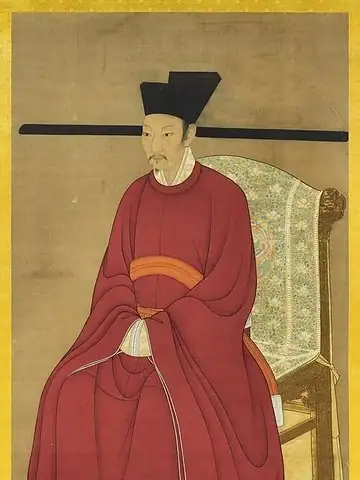
Road to the throne
Early in 1126, with Jin armies already invading across the frontier, Huizong gave up the throne; the crown prince wept and declined, and even fell ill, but his refusal was not accepted and he took the throne.
Reign and death
According to the biography of Li Gang in the History of Song, while the chief ministers held to the plan of leaving the capital, Qinzong decided to set out, and the imperial carriage had even been made ready, but he gave it up after Li Gang argued that the families of the Six Armies were in the capital. In 1126 Jin forces attacked Kaifeng and demanded the cession of the three garrisons of Taiyuan, Zhongshan and Hejian along with hostages from among the chief ministers and imperial princes, and Qinzong agreed to cede the three garrisons. The annals of the History of Song say that the day after a failed night raid he dismissed Li Gang as an apology to the Jin, but when Chen Dong and others, together with tens of thousands of the capital's people, prostrated themselves at the palace gates, he restored Li Gang, and the Jin army withdrew. When the Jin army besieged the capital again, he put on armor and climbed the walls in rain and snow, and gave his own meals to the soldiers, so that people were moved to tears. Early in 1127 Guo Jing, claiming to use the Liujia method, ordered the defenders down from the walls and sallied out, only to suffer a heavy defeat, and the capital fell. According to the biography of Chong Shidao in the History of Song, Qinzong then beat his chest, saying that it had come to this because he had not followed Chong Shidao's advice. When the Jin demanded that his father, the retired emperor, present himself, Qinzong said his father was ill and went to the Jin camp himself. When he went out to the Jin camp a second time, he told Zhang Shuye, who tried to dissuade him, that for the sake of the people he had no choice but to go in person. The Jin set up Zhang Bangchang as emperor of Chu, and Qinzong was carried off to the north together with his empress and his son, the crown prince. According to the History of Jin, in 1128 father and son were brought in white garments before the temple of Emperor Taizu of Jin, and Qinzong was made Marquis Chonghun. The History of Jin records that Qinzong died in 1156, while the annals of the History of Song record only that news of his death arrived in 1161. The Jianyan Yilai Xinian Yaolu and other works give the statement of a Jin envoy that he had died of a wind ailment, and the same work also says that he died in the north in the thirtieth year of the Shaoxing era. The story that he was shot dead on a polo field appears in works outside the official histories, such as the Da Song Xuanhe Yishi. The appraisal in the History of Song says that he had no taste for song and dance or music and that the forces of disorder were already formed, while asking whether he was perhaps weak and ignorant of righteousness, and it concludes that this is to be lamented.
Translated from the Japanese text of this site, which is written from the official histories. Years are the Western calendar years of the dates, as in English reference works. Months are omitted because the histories use the Chinese lunar calendar.