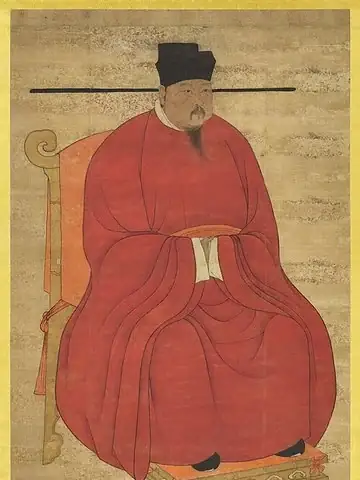
Road to the throne
He was the third son of Emperor Taizong of Song, his mother was Empress Yuande of the Li clan, and he was born in 968. According to the biography of Lü Duan and the Changbian, as Taizong lay dying Wang Ji'en and others plotted to set up the elder brother of the crown prince, Yuanzuo, and Lü Duan rebuffed the empress, who urged that the eldest son be set up, while the Changbian notes that this plot does not appear in the Veritable Records or the state history; according to the annals he took the throne before the coffin in 997.
Reign and death
In 1004, when the Liao army moved south, the biography of Kou Zhun says that Kou Zhun urged the emperor to lead the campaign in person and asked him to go to Chanzhou, while the biography of Bi Shi'an says that the two agreed on it together. According to the annals, on a bitterly cold day as he went north, when he was presented with a sable hat and furs, he declined them, saying that his ministers were suffering from the cold. According to the biography of Kou Zhun, Kou Zhun tried to make Liao call itself a subject, but, pressed by the emperor, who disliked fighting, and by slander, he agreed to the peace. According to the biography of Kou Zhun and the Changbian, the emperor told Cao Liyong that he might permit up to a million, the Changbian adding that this was only if there was no other way, but Kou Zhun told Cao Liyong that he would have him beheaded if he went beyond three hundred thousand, and the agreement was concluded at three hundred thousand. According to the biography of Kou Zhun, later Wang Qinruo argued that the Treaty of Chanyuan was a covenant made under the city walls and that the emperor had been made Kou Zhun's stake in a gamble, while the Changbian attributes the words about the stake to an unnamed slanderer. According to the biography of Wang Dan and the Changbian, the emperor agreed to Wang Qinruo's argument that a sign from Heaven might be made by human hands, and, worried about Wang Dan's opposition, obtained Wang Dan's consent through Wang Qinruo; he still hesitated, but Du Hao's answer decided him, and when he gave Wang Dan a wine jar filled with pearls, Wang Dan raised no further objection. In 1008 he opened with his ministers the yellow silk hanging at the Left Chengtian Gate, called it the Heavenly Text, changed the era name to Dazhong Xiangfu, and sacrificed to Heaven at Mount Tai. In his last years he lay ill, and Kou Zhun was dismissed and banished far away; the biography of Kou Zhun says the emperor did not know of the demotion at first, the Changbian, relying on the Jiwen, says it was not the emperor's own intention, and the biography of Ding Wei says that Ding Wei changed the destination the emperor had in mind to Daozhou. In 1022 his illness grew grave, and he left a testamentary edict making his empress empress dowager and having her handle military and state affairs for the time being, and then died. The appraisal in the annals, while calling him a wise and enlightened ruler, judges that with the feng and shan sacrifices, the auspicious omens and the Heavenly Texts after the Treaty of Chanyuan, ruler and ministers were as if they had gone mad, and surmises that perhaps his ministers had urged these things on him.
Translated from the Japanese text of this site, which is written from the official histories. Years are the Western calendar years of the dates, as in English reference works. Months are omitted because the histories use the Chinese lunar calendar.