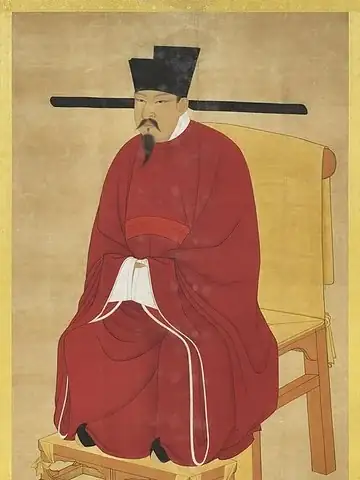
Road to the throne
He was the eldest son of Emperor Yingzong of Song, and his mother was Lady Gao, who later became the empress of Yingzong. He was made crown prince while Emperor Yingzong of Song was ill, and when Yingzong died in 1067 he took the throne.
Reign and death
In 1069 he made Wang Anshi Canzhi Zhengshi, and the new policies were deliberated, but Lü Hui, who criticized Wang Anshi, was dismissed, and the next year a memorial from Sun Jue and others was also rejected. According to the biography of Han Qi, when Emperor Shenzong of Song saw Han Qi's memorial criticizing the green sprouts law he said that Han Qi was a truly loyal minister, and the new policies came close to being abolished, but Wang Anshi, who claimed illness, returned to office and held to his former position all the more firmly; the biography of Wang Anshi says that when Wang Anshi asked to resign and protested Sima Guang's reply edict, Shenzong apologized, and at Han Jiang's urging he kept him. According to the biography of Wang Anshi, in the great drought of 1074 Shenzong wanted to abolish the bad laws, and to Wang Anshi, who said that floods and droughts are constant and that one need only cultivate human affairs, he answered that what he feared was that those human affairs were not cultivated. According to the biography of Zheng Xia, Shenzong, seeing the drawing of the displaced people, halted eighteen matters; according to the biography of Wang Anshi, the two empress dowagers pleaded in tears and Shenzong too doubted him and dismissed Wang Anshi, but the biography of Zheng Xia says that when Lü Huiqing and others pleaded in tears the new policies were restored as before. When Su Shi was censured for his poems and thrown into prison, the biography of Su Shi says that Shenzong alone pitied him, the biography of Empress Cao says that Shenzong wept at the words of the grand empress dowager and Su Shi was spared, and the biography of Wang Anli says that Su Shi's punishment was lightened through Wang Anli's words. In 1081 he ordered a campaign against Western Xia, but Chong E's army ran out of provisions, and Gao Zunyu's army too was pursued as it withdrew and broke up. The next year the newly built fortress of Yongle was taken by a large Western Xia army, and Xu Xi and others died in battle. According to the biography of Xu Xi, when Shenzong heard of this he wept and stopped eating, and afterward he lost his will to campaign against Western Xia. Early in 1085 he fell ill, and granting the request of the Three Departments and the Bureau of Military Affairs he made his son Yong, the Prince of Yan'an, crown prince, and a few days later he died. The appraisal in the annals, while acknowledging that he sought frank advice and worked for good government, criticizes him, saying that Wang Anshi took advantage of the emperor's resolve to wipe away the shame of several generations of defeats, and that the emperor dismissed the veteran ministers and carried out the new policies without doubting them.
Translated from the Japanese text of this site, which is written from the official histories. Years are the Western calendar years of the dates, as in English reference works. Months are omitted because the histories use the Chinese lunar calendar.