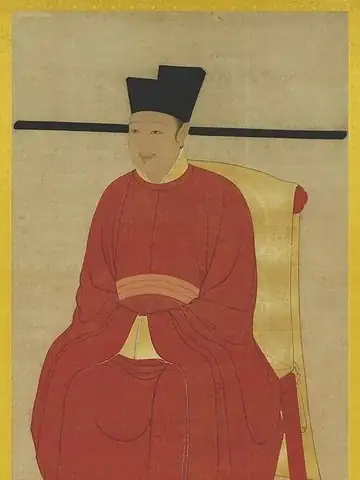
Road to the throne
He was the eleventh son of Emperor Shenzong of Song, and his mother was Empress Qinci of the Chen clan. When Zhezong died without a son in 1100, the chancellor Zhang Dun proposed the Prince of Jian, Zhezong's brother by the same mother, but the Empress Dowager Xiang rejected him and said that by order the Prince of Duan should be set up. The Xu Zizhi Tongjian says that Zhang Dun was rebuked by Zeng Bu before he finished saying that the Prince of Duan was frivolous and could not be lord of the realm; in the History of Song only the appraisal records it. When the empress dowager said that the late emperor had spoken of the Prince of Duan as having fortune and long life and as benevolent and filial, Zhang Dun fell silent, and the Prince of Duan was summoned and took the throne.
Reign and death
According to the biography of Jiang Gongwang in the History of Song, when he was admonished about the rare birds and beasts in the palace gardens he released them, and he carved Jiang Gongwang's name on the staff with which he had chased a silver pheasant that would not leave. In 1102 he made Cai Jing chancellor and asked him how he should carry on the aims of his father and elder brother. The same year he wrote out with his own hand the names of 120 old ministers of the Yuanyou era and had them carved at the Duanli Gate, and in 1104 he had them widened to 309 and carved again, but when a comet appeared in 1106 the stele of the party members was destroyed. According to the biography of Zhu Mian in the History of Song, Cai Jing had Zhu Mian present rare things from the Zhe region to Emperor Huizong, who loved flowers and stones, and the fleets were called the flower and stone fleets. He was delighted when the Daoist adept Lin Lingsu told him that he was the eldest son of the Lord on High, and in 1117 he had himself styled Emperor Jiaozhu Daojun, though only in Daoist documents. In 1120 Fang La raised troops at Qingxi, and the biography of Tong Guan in the History of Song writes that he took advantage of the people suffering from the harm of the flower and stone fleets. According to the biography of Yuwen Xuzhong in the History of Song, when word came that the Jin armies had invaded from two directions he asked Yuwen Xuzhong what should be done, and on his advice issued an edict reproaching himself. Early in 1126 he abolished the flower and stone fleets and yielded the throne to the crown prince. In 1127 he was carried off north by the Jin armies. According to the biography of Cao Xun in the History of Song, on the way he wrote on his collar that his son the Prince of Kang should take the throne at once and come to save his parents, sent it to him, and also sent word that the Prince of Kang should not worry about him. The Jin enfeoffed him as Duke Hunde, and he died at Wuguocheng in 1135. The appraisal in the annals says the reason he lost his state was that he pushed away upright men and kept wicked ministers close, and calls him the most extreme case of toying with things and losing his purpose.
Translated from the Japanese text of this site, which is written from the official histories. Years are the Western calendar years of the dates, as in English reference works. Months are omitted because the histories use the Chinese lunar calendar.