Hong Taiji
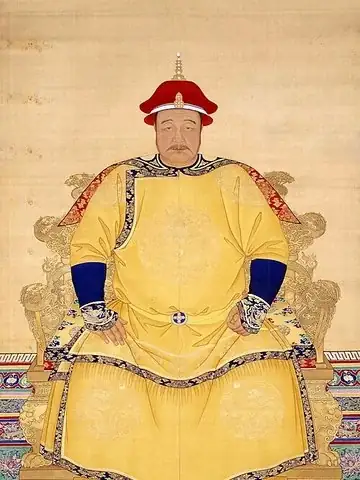
Qing · 2nd ruler
清太宗 Qīng Tàizōng愛新覺羅皇太極 Àixīnjuéluó Huángtàijí
Wade–Giles: Ch'ing T'ai-tsung · Ai-hsin-chüeh-lo Huang-t'ai-chi
Reigned 1636–1643 (7 years)
Reigned 7 years (1636–1643). Died at 52 (East Asian reckoning); cause of death unknown. 2nd ruler of Qing.
Facts
- Reign
- 15 May 1636 – 21 September 1643 (2nd ruler of Qing)
- Length of reign
- 7 years
- Born
- 28 November 1592
- Died
- 21 September 1643
- Age at accession
- 45
- Age at death
- 52
- Cause of death
- UnknownThe primary sources record no cause of death or clue to it
- Path to the throne
- Installed by othersFounded the titleSucceeded the previous ruler of the same regime, but the choice was made by officials, the army, eunuchs, consort kin, an empress dowager or the imperial clan
- Predecessor
- 愛新覺羅努爾哈赤(ヌルハチ) (did not claim the title of emperor)
- Successor
- Shunzhi Emperor
- Era names
- 崇德 Chóngdé (proclaimed 1636)
Ages are given in East Asian reckoning (sui): a person is one year old at birth and gains a year at each New Year, so the figure is one or two years higher than the Western age.
Life
In brief
He succeeded Nurhaci, later named the state Great Qing and took the title of emperor, and was the second ruler of the Qing. He forced Joseon to submit, and defeated a great Ming army at Songshan and Jinzhou.
Road to the throne
He was the eighth son of Nurhaci (Taizu), and in 1616 he became one of the Four Senior Beile alongside Daishan, Amin and Manggultai. When Taizu died without naming a successor, Daishan and his sons Yoto and Sahaliyan put Hong Taiji forward for his talent and virtue and consulted the other beile, and Hong Taiji accepted after declining again and again. He took the throne at Shenyang in 1626 and made the next year the first year of Tiancong. On the day after Taizu died, the senior consort Lady Nara followed him in death.
Reign and death
In 1629 he invaded Ming territory in person, and early in 1630 he defeated a Ming army at the Lugou Bridge near Beijing. In 1635, when Dorgon and others brought the imperial seal back from their campaign, he reported to Heaven and accepted it. In 1636 he accepted an honorific title, named the realm Great Qing, changed the era name to Chongde, and declared an amnesty on the completion of the rites. At the end of the same year he led a campaign against Joseon in person, and in 1637, after Ganghwa Island fell and the king's wife and children were captured, the king, Yi Jong, came out to Samjeondo to surrender and handed over the seal that the Ming had granted him. In 1641, when Hong Chengchou and others stationed troops at Songshan to relieve Jinzhou, he led a great army in person to meet them. When Consort Chen fell ill in the middle of this campaign, he left the siege to his generals and turned back, but she died before he reached her. In 1642 he took Songshan and captured Hong Chengchou, and also took Jinzhou and received the surrender of Zu Dashou. The annals for 1643 contain two entries about illness in the first half of the year. In the same year he died on the night of a day on which he had appeared in the Chongzheng Hall, but the Draft History of Qing writes that he died without illness, and gives neither an illness nor a cause of death.
Translated from the Japanese text of this site, which is written from the official histories. Years are given in the Western calendar; months are omitted because the histories use the Chinese lunar calendar.
During the reign
Number of times each event is recorded in the official histories. How each item is counted
- Era name changes
- 1
- General amnesties
- 3
- Empresses installed
- 1
- Crown princes deposed
- 0
- Personal campaigns
- 3
- Rebellions suppressed
- 0
- Rebellions faced
- 0
- Capital relocations
- 0
Emperors of Qing
- 2ndHong Taiji清太宗 Qīng Tàizōng愛新覺羅皇太極 Àixīnjuéluó Huángtàijí1636–1643 · 7 years · Unknown, age 521636–16437 yearsUnknown, age 52
- 3rdShunzhi Emperor順治帝 Shùnzhì Dì愛新覺羅福臨 Àixīnjuéluó Fúlín1643–1661 · 17 years · Natural causes, age 241643–166117 yearsNatural causes, age 24
- 4thKangxi Emperor康熙帝 Kāngxī Dì愛新覺羅玄燁 Àixīnjuéluó Xuányè1661–1722 · 61 years · Natural causes, age 691661–172261 yearsNatural causes, age 69
- 5thYongzheng Emperor雍正帝 Yōngzhèng Dì愛新覺羅胤禛 Àixīnjuéluó Yìnzhēn1722–1735 · 12 years · Disputed, age 581722–173512 yearsDisputed, age 58
- 6thQianlong Emperor乾隆帝 Qiánlóng Dì愛新覺羅弘曆 Àixīnjuéluó Hónglì1735–1796 · 60 years · Natural causes, age 891735–179660 yearsNatural causes, age 89
- 7thJiaqing Emperor嘉慶帝 Jiāqìng Dì愛新覺羅顒琰 Àixīnjuéluó Yóngyǎn1796–1820 · 24 years · Natural causes, age 611796–182024 yearsNatural causes, age 61
- 8thDaoguang Emperor道光帝 Dàoguāng Dì愛新覺羅旻寧 Àixīnjuéluó Mínníng1820–1850 · 29 years · Natural causes, age 691820–185029 yearsNatural causes, age 69
- 9thXianfeng Emperor咸豐帝 Xiánfēng Dì愛新覺羅奕詝 Àixīnjuéluó Yìzhǔ1850–1861 · 11 years · Natural causes, age 311850–186111 yearsNatural causes, age 31
- 10thTongzhi Emperor同治帝 Tóngzhì Dì愛新覺羅載淳 Àixīnjuéluó Zàichún1861–1875 · 13 years · Natural causes, age 191861–187513 yearsNatural causes, age 19
- 11thGuangxu Emperor光緒帝 Guāngxù Dì愛新覺羅載湉 Àixīnjuéluó Zàitián1875–1908 · 33 years · Assassinated, age 381875–190833 yearsAssassinated, age 38
- 12th, 13th, 14thPuyi宣統帝 Xuāntǒng Dì愛新覺羅溥儀 Àixīnjuéluó Pǔyí1908–1912; restored 1917; restored 1934–1945 · 14 years · Natural causes, age 621908–1912; restored 1917; restored 1934–194514 yearsNatural causes, age 62