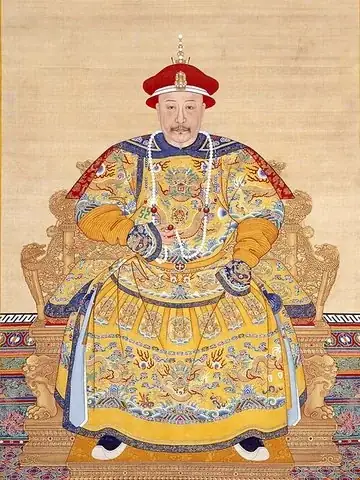
In brief
The discussion in the Draft History of Qing counts his thrift and diligence in government as the foundation of his reign, but laments that although he issued edict after edict asking for opinions, no spirit of frank exchange between ruler and ministers appeared.
Road to the throne
He was the fifteenth son of the Qianlong Emperor, and was made Prince Jia in 1789. According to the biography of Heshen, he had known of Heshen's wickedness since he was a prince, but even after taking the throne he treated Heshen leniently because his father was old. He was made crown prince in 1795, and in 1796 the Qianlong Emperor handed him the imperial seal in the Hall of Supreme Harmony and enthroned him. Even after becoming Retired Emperor, the Qianlong Emperor went on running the government.
Reign and death
In the very month of his accession, sectarians rose in arms in Hubei. When the Qianlong Emperor died in 1799 and he began to rule in his own right, he at once sent Heshen to prison and ordered him to die within the same month. The biography of Heshen records that, about rumours of Heshen plotting rebellion, he asked Wu Xiongguang whether, if no one was following Heshen, there was any need to punish him so quickly, but it does not say when. After Heshen was executed he did not pursue those whom Heshen had recommended, and he rejected charges that Heshen's property had been hidden away. The popular saying that when Heshen fell the Jiaqing Emperor grew fat is found neither in the Draft History of Qing nor in the Veritable Records of the Jiaqing reign. In the same year, when an auspicious alignment of the sun, the moon and the five planets was reported to him, he dismissed it, saying that it was mere coincidence and that the fighting had not yet stopped. According to the biography of Hong Liangji, in the same year he was angered by Hong Liangji, who had written to him that he came to court late among other things, spared him from death and exiled him to Ili. In the drought of the next year he declared in an edict that fewer people had spoken their minds since Hong Liangji was punished, pardoned him and let him go home. In 1803 he was attacked by Chen De on his way back to the palace. Four days later he issued an edict saying that Chen De should be regarded as a mad dog and the matter not pursued deeply, that what he was ashamed of was that moral teaching had not reached everyone, and that Chen De should be dealt with by law, and on that day Chen De and his two sons were executed. In 1809 he wrote a poem in praise of thrift himself and showed it to his courtiers. In 1813, while he was away, several dozen followers of Lin Qing broke into the Forbidden City, and his second son shot down rebels with a firearm. The emperor issued an edict saying he was ashamed of something that had not happened even under the Han, Tang, Song or Ming. In 1818, when a fierce wind filled the air with dust, he blamed his own lack of insight in government and called for frank advice. Three days later he lamented how few ministers were of one mind with him, and that people did not admonish him to his face but talked behind his back. In 1820, on the way to Mulan, he fell ill at the Mountain Resort in Rehe, became critically ill in the evening, and died that night. The annals of Xuanzong and the Veritable Records of the Daoguang Emperor say that, as he lay dying, the ministers opened the box and a document in his own hand from 1799 showed that his second son was the heir. The story that he was killed by lightning is found neither in the annals of Renzong or Xuanzong in the Draft History of Qing nor in the entries of the Veritable Records around his death.
Translated from the Japanese text of this site, which is written from the official histories. Years are the Western calendar years of the dates, as in English reference works. Months are omitted because the histories use the Chinese lunar calendar.