Kublai Khan
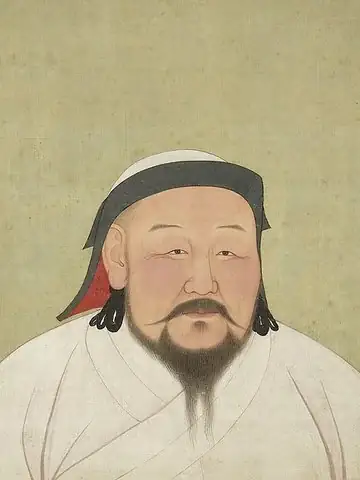
Reigned 33 years (1260–1294). Died at 80 (East Asian reckoning) of natural causes. 5th ruler of Yuan.
Facts
- Reign
- 5 May 1260 – 18 February 1294 (5th ruler of Yuan)
- Length of reign
- 33 years
- Born
- 23 September 1215
- Died
- 18 February 1294
- Age at accession
- 46
- Age at death
- 80
- Cause of death
- Natural causesNatural death or illness (including old age)
- Path to the throne
- Installed by othersFounded the titleSucceeded the previous ruler of the same regime, but the choice was made by officials, the army, eunuchs, consort kin, an empress dowager or the imperial clan
- Predecessor
- モンケ(蒙哥) (did not claim the title of emperor)
- Successor
- Temür Khan
- Era names
- 中統 Zhōngtǒng (proclaimed 1260)
- 至元 Zhìyuán (proclaimed 1264)
Ages are given in East Asian reckoning (sui): a person is one year old at birth and gains a year at each New Year, so the figure is one or two years higher than the Western age.
Life
In brief
Shizu was Kublai, the fourth son of Tolui, who was honored as Ruizong. He took the throne at Kaiping in 1260 and adopted the dynastic name Great Yuan in 1271.
Road to the throne
The annals of Shizu in the History of Yuan name his mother as Empress Dowager Zhuangsheng. They record that when Möngke (Xianzong) took the throne in 1251, he entrusted the military and civil affairs of the Han lands south of the desert to Kublai, the eldest and most capable of his full younger brothers. In 1259 the news of Möngke's death reached Kublai on the north bank of the Yangtze, and in winter ministers of the previous reign plotted to enthrone Ariq Böke, the seventh son of Tolui. In 1260 the princes and high officials gathered at Kaiping urged him to take the throne; he declined three times but accepted when they pressed him. His accession edict states that the princes had chosen him first, and that among the direct grandsons of Chinggis Khan (Taizu) and the full brothers of the late emperor he alone was both capable and eldest.
Reign and death
In 1260 the armies of Alamdar and Qundughai were crushed by the princes at Guzang, and both men were beheaded. In 1264 Ariq Böke came over to him with princes and advisers. The emperor did not punish the princes but executed the advisers, such as Buluqa. His edict said they had been dealt with under the jasaq laws of Chinggis Khan, and changed the fifth year of Zhongtong to the first year of Zhiyuan with a general amnesty. The biography of Ariq Böke in the New History of Yuan records that when he came before the emperor and was asked which of them ought to have succeeded, he answered that he had been in the right then and the Khan was in the right today. In 1276 the Song empress dowager, the boy emperor and the chief ministers surrendered with the seals of state. In 1279 Bing, Prince of Guang, threw himself into the sea at Yashan and died. In 1281 an army set out to invade Japan, but the annals of Shizu record that the fleet was struck by wind and waves and badly defeated, and only one or two in ten made it back to the Goryeo border. In 1287 the emperor left Shangdu to campaign in person against Nayan. The annals of Shizu do not record Nayan's capture; the biography of Öz Temür says that Öz Temür captured Nayan and presented him. In 1294 the emperor fell ill and died in the Zitan Hall. The annals of Shizu do not name the illness.
Translated from the Japanese text of this site, which is written from the official histories. Years are given in the Western calendar; months are omitted because the histories use the Chinese lunar calendar.
During the reign
Number of times each event is recorded in the official histories. How each item is counted
- Era name changes
- 2
- General amnesties
- 7
- Empresses installed
- 2
- Crown princes deposed
- 0
- Personal campaigns
- 3
- Rebellions suppressed
- 18
- Rebellions faced
- 20
- Capital relocations
- 0
Emperors of Yuan
- 5thKublai Khan元世祖 Yuán Shìzǔ忽必烈 Hūbìliè1260–1294 · 33 years · Natural causes, age 801260–129433 yearsNatural causes, age 80
- 6thTemür Khan元成宗 Yuán Chéngzōng鐵穆耳 Tiěmù'ěr1294–1307 · 12 years · Natural causes, age 421294–130712 yearsNatural causes, age 42
- 7thKülüg Khan元武宗 Yuán Wǔzōng海山 Hǎishān1307–1311 · 3 years · Natural causes, age 311307–13113 yearsNatural causes, age 31
- 8thAyurbarwada Buyantu Khan元仁宗 Yuán Rénzōng愛育黎拔力八達 Àiyùlíbálìbādá1311–1320 · 8 years · Natural causes, age 361311–13208 yearsNatural causes, age 36
- 9thGegeen Khan元英宗 Yuán Yīngzōng碩德八剌 Shuòdébālá1320–1323 · 3 years · Assassinated, age 211320–13233 yearsAssassinated, age 21
- 10thYesün Temür元泰定帝 Yuán Tàidìngdì也孫鐵木兒 Yěsūntiěmù'ér1323–1328 · 4 years · Natural causes, age 361323–13284 yearsNatural causes, age 36
- 11thRagibagh Khan元天順帝 Yuán Tiānshùndì阿速吉八 Āsùjíbā1328 · 41 days · Unknown132841 daysUnknown
- 12th, 14thTugh Temür元文宗 Yuán Wénzōng圖帖睦爾 Tútiēmù'ěr1328–1329; restored 1329–1332 · 3 years · Natural causes, age 291328–1329; restored 1329–13323 yearsNatural causes, age 29
- 13thKusala元明宗 Yuán Míngzōng和世㻋 Héshìlà1329 · 184 days · Assassinated, age 301329184 daysAssassinated, age 30
- 15thRinchinbal Khan元寧宗 Yuán Níngzōng懿璘質班 Yìlínzhìbān1332 · 52 days · Natural causes, age 7133252 daysNatural causes, age 7
- 16thToghon Temür元惠宗 Yuán Huìzōng妥懽帖睦爾 Tuǒhuāntiēmù'ěr1333–1370 · 36 years · Natural causes, age 511333–137036 yearsNatural causes, age 51