Skip to content

Zhengde Emperor

He was a Ming emperor who favored Liu Jin and the rest of the Eight Tigers, lived in the Leopard Quarter, and went out to the frontier calling himself the Mighty Martial Great General.
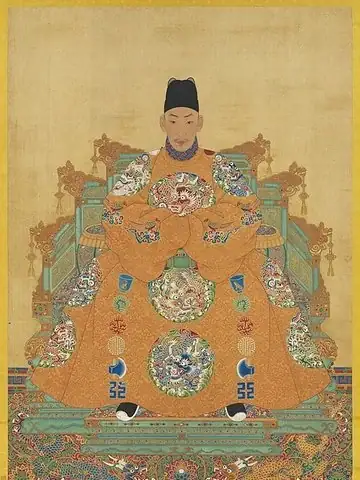
Portrait of Zhengde Emperor

Ming · 11th ruler

Reigned 1505–1521 (15 years)

正德帝 Other names ›

Facts

The Zhengde Emperor reigned for 15 years (1505–1521), taking the throne at 13, and died of natural causes at 29. 11th ruler of Ming.

Reign
19 June 1505 – 20 April 1521 (11th ruler of Ming)
Length of reign
15 years
Born
26 October 1491
Died
20 April 1521
Age at accession
13
Age at death
29
Cause of death
Natural causesNatural death or illness (including old age)
Path to the throne
Designated heirSucceeded the previous ruler of the same regime, who had chosen the heir (by testament, naming a crown prince, etc.)
Predecessor
Hongzhi Emperor
Era names
  • 正德 Zhèngdé (proclaimed 1505)
Temple name
明武宗 Míng Wǔzōng
Personal name
朱厚照 Zhū Hòuzhào
Wade–Giles
Cheng-te Emperor · Chu Hou-chao

Life

Road to the throne

He was the eldest son of the Hongzhi Emperor, became crown prince in 1492, and was clever and fond of riding and archery. He took the throne when the Hongzhi Emperor died in 1505.

Reign and death

In 1506 the court officials asked for the execution of Liu Jin and the other eunuchs known as the Eight Tigers, but he did not heed them, and he put Liu Jin in charge of the Directorate of Ceremonial. According to the biography of Liu Jin, Liu Jin waited for times when the emperor was playing to submit his memorials, and after being driven off he decided matters on his own from then on. In 1507 he had the Leopard Quarter built. The biography of Qian Ning has it that it was Qian Ning who asked to have the Leopard Quarter built inside the palace and lured the emperor into going about in disguise. In 1510, when Zhang Yong reported Liu Jin's unlawful acts, according to the biography of Liu Jin the emperor first demoted Liu Jin to the post of attendant; but when he confiscated Liu Jin's household goods himself and found a counterfeit imperial seal and daggers hidden in a fan, he then grew angry for the first time, and Liu Jin was put to death. In 1517, while the censor Zhang Qin, who had barred the pass, was away, the emperor slipped through the pass in plain clothes. According to the biography of Jiang Bin, at Xuanfu he went with Jiang Bin into people's houses at night seeking women, and called Xuanfu his home. The same year, at Yanghe he called himself the Mighty Martial Great General. The annals, the Veritable Records, and the account of the Tatars write that at the battle of Yingzhou the enemy withdrew after the emperor directed the fighting in person; the Veritable Records says that 16 heads were taken and that the imperial carriage was nearly lost, while the biography of Jiang Bin does not write that the emperor fought and gives 16 heads with several hundred dead among the government troops. When he returned to the pass the next year, the emperor only laughed at Zhang Qin and did not punish him. In 1519 he had 146 men who had remonstrated against the imperial tour beaten with rods, and 11 of them died. The same year, when the Prince of Ning, Chenhao, rebelled, he announced that he would lead the campaign in person, but Wang Shouren captured Chenhao, and the emperor suppressed the report of victory. In 1520, on the way back from Nanjing he fished at Jishui Pond, his boat capsized, and he was rescued but fell ill. Early in 1521 he fell ill at the sacrifice at the southern suburb and could not finish the rites; the Veritable Records and the biography of Yang Tinghe say that he vomited blood, and in 1521 he died in the Leopard Quarter. When his illness became critical, he is said to have declared that all that had gone before was his own mistake. He had no son, and by his testamentary edict the eldest son of the Prince Xian of Xing was summoned to succeed him. The appraisal in the annals, while blaming him for indulging in pleasure and keeping petty men close, also says that he held the authority to employ men in his own hands and that his ministers patched and set right his government, so that the state did not come to ruin. The closing assessment in the Veritable Records praises his intelligence and decisiveness.

Translated from the Japanese text of this site, which is written from the official histories. Years are the Western calendar years of the dates, as in English reference works. Months are omitted because the histories use the Chinese lunar calendar.

During the reign

Number of times each event is recorded in the official histories. How each item is counted

Era name changes
1
General amnesties
2
Empresses installed
1
Crown princes deposed
0
Personal campaigns
2
Rebellions suppressed
6
Rebellions faced
6
Capital relocations
0

Emperors of Ming

All 16 emperors of Ming