Skip to content

Taichang Emperor

He was a Ming emperor whom his father did not make crown prince for a long time, who died soon after taking the throne, and whose death was disputed in the red pill case.
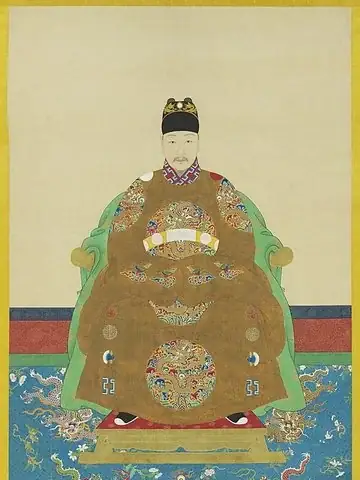
Portrait of Taichang Emperor

Ming · 15th ruler

Reigned 1620 (29 days)

泰昌帝 Other names ›

Facts

The Taichang Emperor reigned for 29 days (1620), taking the throne at 37, and died at 37 or 38; the cause of death is disputed. 15th ruler of Ming.

Reign
28 August 1620 – 26 September 1620 (15th ruler of Ming)
Length of reign
29 days
Born
September 1582
Died
26 September 1620
Age at accession
37
Age at death
37–38
Cause of death
DisputedPrimary sources or accepted accounts conflict and cannot be narrowed to one
Path to the throne
Designated heirSucceeded the previous ruler of the same regime, who had chosen the heir (by testament, naming a crown prince, etc.)
Predecessor
Wanli Emperor
Era names
  • 泰昌 Tàichāng (proclaimed 1620)
Temple name
明光宗 Míng Guāngzōng
Personal name
朱常洛 Zhū Chángluò
Wade–Giles
T'ai-ch'ang Emperor · Chu Ch'ang-lo

Life

Road to the throne

He was the eldest son of the Wanli Emperor, and his mother was Lady Wang, who had risen from palace maid to Consort Gong. When Noble Consort Zheng, whom the Wanli Emperor favoured, gave birth to Changxun, the Wanli Emperor did not decide on a crown prince however much the court officials pressed him, and the crown prince was named in 1601. According to the biographies of empresses and consorts, when the Wanli Emperor, reluctant to name him crown prince, said that the eldest son was the child of a palace maid, his grandmother Empress Dowager Li angrily replied that he too was the child of a palace maid, and the biography concludes that the Taichang Emperor was made crown prince because of this. The appraisal in the biographies of Jiang Yinglin and others says that the truth of this story cannot be known. According to the biographies of empresses and consorts, when his mother lay critically ill in 1611, he obtained permission and went to visit her, and when he broke the lock and entered, his mother took the crown prince's robe in her hand and wept that he had grown so big and she would die without regret. According to the biography of Wang Zhicai, when suspicion in the club attack case of 1615 reached Noble Consort Zheng, the crown prince was afraid, and at his father's urging he rebuked the assembled officials, saying that father and son were so close, and yet the outer court was making him an unfilial son. When his father died in 1620, he followed the testamentary edict and sent a million taels of silver to the frontier, ordered the mining taxes abolished, and took the throne.

Reign and death

The biographies of eunuchs in the History of Ming write that he favoured the beautiful women Noble Consort Zheng presented, fell ill soon after, and grew worse with Cui Wensheng's medicine, while the biography of Fang Congzhe treats the medicine as rumor, and the biographies of Yang Lian and Zhou Jiamo treat the matter of the women as rumor. He tried to confer a title on Noble Consort Zheng in keeping with his father's dying wish but stopped, and the title is given as empress by the Veritable Records, the Mingshi Jishi Benmo and the biographies of empresses and consorts, and as empress dowager by the other three biographies in the History of Ming. According to the biography of Yang Lian, when the emperor summoned Yang Lian, who had impeached Cui Wensheng, everyone expected him to be beaten at court, but the emperor spoke gently and dismissed Cui Wensheng. When his illness grew grave, Li Kezhuo presented a medicine called the red pill, and the annals in the History of Ming merely set it beside his death the next day and do not connect the two. In the biography of Fang Congzhe, even though Fang Congzhe answered that he did not dare believe it, the emperor summoned Li Kezhuo and had him present the medicine and praised him as a loyal minister, and the emperor died the next morning, after Li Kezhuo said that he had presented another pill. The Veritable Records write that his illness was of long standing and errors in medicine were also added to it, yet praise him for his diligence in government, and say that to this day he is called the one-month Son of Heaven and the sage of ten thousand years. The appraisal in the annals says that he died before his measures were carried out, and that disputes over the three cases made factional strife fiercer.

Translated from the Japanese text of this site, which is written from the official histories. Years are the Western calendar years of the dates, as in English reference works. Months are omitted because the histories use the Chinese lunar calendar.

During the reign

Number of times each event is recorded in the official histories. How each item is counted

Era name changes
1
General amnesties
1
Empresses installed
0
Crown princes deposed
0
Personal campaigns
0
Rebellions suppressed
0
Rebellions faced
0
Capital relocations
0

Emperors of Ming

All 16 emperors of Ming