Yongle Emperor
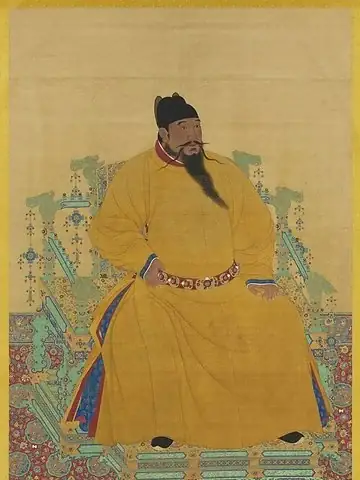
Ming · 3rd ruler
永樂帝 Yǒnglè Dì朱棣 Zhū Dì
Wade–Giles: Yung-lo Emperor · Chu Ti
Reigned 1402–1424 (22 years)
Reigned 22 years (1402–1424). Died at 65 (East Asian reckoning) of natural causes. 3rd ruler of Ming.
Facts
- Reign
- 17 July 1402 – 12 August 1424 (3rd ruler of Ming)
- Length of reign
- 22 years
- Born
- 1360
- Died
- 12 August 1424
- Age at accession
- 43
- Age at death
- 65
- Cause of death
- Natural causesNatural death or illness (including old age)
- Path to the throne
- UsurpationSeized the throne from the previous emperor (removing the predecessor and taking the throne were one act)
- Predecessor
- Jianwen Emperor
- Successor
- Hongxi Emperor
- Era names
- 永樂 Yǒnglè (proclaimed 1402)
Ages are given in East Asian reckoning (sui): a person is one year old at birth and gains a year at each New Year, so the figure is one or two years higher than the Western age.
Life
In brief
Beginning as Prince of Yan, he rose in arms and took the throne from his nephew the Jianwen Emperor, moved the capital to Beijing, and led five campaigns into Mongolia in person. The assessment in the History of Ming praises his achievements, but says that the perverse deeds committed when the Jianwen era was erased were a stain on his virtue that could not be covered up.
Road to the throne
He was the fourth son of the Hongwu Emperor; he was made Prince of Yan in 1370 and went to Beiping in 1380. After the Hongwu Emperor's death, as the Jianwen Emperor pressed on with cutting back the princes' fiefs, he felt his life was in danger, feigned madness and claimed to be ill. In 1399 he killed Xie Gui and Zhang Bing, seized the nine gates of Beiping, and raised troops against Qi Tai and Huang Zicheng as treacherous ministers, calling his army the force for pacifying the troubles (Jingnan). In 1402, when the Jinchuan Gate was opened and the capital fell, he took the throne in the Fengtian Hall, and put Qi Tai, Huang Zicheng and Fang Xiaoru to death and wiped out their families. The annals of Chengzu say only that he buried the Jianwen Emperor, but the annals of Emperor Gongmin in the same History of Ming say that the emperor disappeared in a fire in the palace, and also record a story that he escaped through a tunnel.
Reign and death
According to the biography of Zheng He, Zheng He and others were sent to the Western Ocean in 1405 because the emperor suspected that Emperor Hui had fled overseas and wanted his tracks followed, and also to display the might of the state. In 1403 he renamed Beiping as Beijing, and in 1420 he proclaimed Beijing the capital. On his campaign of 1410 he crushed Bunyashiri on the Onon River and went on to defeat Arughtai. In 1414 he defeated Mahmud of the Oirats at Hulan Hushiwen. On the campaign of 1422 Arughtai escaped him, so on the way back he defeated the Uriankhai in person. In 1423 the enemy had scattered and no decisive battle came, and in 1424 he advanced to the Dalan Namur River but turned back without meeting the enemy. On that return march he fell ill at Cangyashu and died at Yumuchuan, leaving a testamentary edict passing the throne to the crown prince. Because the army was still in the field his death was kept secret, a coffin was made of melted tin, and meals were served as usual until the army was home. His temple name was at first Taizong, and it was changed to Chengzu in 1538.
Translated from the Japanese text of this site, which is written from the official histories. Years are given in the Western calendar; months are omitted because the histories use the Chinese lunar calendar.
During the reign
Number of times each event is recorded in the official histories. How each item is counted
- Era name changes
- 1
- General amnesties
- 2
- Empresses installed
- 1
- Crown princes deposed
- 0
- Personal campaigns
- 5
- Rebellions suppressed
- 9
- Rebellions faced
- 10
- Capital relocations
- 1
Emperors of Ming
- 1stHongwu Emperor洪武帝 Hóngwǔ Dì朱元璋 Zhū Yuánzhāng1368–1398 · 30 years · Natural causes, age 711368–139830 yearsNatural causes, age 71
- 2ndJianwen Emperor建文帝 Jiànwén Dì朱允炆 Zhū Yǔnwén1398–1402 · 4 years · Disputed1398–14024 yearsDisputed
- 3rdYongle Emperor永樂帝 Yǒnglè Dì朱棣 Zhū Dì1402–1424 · 22 years · Natural causes, age 651402–142422 yearsNatural causes, age 65
- 4thHongxi Emperor洪熙帝 Hóngxī Dì朱高熾 Zhū Gāochì1424–1425 · 264 days · Natural causes, age 481424–1425264 daysNatural causes, age 48
- 5thXuande Emperor宣德帝 Xuāndé Dì朱瞻基 Zhū Zhānjī1425–1435 · 9 years · Natural causes, age 381425–14359 yearsNatural causes, age 38
- 6th, 8thEmperor Yingzong of Ming正統帝 Zhèngtǒng Dì朱祁鎮 Zhū Qízhèn1435–1449; restored 1457–1464 · 21 years · Natural causes, age 381435–1449; restored 1457–146421 yearsNatural causes, age 38
- 7thJingtai Emperor景泰帝 Jǐngtài Dì朱祁鈺 Zhū Qíyù1449–1457 · 7 years · Disputed, age 301449–14577 yearsDisputed, age 30
- 9thChenghua Emperor成化帝 Chénghuà Dì朱見深 Zhū Jiànshēn1464–1487 · 23 years · Natural causes, age 411464–148723 yearsNatural causes, age 41
- 10thHongzhi Emperor弘治帝 Hóngzhì Dì朱祐樘 Zhū Yòutáng1487–1505 · 17 years · Natural causes, age 361487–150517 yearsNatural causes, age 36
- 11thZhengde Emperor正德帝 Zhèngdé Dì朱厚照 Zhū Hòuzhào1505–1521 · 15 years · Natural causes, age 311505–152115 yearsNatural causes, age 31
- 12thJiajing Emperor嘉靖帝 Jiājìng Dì朱厚熜 Zhū Hòucōng1521–1567 · 45 years · Natural causes, age 601521–156745 yearsNatural causes, age 60
- 13thLongqing Emperor隆慶帝 Lóngqìng Dì朱載坖 Zhū Zàijì1567–1572 · 5 years · Natural causes, age 361567–15725 yearsNatural causes, age 36
- 14thWanli Emperor萬曆帝 Wànlì Dì朱翊鈞 Zhū Yìjūn1572–1620 · 48 years · Natural causes, age 581572–162048 yearsNatural causes, age 58
- 15thTaichang Emperor泰昌帝 Tàichāng Dì朱常洛 Zhū Chángluò1620 · 29 days · Disputed, age 39162029 daysDisputed, age 39
- 16thTianqi Emperor天啓帝 Tiānqǐ Dì朱由校 Zhū Yóujiào1620–1627 · 7 years · Natural causes, age 231620–16277 yearsNatural causes, age 23
- 17thChongzhen Emperor崇禎帝 Chóngzhēn Dì朱由檢 Zhū Yóujiǎn1627–1644 · 16 years · Suicide (incl. forced), age 351627–164416 yearsSuicide (incl. forced), age 35