Skip to content

Longqing Emperor

He was a Ming emperor who enfeoffed Altan Khan as Prince of Shunyi and pacified the northern frontier, but did not decide government affairs himself and had an official who admonished him beaten with sticks.
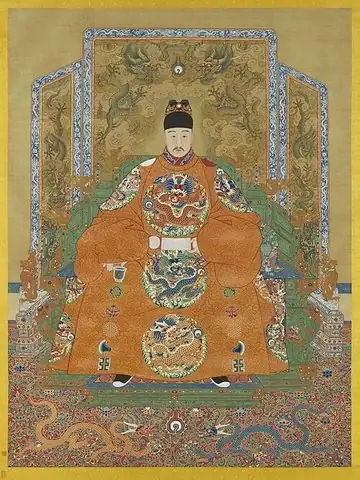
Portrait of Longqing Emperor

Ming · 13th ruler

Reigned 1567–1572 (5 years)

隆慶帝 Other names ›

Facts

The Longqing Emperor reigned for 5 years (1567–1572), taking the throne at 29, and died of natural causes at 35. 13th ruler of Ming.

Reign
4 February 1567 – 5 July 1572 (13th ruler of Ming)
Length of reign
5 years
Born
4 March 1537
Died
5 July 1572
Age at accession
29
Age at death
35
Cause of death
Natural causesNatural death or illness (including old age)
Path to the throne
Designated heirSucceeded the previous ruler of the same regime, who had chosen the heir (by testament, naming a crown prince, etc.)
Predecessor
Jiajing Emperor
Successor
Wanli Emperor
Era names
  • 隆慶 Lóngqìng (proclaimed 1567)
Temple name
明穆宗 Míng Mùzōng
Personal name
朱載坖 Zhū Zàijì
Wade–Giles
Lung-ch'ing Emperor · Chu Tsai-chi

Life

Road to the throne

He was the third son of the Jiajing Emperor, and his mother was Consort Kang of the Du clan. He was enfeoffed as Prince of Yu in 1539, but according to the biography of the Prince of Jing, after his elder brother, Crown Prince Zhuangjing, died, their father still delayed naming a crown prince, and in his later years, on the words of the fangshi, he met neither of the two princes. The opening of the Veritable Records writes that after he moved out to his princely residence as Prince of Yu he went to court each season, and though he was often not granted an audience, he carefully kept to the way of a son. In 1567 his father died and he took the throne, and by a testamentary edict he changed the inconvenient government decrees of the previous reign and released Hai Rui from prison.

Reign and death

According to the biography of Xu Jie, though he could not bear the extreme words of the remonstrating officials and ordered them punished, he did not punish them when Xu Jie entreated him, and eight or nine out of ten of Xu Jie's admonitions were carried out. In 1568 the supervising secretary Shi Xing submitted a memorial and was beaten with sticks at court and reduced to commoner status, but according to the Veritable Records the memorial acknowledged the emperor's diligence since his accession while warning him against his recent idleness and amusements. The biography of Zhan Yangbi writes that the emperor, given over to music and women, sent Empress Chen, who had admonished him, out to a separate palace, while the biographies of empresses and consorts write only that she had no sons, was often ill, and lived in a separate palace. In 1569, to Zhan Yangbi, who asked that the empress be returned, the emperor answered that it was because she had no sons and was ill, and did not punish him, but in the same year he had Zhan Yangbi, who had impeached wasteful spending, beaten with sticks at court and struck from the rolls. In 1570, when Altan Khan's grandson Bahanaji came to surrender, the emperor, against the opposition of the court officials, ordered that he be generously treated, and the next year he enfeoffed Altan Khan as Prince of Shunyi and the tribute markets of the three garrisons were established. The biography of Gao Gong holds that it was Gao Gong and Zhang Juzheng who set aside the general opinion and promoted the investiture and tribute. In 1572 he fell ill, entrusted the affairs after his death to Gao Gong, Zhang Juzheng and Gao Yi, and died, but according to the Veritable Records he could not speak at this time and gazed at the assembled officials and nodded. The biography of Gao Gong also holds that the emperor's intention was to entrust matters only to the grand secretaries, while the biography of Feng Bao holds that right after the emperor's death Feng Bao forged a testamentary edict and added himself to the dying charge. The closing assessment of the Veritable Records relates that he declined to have the donkey intestines he was fond of served, saying that it would mean killing one donkey every day, and writes that his meals were always plain. The appraisal in the History of Ming praises him for permitting the investiture and tribute and for lightening the taxes so that the people could rest, while assessing that he could not wield the imperial reins, and that his leniency was more than enough but his firmness and discernment were insufficient.

Translated from the Japanese text of this site, which is written from the official histories. Years are the Western calendar years of the dates, as in English reference works. Months are omitted because the histories use the Chinese lunar calendar.

During the reign

Number of times each event is recorded in the official histories. How each item is counted

Era name changes
1
General amnesties
2
Empresses installed
1
Crown princes deposed
0
Personal campaigns
0
Rebellions suppressed
2
Rebellions faced
4
Capital relocations
0

Emperors of Ming

All 16 emperors of Ming