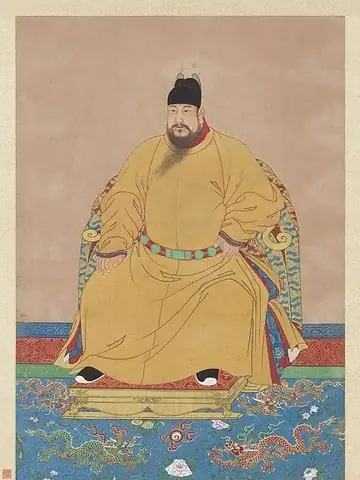
Hongxi Emperor
He was a Ming emperor who was slandered by his younger brothers and held the base while his father was away, and who after taking the throne governed leniently, but died the next year.
Emperors of Ming
- 1stHongwu Emperor洪武帝 Hóngwǔ Dì朱元璋 Zhū Yuánzhāng1368–1398 · 30 years · Natural causes, age 691368–139830 yearsNatural causes, age 69
- 2ndJianwen Emperor建文帝 Jiànwén Dì朱允炆 Zhū Yǔnwén1398–1402 · 4 years · Disputed1398–14024 yearsDisputed
- 3rdYongle Emperor永樂帝 Yǒnglè Dì朱棣 Zhū Dì1402–1424 · 22 years · Natural causes, age 63–641402–142422 yearsNatural causes, age 63–64
- 4thHongxi Emperor洪熙帝 Hóngxī Dì朱高熾 Zhū Gāochì1424–1425 · 264 days · Natural causes, age 461424–1425264 daysNatural causes, age 46
- 5thXuande Emperor宣德帝 Xuāndé Dì朱瞻基 Zhū Zhānjī1425–1435 · 9 years · Natural causes, age 36–371425–14359 yearsNatural causes, age 36–37
- 6th, 8thEmperor Yingzong of Ming正統帝 Zhèngtǒng Dì朱祁鎮 Zhū Qízhèn1435–1449; restored 1457–1464 · 21 years · Natural causes, age 36–371435–1449; restored 1457–146421 yearsNatural causes, age 36–37
- 7thJingtai Emperor景泰帝 Jǐngtài Dì朱祁鈺 Zhū Qíyù1449–1457 · 7 years · Disputed, age 28–291449–14577 yearsDisputed, age 28–29
- 9thChenghua Emperor成化帝 Chénghuà Dì朱見深 Zhū Jiànshēn1464–1487 · 23 years · Natural causes, age 39–401464–148723 yearsNatural causes, age 39–40
- 10thHongzhi Emperor弘治帝 Hóngzhì Dì朱祐樘 Zhū Yòutáng1487–1505 · 17 years · Natural causes, age 341487–150517 yearsNatural causes, age 34
- 11thZhengde Emperor正德帝 Zhèngdé Dì朱厚照 Zhū Hòuzhào1505–1521 · 15 years · Natural causes, age 291505–152115 yearsNatural causes, age 29
- 12thJiajing Emperor嘉靖帝 Jiājìng Dì朱厚熜 Zhū Hòucōng1521–1567 · 45 years · Natural causes, age 591521–156745 yearsNatural causes, age 59
- 13thLongqing Emperor隆慶帝 Lóngqìng Dì朱載坖 Zhū Zàijì1567–1572 · 5 years · Natural causes, age 351567–15725 yearsNatural causes, age 35
- 14thWanli Emperor萬曆帝 Wànlì Dì朱翊鈞 Zhū Yìjūn1572–1620 · 48 years · Natural causes, age 561572–162048 yearsNatural causes, age 56
- 15thTaichang Emperor泰昌帝 Tàichāng Dì朱常洛 Zhū Chángluò1620 · 29 days · Disputed, age 37–38162029 daysDisputed, age 37–38
- 16thTianqi Emperor天啓帝 Tiānqǐ Dì朱由校 Zhū Yóujiào1620–1627 · 6 years · Natural causes, age 21–221620–16276 yearsNatural causes, age 21–22
- 17thChongzhen Emperor崇禎帝 Chóngzhēn Dì朱由檢 Zhū Yóujiǎn1627–1644 · 16 years · Suicide (incl. forced), age 331627–164416 yearsSuicide (incl. forced), age 33