Emperor Yingzong of Ming
He was a Ming emperor who was taken prisoner by the Oirats in the Tumu Crisis and later returned to the throne in the Duomen Coup.
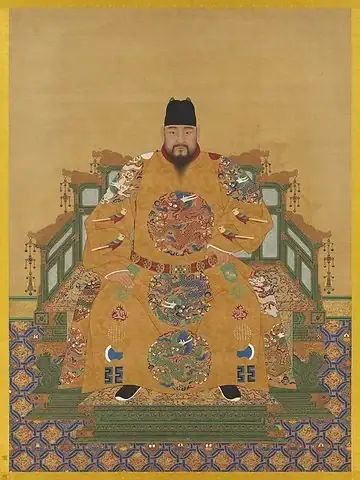
Ming · 6th ruler (8th when restored)
Reigned 1435–1449; restored 1457–1464 (21 years)
正統帝 Other names ›
Emperors of Ming
- 1stHongwu Emperor洪武帝 Hóngwǔ Dì朱元璋 Zhū Yuánzhāng1368–1398 · 30 years · Natural causes, age 691368–139830 yearsNatural causes, age 69
- 2ndJianwen Emperor建文帝 Jiànwén Dì朱允炆 Zhū Yǔnwén1398–1402 · 4 years · Disputed1398–14024 yearsDisputed
- 3rdYongle Emperor永樂帝 Yǒnglè Dì朱棣 Zhū Dì1402–1424 · 22 years · Natural causes, age 63–641402–142422 yearsNatural causes, age 63–64
- 4thHongxi Emperor洪熙帝 Hóngxī Dì朱高熾 Zhū Gāochì1424–1425 · 264 days · Natural causes, age 461424–1425264 daysNatural causes, age 46
- 5thXuande Emperor宣德帝 Xuāndé Dì朱瞻基 Zhū Zhānjī1425–1435 · 9 years · Natural causes, age 36–371425–14359 yearsNatural causes, age 36–37
- 6th, 8thEmperor Yingzong of Ming正統帝 Zhèngtǒng Dì朱祁鎮 Zhū Qízhèn1435–1449; restored 1457–1464 · 21 years · Natural causes, age 36–371435–1449; restored 1457–146421 yearsNatural causes, age 36–37
- 7thJingtai Emperor景泰帝 Jǐngtài Dì朱祁鈺 Zhū Qíyù1449–1457 · 7 years · Disputed, age 28–291449–14577 yearsDisputed, age 28–29
- 9thChenghua Emperor成化帝 Chénghuà Dì朱見深 Zhū Jiànshēn1464–1487 · 23 years · Natural causes, age 39–401464–148723 yearsNatural causes, age 39–40
- 10thHongzhi Emperor弘治帝 Hóngzhì Dì朱祐樘 Zhū Yòutáng1487–1505 · 17 years · Natural causes, age 341487–150517 yearsNatural causes, age 34
- 11thZhengde Emperor正德帝 Zhèngdé Dì朱厚照 Zhū Hòuzhào1505–1521 · 15 years · Natural causes, age 291505–152115 yearsNatural causes, age 29
- 12thJiajing Emperor嘉靖帝 Jiājìng Dì朱厚熜 Zhū Hòucōng1521–1567 · 45 years · Natural causes, age 591521–156745 yearsNatural causes, age 59
- 13thLongqing Emperor隆慶帝 Lóngqìng Dì朱載坖 Zhū Zàijì1567–1572 · 5 years · Natural causes, age 351567–15725 yearsNatural causes, age 35
- 14thWanli Emperor萬曆帝 Wànlì Dì朱翊鈞 Zhū Yìjūn1572–1620 · 48 years · Natural causes, age 561572–162048 yearsNatural causes, age 56
- 15thTaichang Emperor泰昌帝 Tàichāng Dì朱常洛 Zhū Chángluò1620 · 29 days · Disputed, age 37–38162029 daysDisputed, age 37–38
- 16thTianqi Emperor天啓帝 Tiānqǐ Dì朱由校 Zhū Yóujiào1620–1627 · 6 years · Natural causes, age 21–221620–16276 yearsNatural causes, age 21–22
- 17thChongzhen Emperor崇禎帝 Chóngzhēn Dì朱由檢 Zhū Yóujiǎn1627–1644 · 16 years · Suicide (incl. forced), age 331627–164416 yearsSuicide (incl. forced), age 33