Skip to content

Hongwu Emperor

He rose from among the common people and went from Buddhist monk to emperor, founding the Ming.
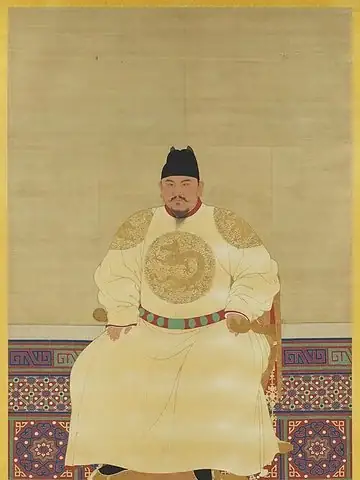
Portrait of Hongwu Emperor

Ming · 1st ruler

Reigned 1368–1398 (30 years)

洪武帝 Other names ›

Facts

The Hongwu Emperor reigned for 30 years (1368–1398), taking the throne at 39, and died of natural causes at 69. 1st ruler of Ming.

Reign
23 January 1368 – 24 June 1398 (1st ruler of Ming)
Length of reign
30 years
Born
21 October 1328
Died
24 June 1398
Age at accession
39
Age at death
69
Cause of death
Natural causesNatural death or illness (including old age)
Path to the throne
Self-proclaimedFounded the titleClaimed the imperial title without receiving the throne from an earlier ruler (e.g. Emperor Gaozu of Han, Emperor Guangwu of Han, Hongwu Emperor)
Era names
  • 洪武 Hóngwǔ (proclaimed 1368)
Temple name
明太祖 Míng Tàizǔ
Personal name
朱元璋 Zhū Yuánzhāng
Wade–Giles
Hung-wu Emperor · Chu Yüan-chang

Life

In brief

The History of Ming judges that, having learned from the laxity of Yuan government, he ruled strictly, yet he invited old scholars with courtesy, kept eunuchs out of government, and cared for the people all the more in his later years.

Road to the throne

In 1344, after drought, locusts and epidemic took his parents and elder brother, he had no one to rely on and entered a temple as a monk. In 1352 he joined the army of Guo Zixing and married Lady Ma, Guo's adopted daughter. When Guo came to suspect him and he went short of food, Lady Ma carried freshly baked cakes to him inside her clothes and burned her skin. When Guo died in 1355, he refused the post of vice commander offered by Han Lin'er, not wishing to be controlled by others, but still used Han Lin'er's era name. He crossed the Yangtze and took Caishi and Taiping, and when Guo's son Guo Tianxu and Guo's wife's brother Zhang Tianyou were killed in battle, all of Guo's commanders came over to him. When Fang Guozhen presented him with a saddle of gold and jade, he refused it, saying that what he needed now was talent and grain, not treasures, and he also had ornate decoration removed from the plans of his palace. In 1363 he defeated Chen Youliang on Lake Poyang, and in 1367 Xu Da captured Zhang Shicheng. In 1368 he sacrificed to Heaven and Earth at the southern suburb and took the imperial throne, naming the state Ming and the era Hongwu.

Reign and death

He later told his ministers that Zhang Shicheng had relied on wealth and Chen Youliang on strength, while he had nothing to rely on, but did not like killing and kept faith and frugality. As empress, Lady Ma would calmly admonish him after he returned from court in anger, and on many occasions he lightened punishments for her sake. When she died in 1382 he wept bitterly, and he never named another empress. In 1380 Hu Weiyong was executed for plotting rebellion, and the office of chancellor itself was abolished. In 1390 he ordered Li Shanchang to die, in 1393 he had Lan Yu executed on a charge of rebellion, and later other founding generals such as Fu Youde and Feng Sheng were executed one after another. When Song Lian once drank with guests, he had him watched in secret, and when Song answered truthfully the next day he laughed that Song did not deceive him; he once praised him for not uttering a single false word in 19 years of service, yet when Song's grandson was caught up in the Hu Weiyong case he meant to put Song to death, and the empress and the crown prince worked hard to save him. The History of Ming has no story of him executing authors for wording in memorials that he took as veiled mockery, and Xu Yikui, said in popular accounts to have been executed, is recorded there as going home after resigning through illness; but it does record that he bore a grudge against Gao Qi for satirizing him in verse, and had him cut in two at the waist in anger on seeing a beam-raising text Gao had written. In 1395, saying that the punishments outside the law he had used himself were not the ordinary law, he forbade his successors to use tattooing, cutting off noses and similar punishments, and forbade them to restore the post of chancellor. In 1392 the crown prince Zhu Biao died, and he made his grandson Yunwen imperial grandson-heir. He died in the Western Palace in 1398 and by his testamentary edict passed the throne to the imperial grandson-heir Yunwen.

Translated from the Japanese text of this site, which is written from the official histories. Years are the Western calendar years of the dates, as in English reference works. Months are omitted because the histories use the Chinese lunar calendar.

During the reign

Number of times each event is recorded in the official histories. How each item is counted

Era name changes
1
General amnesties
3
Empresses installed
1
Crown princes deposed
0
Personal campaigns
0
Rebellions suppressed
35
Rebellions faced
35
Capital relocations
0

Emperors of Ming

All 16 emperors of Ming