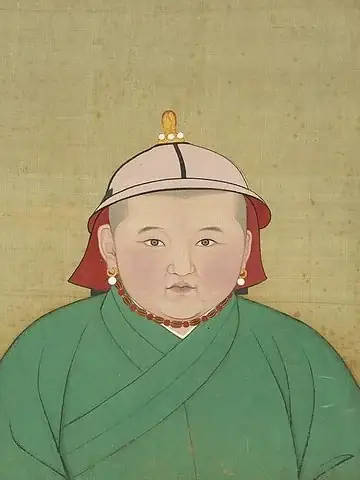
Facts
Rinchinbal Khan reigned for 52 days (1332), taking the throne at 6, and died of natural causes at 6. 15th ruler of Yuan.
- Reign
- 23 October 1332 – 14 December 1332 (15th ruler of Yuan)
- Length of reign
- 52 days
- Born
- 1 May 1326
- Died
- 14 December 1332
- Age at accession
- 6
- Age at death
- 6
- Cause of death
- Natural causesNatural death or illness (including old age)
- Path to the throne
- Designated heirSucceeded the previous ruler of the same regime, who had chosen the heir (by testament, naming a crown prince, etc.)
- Temple name
- 元寧宗 Yuán Níngzōng
- Personal name
- 懿璘質班 Yìlínzhìbān
- Wade–Giles
- Yüan Ning-tsung
Life
Road to the throne
He was the second son of Kusala, and his mother was the empress Babusha. His elder brother Toghon Temür, who later became emperor, was the eldest son, and Rinchinbal was enfeoffed as Prince of Fu. In 1330 the biographies of empresses and consorts in the History of Yuan record that Tugh Temür's empress plotted with a eunuch to kill Kusala's empress Babusha, and the annals of Shundi in the History of Yuan record that Babusha was slandered and killed. When Tugh Temür died at Shangdu in 1332, Tugh Temür's empress conveyed his dying command and declared that the throne should pass to a son of Kusala. His elder brother was living away in Jingjiang, and Rinchinbal, whom Tugh Temür was very fond of, had been kept at the capital. The annals of Shundi in the History of Yuan and the biographies of empresses and consorts and the biography of El Tegüs in the New History of Yuan record that after Tugh Temür died El Temür asked that El Tegüs, a son of Tugh Temür, be set up and that Tugh Temür's empress would not permit it, and the Xu Zizhi Tongjian also records that El Temür made this request; the annals of Ningzong do not record this story, the biographies of empresses and consorts and the biography of El Temür in the History of Yuan place the proposal to set up El Tegüs after Rinchinbal's death, and the annals of Shundi and the biographies of empresses and consorts in the History of Yuan, and the Xu Zizhi Tongjian, hold that she had Rinchinbal set up. The annals of Ningzong in the New History of Yuan record that, though Tugh Temür left word that Toghon Temür should be set up, El Temür concealed the testamentary edict and set up Rinchinbal. Before the accession, the affairs of the Secretariat and the various offices were all submitted to Tugh Temür's empress for decision. In 1332 Rinchinbal took the throne in the Daming Hall and proclaimed a general amnesty.
Reign and death
According to the biographies of empresses and consorts in the History of Yuan and the New History of Yuan, Daliyetemishi of the Hongjila clan was made empress. In the same year he died and was buried in the Qinian Valley. The annals of Ningzong in the History of Yuan and the New History of Yuan, along with the annals of Shundi, the biographies of empresses and consorts, the biography of El Temür and other accounts that touch on his death, record only that he died and do not state the cause. The next year, 1333, his elder brother Toghon Temür took the throne. In 1340 an edict of Toghon Temür stated that Tugh Temür's empress had not set up Kusala's eldest son but had set up the young younger brother Rinchinbal, and it stripped her of her honorific title. In 1343 Toghon Temür asked, at the imperial ancestral temple, whether he should bow before the chamber of his younger brother Rinchinbal, and bowed on the answer of the Erudite Liu Wen and others. In 1356 Toghon Temür, wishing to lighten the punishment of the Hama brothers, who were sons of Rinchinbal's wet nurse, said that they had been nursed at the same breast as his younger brother, but further memorials followed, and the brothers were banished and then beaten to death with rods. The historians' comment in the New History of Yuan argues that entering Rinchinbal, who died young before the year was out, in the ancestral temple and giving him a temple name ending in Zong was due to the courtiers' lack of learning, and that it was a great failure of ritual.
Translated from the Japanese text of this site, which is written from the official histories. Years are the Western calendar years of the dates, as in English reference works. Months are omitted because the histories use the Chinese lunar calendar.