Skip to content

Ragibagh Khan

He was an emperor of Yuan who was set up at Shangdu by the powerful minister Daolasha after the death of his father Yesün Temür, but was defeated in the war against the side of Tugh Temür, who had taken the throne at Dadu; his own whereabouts became unknown when Shangdu surrendered.
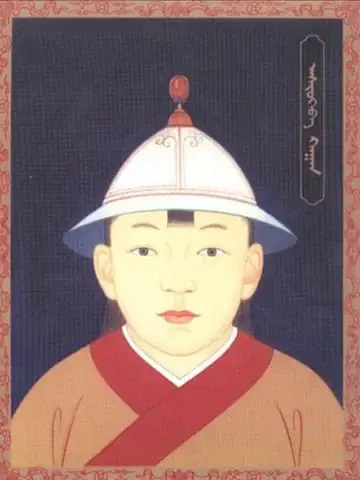
Portrait of Ragibagh Khan

Yuan · 11th ruler

Reigned 1328 (44 days)

元天順帝 Other names ›

Facts

Ragibagh Khan reigned for 44 days (1328), taking the throne at 7 or 8; the age at death and cause of death are unknown. 11th ruler of Yuan.

Reign
October 1328 – 14 November 1328 (11th ruler of Yuan)
Length of reign
44 days
Born
Unknown
Died
Unknown
Age at accession
7–8
Age at death
Unknown
Cause of death
UnknownThe primary sources record no cause of death or clue to it
Path to the throne
Designated heirSucceeded the previous ruler of the same regime, who had chosen the heir (by testament, naming a crown prince, etc.)
Predecessor
Yesün Temür
Era names
  • 天順 Tiānshùn (proclaimed 1328)
Chinese name
元天順帝 Yuán Tiānshùndì
Personal name
阿速吉八 Āsùjíbā
Wade–Giles
Yüan T'ien-shun-ti

Life

Road to the throne

He was a son of Yesün Temür and was made crown prince in 1324. According to the biographies of empresses and consorts in the New History of Yuan, his mother, Empress Babuhan, had served Yesün Temür since the time of his princely residence and had borne her son. In the same year, a classics colloquium was opened and tutors were chosen to teach the crown prince and the sons and grandsons of the princes and high ministers, the Difan, the Zizhi Tongjian, and other works were lectured on, and a household office for the crown prince was also established. In 1328, when Yesün Temür died, according to the biography of Daolasha in the New History of Yuan, Daolasha received his deathbed charge and set up the young crown prince, but the princes and ministers had not assembled and no edict of accession was issued. The annals of Mingzong in the History of Yuan state that Daolasha monopolized power and did not set up a sovereign even after more than a month. According to the biography of El Temür in the History of Yuan, Daolasha and the princes who had attached themselves to him deemed it advantageous to set up a young one, but El Temür in Dadu, out of the favor Külüg Khan had shown him, thought that a son of Külüg Khan should be set up. In the same year, the annals of Yesün Temür in the History of Yuan record in a single sentence that Daolasha set up the crown prince as emperor and changed the era name to Tianshun, while the annals of Mingzong in the History of Yuan place this at Shangdu, as does the New History of Yuan.

Reign and death

At that time, in Dadu, El Temür proclaimed that a son of Külüg Khan was to be welcomed and brought the Prince of Huai from Jiangling, and the Prince of Huai took the throne at Dadu and became Tugh Temür. Daolasha divided his troops and had them attack Dadu, and Wang Chan, the Prince of Liang on the Shangdu side, broke through Juyong Pass, but was defeated by El Temür and withdrew to Changping. In time Yuelu Temür, the Prince of Qi, and others surrounded Shangdu, and Daolasha, bearing the imperial seal, surrendered, and, according to the biography of El Temür in the History of Yuan, asked to die. Daolasha was put to death and his corpse was dismembered in the marketplace. The annals of Yesün Temür in the New History of Yuan, the Yuanshi Jishi Benmo, and the Qing-era Xu Zizhi Tongjian, among others, record that after Shangdu surrendered the whereabouts of Ragibagh Khan were unknown. The History of Yuan, the New History of Yuan, and the Xu Zizhi Tongjian do not record that he was killed, but the assessment by Qiu Jun of the Ming, cited in the Yuanshi Jishi Benmo, states that the other histories do not make clear the cause of his death and concludes that Tugh Temür's sending of troops and causing his death amounted to regicide. Zhao Yi of the Qing judges that Daolasha's setting him up was in itself the correct principle of father-to-son succession.

Translated from the Japanese text of this site, which is written from the official histories. Years are the Western calendar years of the dates, as in English reference works. Months are omitted because the histories use the Chinese lunar calendar.

During the reign

Number of times each event is recorded in the official histories. How each item is counted

Era name changes
1
General amnesties
0
Empresses installed
0
Crown princes deposed
0
Personal campaigns
0
Rebellions suppressed
0
Rebellions faced
1
Capital relocations
0

Emperors of Yuan

All 15 rulers of Yuan