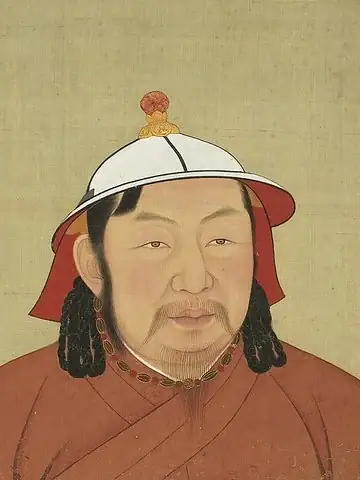
Facts
Ayurbarwada Buyantu Khan reigned for 8 years (1311–1320), taking the throne at 25, and died of natural causes at 34. 8th ruler of Yuan.
- Reign
- 7 April 1311 – 1 March 1320 (8th ruler of Yuan)
- Length of reign
- 8 years
- Born
- 9 April 1285
- Died
- 1 March 1320
- Age at accession
- 25
- Age at death
- 34
- Cause of death
- Natural causesNatural death or illness (including old age)
- Path to the throne
- Designated heirSucceeded the previous ruler of the same regime, who had chosen the heir (by testament, naming a crown prince, etc.)
- Temple name
- 元仁宗 Yuán Rénzōng
- Personal name
- 愛育黎拔力八達 Àiyùlíbálìbādá
- Wade–Giles
- Yüan Jen-tsung
Life
Road to the throne
He was the second son of Shunzong and the younger brother of Külüg Khan, and his mother was the Empress Dowager Xingsheng. In 1307, on his way to mourn for Temür Khan, he said that without having tasted hardship one does not know the toil of farming, and ate the gruel an old farmer offered him. The same year, when Aqutai and others plotted to have Temür Khan's empress rule as regent, he received word from Harghasun, led the guards in, seized Aqutai and the others, and put them to death. When Külüg Khan took the throne he was set up as crown prince, and he had the Daxue Yanyi published, saying that this one book was enough to govern the realm. When Külüg Khan died in 1311, he meant to put to death all who had ruined the state, but, admonished by Yang Duo'erzhi, he put to death only the worst. The same year he took the throne in the Daming Hall at Dadu. Before his accession, in 1311, Temüder had been appointed Right Chancellor, and the biography of Temüder says that the empress dowager had summoned him.
Reign and death
In 1313 an edict was issued to hold the imperial examinations, and in 1315 the metropolitan examination for the jinshi was held. According to the annals of Mingzong, in 1316 Temüder, to secure his position, sought to have Gegeen Khan made crown prince, and together with the empress dowager's favored minister slandered Kusala, a son of Külüg Khan, and Kusala was sent out to Yunnan as Prince of Zhou. In 1317, when more than forty investigating censors impeached Temüder for corruption and greed, according to the biography of Temüder the emperor was enraged and ordered his arrest, but Temüder hid in the house of a close attendant of Xingsheng Palace and was not caught, and the emperor, fearing that it might have come from the empress dowager's wish, stopped at dismissing him, and in less than a year Temüder was brought back as Grand Preceptor of the Crown Prince. The biographies of empresses in the History of Yuan write that the empress dowager's wantonness became extreme, and the New History of Yuan adds that the emperor, fearing to wound the empress dowager's feelings, did not inquire deeply. In 1320 the emperor fell ill and died in the Guangtian Palace, but the annals of Renzong and the annals of Yingzong differ on the day he fell ill, and the annals of Renzong do not record the name of the illness. The historians' comment in the New History of Yuan praises him as a good ruler of Yuan while criticizing that he was controlled by the empress dowager, and the assessment quoted in the Yuanshi Jishi Benmo blames him for not keeping his promise with Külüg Khan and passing the throne to Gegeen Khan.
Translated from the Japanese text of this site, which is written from the official histories. Years are the Western calendar years of the dates, as in English reference works. Months are omitted because the histories use the Chinese lunar calendar.