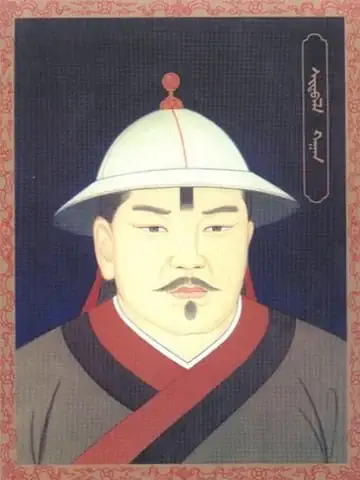
Road to the throne
He was the legitimate son of Ayurbarwada Buyantu Khan and the Empress Zhuangyi Cisheng, and he was born in 1303. When Ayurbarwada Buyantu Khan wished to set him up as his heir, he declined, saying that since he had an elder brother, that brother should be set up and he himself would assist him, but the empress dowager, Ayurbarwada Buyantu Khan's mother, would not permit it, and in 1317 he was set up as crown prince. When Ayurbarwada Buyantu Khan died in 1320, Temüder became Right Chancellor by the order of the empress dowager. In the same year he took the throne in the Daming Hall. According to the biographies of empresses and consorts, the empress dowager saw Gegeen Khan as somewhat weak and soft, and the hangers-on, holding that setting up Kusala would be to their disadvantage, backed Gegeen Khan for the throne, but when the empress dowager saw his resolute countenance after he took the throne, she regretted that she had not meant to raise this child.
Reign and death
In the year he took the throne he raised Baiju to Manager of Governmental Affairs in the Secretariat and then to Left Chancellor. When he was told that Asan and others had plotted to depose him and set up another, Baiju asked for an inquiry, but Gegeen Khan, fearing that the grand empress dowager's name would be brought up, had them all put to death. In 1321 he killed two of the investigating censors who had remonstrated against the building of the temple on Mount Shou'an, and had two others beaten with rods and banished to the land of Nurgan. In 1322 Temüder died, Baiju became Right Chancellor, and according to the biography of Baiju no Left Chancellor was appointed and he was given sole charge of the government. In the same year he forbade Han Chinese to bear weapons and practice martial arts, and also forbade the use of southerners in the imperial guards and the like. In 1323 he fixed the regulations and promulgated them throughout the realm as the Dayuan Tongzhi, and issued an edict to carry out the law of assistance in corvée. He also stripped Temüder of his offices and titles and destroyed his stele, and destroyed the steles of his father and grandfather. According to the biography of Baiju, the faction of Tegshi feared this and before long launched a treasonable plot. According to the biography of Baiju and the annals of Yesün Temür, Tegshi told the Prince of Jin, Yesün Temür, of the treasonable plot, but the Prince of Jin imprisoned Tegshi's envoy and separately sent an envoy to Shangdu to report the disturbance, and the news did not arrive in time. In the same year, at Nanpo on the way back from Shangdu, Tegshi and others killed Baiju and killed Gegeen Khan in his traveling tent. The discussion in the History of Yuan judges him firm and clear-sighted, but says that because he was decisive in punishment the treacherous faction feared execution and brought about the great upheaval; the historians' comment in the New History of Yuan, while granting his strictness and clarity, holds that it came from his failure to punish in keeping the treasonable faction about him.
Translated from the Japanese text of this site, which is written from the official histories. Years are the Western calendar years of the dates, as in English reference works. Months are omitted because the histories use the Chinese lunar calendar.