Skip to content

Tugh Temür

He was the emperor of Yuan who established the Pavilion of the Star of Literature, took the throne again after the sudden death of his elder brother Kusala, and, as the New History of Yuan and others relate, repented on his deathbed of the affair at Ongghuchad.
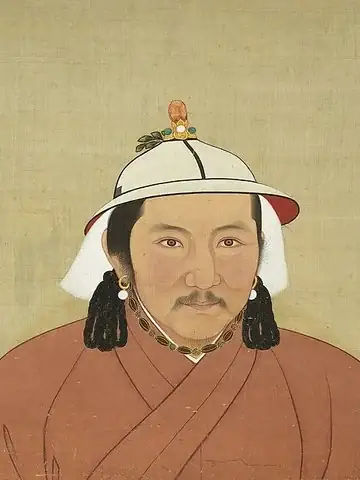
Portrait of Tugh Temür

Yuan · 12th ruler (14th when restored)

Reigned 1328–1329; restored 1329–1332 (3 years)

元文宗 Other names ›

Facts

Tugh Temür reigned for 3 years (1328–1329; restored 1329–1332), taking the throne at 24, and died of natural causes at 28. 12th ruler of Yuan; counted again as the 14th on being restored in 1329.

Reign (first)
16 October 1328 – 26 February 1329 (12th ruler of Yuan)
Reign (restored)
8 September 1329 – 2 September 1332 (counted again as the 14th ruler of Yuan)
Length of reign
3 years
Born
16 February 1304
Died
2 September 1332
Age at accession
24
Age at death
28
Cause of death
Natural causesNatural death or illness (including old age)
Path to the throne
Proclaimed by supportersFounded the titleRestoredDid not receive the throne from an earlier ruler, and did not claim it on their own initiative but was set up by others (e.g. the emperors of the Southern Ming)
Predecessor
Kusala (restoration)
Era names
  • 天曆 Tiānlì (proclaimed 1328)
  • 至順 Zhìshùn (proclaimed 1330)
Temple name
元文宗 Yuán Wénzōng
Personal name
圖帖睦爾 Tútiēmù'ěr
Wade–Giles
Yüan Wen-tsung

Life

Road to the throne

He was the second son of Külüg Khan and the younger brother of Kusala, and his mother was a Tangut. When Yesün Temür took the throne he was summoned and made the Prince of Huai, and later was sent out to Jiankang. When Yesün Temür died in 1328, El Temür proclaimed that a son of Külüg Khan should be set up and raised troops. When El Temür asked him to take the throne, he firmly declined, saying that his elder brother was in the north. Even so, he took the throne at Dadu the same year, and in an edict said that he would await the coming of his elder brother.

Reign and death

In 1329 he sent El Temür bearing the imperial seal to Kusala, and Kusala made Tugh Temür crown prince. A few days after Kusala feasted Tugh Temür and the princes and ministers at Ongghuchad, Kusala died suddenly, and Tugh Temür took the throne again at Shangdu. The biography of El Temür in the New History of Yuan writes that El Temür told Tugh Temür of a plot of regicide, and that Kusala soon died suddenly. The biography of El Temür in the History of Yuan also writes that El Temür himself had joined the treasonable plot in the death of Kusala. The historians' comment in the New History of Yuan judges that the murder of Kusala probably came from El Temür and was not Tugh Temür's own intent, but that, having known of it, it was the same as if Tugh Temür had done the murder himself. In 1329 he established the Academy of the Pavilion of the Star of Literature, and in 1331 the compilation of the Jingshi Dadian was finished. When the academicians asked to resign, he kept them, saying that he had gone through hardship in his youth and did not know the essentials of government, and that he delighted to hear of the order and disorder of past and present. According to the annals of Shundi, when Babusha was killed in 1330, Toghon Temür, a son of Kusala, was moved to Daecheong Island, and later, with an edict saying that he was not Kusala's son, he was moved to Jingjiang. In 1332 Tugh Temür died, and the annals do not record the cause of his death. The New History of Yuan and the Xu Zizhi Tongjian record that on his deathbed Tugh Temür repented of the affair at Ongghuchad as the great error of his life, and that El Temür concealed the testamentary edict. The History of Yuan also writes that by his testamentary edict a son of Kusala was set up, and gives no words of repentance, but its annals of Shundi record that El Temür asked that El Tegüs be set up, and the empress refused. In 1340 Toghon Temür, on the ground that Tugh Temür had made Kusala swallow his resentment and die, had Tugh Temür's tablet removed from the ancestral temple. The historians' comment in the New History of Yuan judges that, with El Temür wielding power as he pleased, Tugh Temür never said yes or no and indulged himself in brush and ink.

Translated from the Japanese text of this site, which is written from the official histories. Years are the Western calendar years of the dates, as in English reference works. Months are omitted because the histories use the Chinese lunar calendar.

During the reign

Number of times each event is recorded in the official histories. How each item is counted

Era name changes
2
General amnesties
5
Empresses installed
0
Crown princes deposed
0
Personal campaigns
0
Rebellions suppressed
4
Rebellions faced
6
Capital relocations
0

Emperors of Yuan

All 15 rulers of Yuan